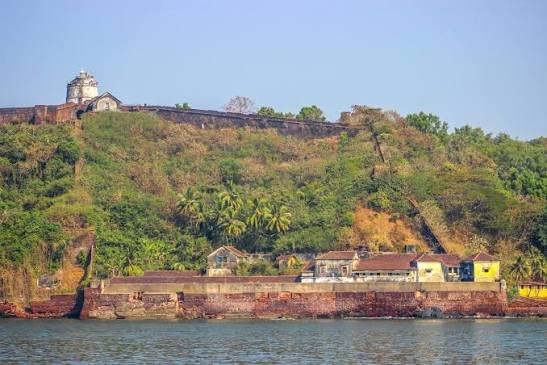
Central Jail Aguada is unlike any other prison on this list — it isn’t a jail anymore at all. Built into the lower level of a 17th-century Portuguese fort on Goa’s Sinquerim Beach, this facility served as Goa’s largest prison for decades before closing in 2015. Today, it stands transformed into the Freedom Struggle Museum, a heritage site that draws tourists rather than housing prisoners. Its story spans four centuries, from Portuguese naval defence against the Dutch, to a brutal detention centre under dictator Salazar, to its final chapter as independent India’s Goa Central Jail, once holding serial killer Charles Sobhraj among its inmates.
| Quick Facts | Details |
|---|---|
| Full name | Central Jail Aguada (part of Fort Aguada) |
| Location | Sinquerim Beach, Candolim, North Goa |
| Fort built | 1612, by the Portuguese |
| Converted to prison | 1930s, under the Salazar regime |
| Served as Goa’s Central Jail | 1961 (post-liberation) to 2015 |
| Present status | Closed as a jail; reopened as Freedom Struggle Museum in December 2021 |
| Managed by | Goa Tourism Development Corporation |
Where Exactly Is It Located
Fort Aguada, and the jail complex within it, sits at the southern tip of the landmass overlooking the confluence of the Mandovi River and the Arabian Sea, near Sinquerim Beach in North Goa. It’s roughly 16 km from Panaji, Goa’s capital, which sits directly across the river.
- Address: Fort Aguada, Sinquerim, Candolim, North Goa, Goa
- Nearby landmark: Close to Sinquerim Beach and the Taj Fort Aguada Resort & Spa, which occupies part of the fort complex
- Access: Well connected by road from Panaji and Candolim; easily reachable by taxi, rented scooter, or local bus
The site’s location was chosen for strategic military reasons centuries ago, guarding the mouth of the Mandovi against enemy ships — the same commanding sea view that now makes it a popular tourist and sunset-viewing spot.
The Origins: A 17th-Century Portuguese Fort
Fort Aguada was built by the Portuguese in 1612, under the supervision of Goa’s then Viceroy, Ruy Tavara, primarily to defend against Dutch and Maratha naval threats. Its name comes from the Portuguese word for water — “agua” — a reference to a freshwater spring found within the fort premises, which was later used to resupply passing ships.
- The fort has two distinct levels: Upper Aguada Fort and Lower Aguada Fort
- Walls reach up to 5 metres in height and width, a major reason the fort was never successfully captured during 450 years of Portuguese rule
- A four-tiered lighthouse, among the oldest in Asia, was added in 1864 and stood for about a century before being replaced by a newer one in 1976
For over three centuries, Fort Aguada functioned purely as a military and maritime defence structure, with no connection to imprisonment.
From Fort to Prison: The Salazar Era
The fort’s transformation into a jail didn’t happen until the 1930s, under the dictatorship of Portuguese Prime Minister António de Oliveira Salazar. The southern part of the Lower Aguada Fort was converted into a prison, primarily intended to hold Salazar’s political opponents.
- Goan freedom fighters resisting Portuguese colonial rule were imprisoned and, according to multiple accounts, tortured here during this period
- The jail became closely associated with the broader Goa liberation movement, since many of those detained were activists pushing for Goa’s integration with independent India
- This period lasted until Goa’s liberation by Indian armed forces in 1961, ending over four centuries of Portuguese rule in the territory
Goa’s Central Jail: 1961 to 2015
After Goa became part of India in 1961, the same prison complex continued operating, this time as Goa’s official Central Jail.
- It functioned as Goa’s largest prison for over five decades under Indian administration
- The jail primarily held convicts, including many accused of narcotics-related offences and trafficking, reflecting Goa’s later reputation as a hub for such cases
- One of its most notorious inmates was Charles Sobhraj, the serial killer known for a string of crimes across Asia, who was held here at one point
By 2015, the facility had been decommissioned as a functioning jail, and prisoners were relocated to a newer facility, ending its use as an active prison after roughly 85 years in that role.
Transformation into the Freedom Struggle Museum
Following its closure, the Goa Tourism Development Corporation, working alongside the Goa Heritage Action Group and local freedom fighters, undertook a renovation of the old jail complex.
- The museum was inaugurated on 19 December 2021, symbolically timed to mark Goa’s Liberation Day
- It’s designed as a tribute to Goa’s freedom struggle, showcasing the sacrifices of those imprisoned here for resisting Portuguese rule
- The complex includes a documentary screening space set up inside the former condemnation cell, showing films on Goa’s freedom movement and its historic forts
- Heritage walks are available, taking visitors through the old cells, kitchens, a chapel, and the original freshwater spring that gave the fort its name
Today, the jail’s former cells sit alongside exhibitions and light-and-sound displays, a striking contrast to its decades as a place of confinement.
Can You Visit Aguada Central Jail Today
Yes — unlike every other jail covered in this series, Central Jail Aguada is fully open to the public, since it now operates as the Freedom Struggle Museum rather than an active prison. Entry to the broader fort is free, with visiting hours generally between 9:30 AM and 6:00 PM daily, though a separate museum ticket applies for the jail complex itself.
FAQs
Q1: Is Central Jail Aguada still a functioning prison?
A. No, it closed as an active jail in 2015 and has since been converted into the Freedom Struggle Museum, which opened to the public in December 2021.
Q2: Who was imprisoned at Aguada Jail?
A. It held Goan freedom fighters resisting Portuguese rule before 1961, and later, after becoming Goa’s Central Jail, housed convicts including notorious criminal Charles Sobhraj.
Q3: Can tourists visit the old jail cells today?
A. Yes, guided heritage walks let visitors explore the former cells, chapel, kitchens, and freshwater spring inside the jail complex, along with documentary screenings on Goa’s history.
Q4: Why is it called “Aguada”?
A. The name comes from the Portuguese word for water, referring to a freshwater spring within the fort that was historically used to resupply passing ships.