Oats and poha can both be ready before the morning rush becomes a problem, but they begin as very different grains. Oats are generally eaten as a whole-grain cereal and are particularly notable for beta-glucan soluble fibre. Poha is made from flattened rice and is valued for its light texture, quick cooking and ability to carry vegetables, peanuts and Indian spices.
The better breakfast, however, is rarely determined by the grain alone. Plain poha cooked with vegetables and peanuts can make a more balanced meal than heavily sweetened instant oats, while savoury oats prepared with vegetables and a protein source can be more substantial than plain poha.
Oats generally have an advantage for fibre and protein, while poha is an excellent quick, familiar and versatile Indian breakfast. How you prepare either one matters more than simply choosing the food with the healthier reputation.
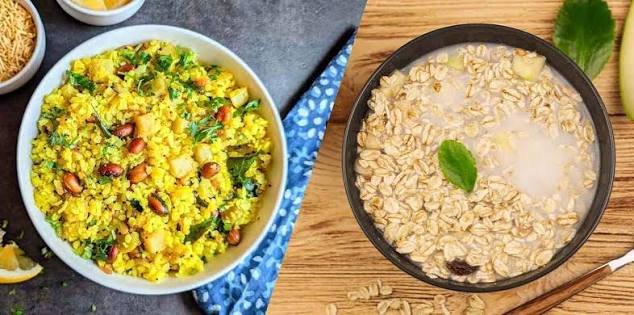
Oats vs Poha: Quick Comparison
| Feature | Oats | Poha |
|---|---|---|
| Main grain | Oats | Rice |
| Processing | Rolled, cut or otherwise processed oat grain | Rice flattened into flakes |
| Protein | Generally higher | Generally lower |
| Fibre | Generally higher | Usually lower |
| Notable fibre | Beta-glucan | Much less beta-glucan |
| Texture | Creamy or chewy | Soft and fluffy |
| Cooking time | Quick | Very quick |
| Savoury preparation | Excellent | Excellent |
| Sweet preparation | Common | Less common |
| Indian-style breakfast | Increasingly common | Traditional favourite |
| Best for | Fibre-rich, substantial breakfast | Quick, light and adaptable breakfast |
What Are Oats?
Oats are cereal grains commonly sold in several forms.
You may encounter:
- Steel-cut oats
- Rolled oats
- Quick oats
- Instant oats
The degree of processing changes cooking time and texture.
Oats are particularly known for containing beta-glucan, a type of soluble fibre.
They also provide:
- Complex carbohydrates
- Protein
- Fibre
- B vitamins
- Minerals such as magnesium and phosphorus
Oats can be prepared as sweet porridge, but they do not need to be sweet.
Indian-style savoury oats can include vegetables and familiar spices, making them suitable for people who prefer a traditional savoury breakfast.
What Is Poha?
Poha is flattened rice.
Rice grains are processed and flattened into flakes that soften quickly when moistened and cooked.
Poha comes in different thicknesses, and the appropriate variety can depend on the recipe.
A typical Indian poha preparation may contain:
- Onion
- Mustard seeds
- Curry leaves
- Green chilli
- Turmeric
- Peanuts
- Coriander
- Lemon
- Vegetables
This transforms simple flattened rice into a more varied meal.
Regional recipes differ considerably, which is part of poha’s appeal.
1. Protein
Winner: Oats
Oats generally provide more protein than plain poha when comparable dry quantities are considered.
That gives oats an advantage if you are comparing only the base grains.
However, breakfast does not have to obtain all its protein from the cereal.
Poha can be combined with ingredients such as:
- Peanuts
- Peas
- Curd
- Other suitable protein foods
Similarly, oats can be prepared with milk, curd, nuts or other protein-containing ingredients.
The final meal may therefore look quite different from the base-food comparison.
2. Fibre
Winner: Oats
Oats generally contain considerably more fibre than white-rice-based poha.
Their beta-glucan content is particularly notable.
Beta-glucan is a soluble fibre that has been extensively studied in relation to blood cholesterol and other aspects of metabolic health.
Poha can still be part of a balanced diet, but ordinary white poha is not nutritionally equivalent to a whole grain such as oats in terms of fibre.
You can improve the fibre content of a poha breakfast by adding plenty of vegetables and other fibre-containing foods.
3. Calories
Winner: No useful universal winner
Calories depend heavily on whether you compare foods:
- Dry
- Cooked
- Per 100 grams
- Per actual serving
Cooked oats absorb substantial water.
Poha also absorbs water during preparation.
Then additional ingredients change the numbers.
A bowl of oats prepared with milk, nuts, fruit and sweetener may provide substantially more energy than plain vegetable poha.
Poha cooked with a large amount of oil and peanuts can also become considerably more energy-dense.
The recipe matters more than a generic calorie figure.
4. Carbohydrates
Winner: Neither needs to be avoided because it contains carbohydrates
Both oats and poha are carbohydrate-rich cereal foods.
But their composition differs.
Oats generally provide more fibre and protein alongside their carbohydrates.
Poha provides easily incorporated carbohydrate energy and can be paired with vegetables and protein-containing foods.
Carbohydrates are a normal source of dietary energy, particularly important for active and growing people.
The useful question is not “Which has fewer carbs?” but what else accompanies those carbohydrates in the meal?
5. Blood-Glucose Response
Winner: Oats generally have an advantage, but preparation matters
Oats’ fibre, particularly beta-glucan, can influence digestion and the post-meal glucose response.
Poha’s response depends on factors such as:
- Type of rice
- Processing
- Portion
- Cooking
- Added ingredients
- Foods eaten alongside it
Adding vegetables, peanuts and a protein-containing side can change the overall meal.
Instant oat products also deserve attention. A flavoured instant oat packet containing substantial added sugar is not nutritionally identical to plain oats.
People managing diabetes should follow individual dietary guidance rather than assuming every oat product is automatically suitable.
6. Satiety
Winner: Oats, generally
Oats’ combination of fibre and protein can make them particularly satisfying.
Beta-glucan absorbs water and contributes to the characteristic thick texture of oat porridge.
Poha can also produce a satisfying breakfast when it includes ingredients such as:
- Vegetables
- Peanuts
- Peas
- Curd
Plain poha prepared mostly from flattened rice may be less substantial than a well-built bowl containing these additions.
Again, the recipe can narrow the difference considerably.
7. Digestion
Winner: Individual dependent
Poha has a reputation as a light breakfast and many people find its soft texture comfortable to eat in the morning.
Oats contain more fibre, which can be beneficial but may feel different to someone who is not accustomed to a high-fibre breakfast.
Suddenly increasing fibre intake can cause temporary digestive discomfort in some people.
There is no universal rule saying poha is always easier to digest or oats are always better for digestion.
Individual tolerance matters.
8. Cooking Time
Winner: Poha, slightly
Poha is one of India’s most convenient cooked breakfasts.
Once the ingredients are prepared, it can be ready very quickly.
Quick or instant oats can be similarly fast.
Steel-cut oats take considerably longer.
So the comparison depends partly on which oats you buy.
For a rushed weekday morning, both poha and quick/rolled oats can be practical options.
9. Savoury Breakfast
Winner: Poha for traditional flavour
Poha is naturally suited to Indian savoury flavours.
Mustard seeds, curry leaves, onion, turmeric, coriander and lemon create a familiar breakfast without requiring complicated preparation.
Oats can also work surprisingly well in savoury dishes.
You can prepare vegetable oats using ingredients such as:
- Carrots
- Peas
- Beans
- Onion
- Tomato
- Cumin
- Curry leaves
This can be useful for people who want the nutritional characteristics of oats but do not enjoy sweet porridge.
10. Sweet Breakfast
Winner: Oats
Oats are much more adaptable to sweet breakfast bowls.
They can be combined with:
- Milk
- Curd or yogurt
- Fruit
- Nuts
- Seeds
- Cinnamon or other preferred flavours
Sweetness does not necessarily require large amounts of sugar, honey or syrup.
Fruit can provide flavour and sweetness.
Flavoured packaged oats should be checked carefully because some products can contain significant added sugar.
11. Vegetables
Winner: Poha makes them particularly easy to add
One of poha’s biggest practical strengths is how naturally vegetables fit into the recipe.
Peas, carrots, beans and other suitable vegetables can be incorporated without making breakfast feel unusual.
Oats can also contain vegetables, particularly in savoury recipes.
The important point is that neither breakfast needs to consist only of grain.
Adding vegetables increases food variety and contributes fibre, vitamins and minerals.
12. Packaged Products Need a Separate Comparison
Plain oats and plain poha are simple grain products.
Flavoured instant versions can be very different.
A packaged breakfast product may contain:
- Added sugar
- Significant sodium
- Flavourings
- Added fats
- Other ingredients
Do not assume “oats” printed prominently on the front automatically makes a packaged product nutritionally superior.
Similarly, ready-to-eat poha can differ considerably from homemade poha.
Read the ingredient list and nutrition panel when comparing packaged options.
Oats or Poha: Which Should You Choose?
Choose oats if:
- Higher fibre is a priority.
- You want more protein from the base grain.
- You enjoy porridge or overnight oats.
- You want a breakfast containing beta-glucan.
- You like both sweet and savoury breakfast options.
Choose poha if:
- You prefer traditional Indian flavours.
- You want a quick, light breakfast.
- You enjoy adding vegetables, peanuts and lemon.
- Flattened rice is already familiar in your household.
- You prefer savoury breakfasts.
There is no need to eat the same breakfast every morning.
Make Either Breakfast More Complete
Instead of asking only whether oats or poha wins, consider how to build a better breakfast around either one.
An oat breakfast could include:
Oats + milk or curd + fruit + nuts
A poha breakfast could include:
Vegetable poha + peanuts + curd
The exact combinations can be adjusted according to dietary preferences.
This provides a broader mix of carbohydrates, protein, fibre, fats and micronutrients.
For children and teenagers especially, breakfast should support growth, concentration and daily activity rather than becoming an exercise in choosing the lowest-calorie food.
Oats have a genuine nutritional advantage in fibre and generally protein, but that does not make poha an inferior breakfast. A well-prepared vegetable poha can be an excellent everyday meal, while plain oats provide an easy foundation for a fibre-rich breakfast.
Rotating both can provide the simplest answer: oats on some mornings, poha on others, and other traditional breakfasts throughout the week.
FAQs
Q1. Which is healthier for breakfast, oats or poha?
A. Oats generally provide more fibre and protein, while poha is a convenient and versatile rice-based breakfast. A vegetable-rich poha with a protein-containing side can still make an excellent balanced meal.
Q2. Which has more protein, oats or poha?
A. Oats generally contain more protein than plain poha when comparable dry quantities are considered. However, adding peanuts, peas, curd or another protein source can increase the protein content of a poha meal.
Q3. Which has more fibre, oats or poha?
A. Oats generally contain considerably more fibre and are particularly notable for beta-glucan soluble fibre. Ordinary white-rice poha usually contains less fibre.
Q4. Is poha good for everyday breakfast?
A. Yes. Poha can form part of regular meals, particularly when prepared with vegetables and suitable protein- or fat-containing foods such as peas, peanuts or curd. Dietary variety across the week is still useful.
Q5. Can oats be prepared like Indian poha?
A. Yes. Oats can be cooked as a savoury breakfast with onion, vegetables, curry leaves, cumin, mustard seeds and other preferred Indian spices. The texture differs from poha, but it can be a practical alternative to sweet oat porridge.