A bowl of dal does not need to be complicated to be nutritionally useful. Moong and masoor are both quick-cooking pulses that can turn into a simple dal with little more than water, turmeric and a tadka, yet they produce noticeably different results. Moong becomes soft and mild, while masoor develops a fuller earthy flavour and typically cooks into a smooth, comforting consistency.
Nutritionally, both provide plant protein, fibre, complex carbohydrates and important micronutrients. The differences are not large enough to make one universally superior.
For everyday meals, moong dal is particularly useful when you want a mild, versatile dal, while masoor dal is an equally practical option when you prefer a stronger flavour and want variety in your pulse intake. Rotating both is usually more sensible than choosing only one.
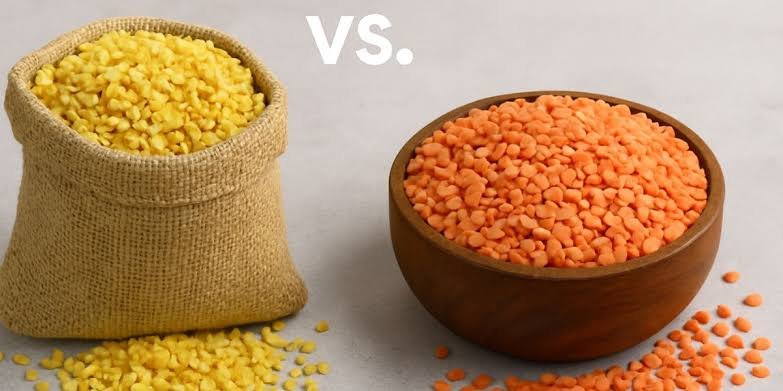
Moong Dal vs Masoor Dal: Quick Comparison
| Feature | Moong Dal | Masoor Dal |
|---|---|---|
| Source | Mung bean | Lentil |
| Common colour | Yellow when split and skinned; green forms also available | Orange/red when split and skinned; brown whole form |
| Flavour | Mild | Earthier, slightly stronger |
| Protein | Good plant source | Good plant source |
| Fibre | Good source; whole forms generally retain more | Good source; whole forms generally retain more |
| Iron | Provides iron | Provides iron |
| Folate | Provides folate | Provides folate |
| Cooking time | Fast | Fast |
| Texture after cooking | Soft and creamy | Soft and smooth |
| Khichdi | Excellent | Can be used |
| Everyday dal | Excellent | Excellent |
| Best approach | Use as part of pulse variety | Use as part of pulse variety |
What Is Moong Dal?
Moong comes from the mung bean.
It appears in several forms in Indian kitchens:
- Whole green moong
- Split green moong
- Yellow moong dal
Yellow moong dal has had its green outer skin removed and is split, allowing it to cook relatively quickly.
Its mild flavour makes it adaptable to many dishes.
Apart from ordinary dal, moong is commonly used for:
- Khichdi
- Chilla
- Dal soups
- Moong dal tadka
- Halwa
- Sprouted preparations using suitable whole moong
Because its taste is relatively neutral, the spices and tadka can substantially change the character of the finished dish.
What Is Masoor Dal?
Masoor is a type of lentil.
The split, skinned version commonly sold as masoor dal has a distinctive orange or reddish appearance when dry.
After cooking, however, that bright colour changes considerably.
Whole masoor retains its outer covering and is generally brownish.
Masoor dal is popular because it cooks quickly and develops a smooth texture without requiring extremely long soaking or cooking.
It works particularly well for:
- Simple dal
- Dal tadka
- Soups
- One-pot meals
- Vegetable-and-lentil preparations
Its slightly earthier flavour distinguishes it from mild yellow moong.
1. Protein
Winner: Both
Moong and masoor are both useful sources of plant protein.
Exact values depend on whether the comparison is made using dry or cooked dal.
This distinction is important because pulses absorb substantial water during cooking. As a result, 100 grams of cooked dal contains much more water than 100 grams of dry dal.
Comparisons should therefore use equivalent forms.
For everyday nutrition, the difference between moong and masoor protein is generally less important than regularly including pulses and other protein foods in meals.
2. Fibre
Winner: Both, with whole versions having an advantage
Both pulses contribute dietary fibre.
However, processing matters.
Removing the outer skin changes the fibre content, which is why whole moong and whole masoor can differ from their split, skinned versions.
Fibre contributes to normal digestive function and helps make meals satisfying.
You can increase the overall fibre quality of a meal by combining dal with foods such as:
- Vegetables
- Whole grains
- Salad where appropriate
- Other pulses
The entire plate matters more than a small fibre difference between two dals.
3. Iron
Winner: Both contribute
Moong and masoor contain plant-based iron.
The iron in plant foods is non-haem iron, and its absorption is influenced by other components of the meal.
Including a vitamin C-containing food in the overall diet can help improve absorption of non-haem iron.
Examples include foods such as:
- Lemon
- Amla
- Guava
- Tomatoes
- Capsicum
- Citrus fruits
Dal can therefore contribute to iron intake, but it should be part of a varied diet rather than relied upon as the only source.
Anyone with diagnosed iron deficiency should obtain appropriate healthcare guidance rather than attempting to treat it simply by eating more of one particular dal.
4. Folate and Other Micronutrients
Winner: Both
Pulses are valuable not only because of protein.
Moong and masoor also provide various micronutrients, including folate and minerals.
Their exact composition differs, but there is little practical reason for most households to choose one exclusively based on a single micronutrient.
Eating several types of pulses across the week can provide greater dietary variety.
For example, meals might rotate among:
- Moong
- Masoor
- Toor/arhar
- Chana dal
- Urad
- Rajma
- Chickpeas
This is one of the strengths of traditional Indian eating patterns.
5. Cooking Time
Winner: Tie
Yellow moong dal and split red masoor dal are both convenient when cooking time is limited.
Both soften relatively quickly compared with many whole pulses.
They can also be pressure-cooked for faster preparation.
Actual cooking time depends on:
- Whether the dal is split or whole
- Soaking
- Quantity
- Cooking method
- Desired consistency
For a quick weekday dal, either is an excellent option.
6. Taste
Winner: Personal preference
Moong dal is mild.
This makes it useful when you want the tadka, vegetables or accompanying dish to provide most of the flavour.
Masoor has a more noticeable earthy lentil flavour.
It works particularly well with simple onion-tomato masala and warming spices.
Neither needs complicated seasoning.
A basic tadka made with ingredients such as cumin, garlic or other preferred spices can turn either into a flavourful everyday dish.
7. Texture
Winner: Depends on the dish
Yellow moong breaks down readily and can produce a soft, creamy consistency.
Masoor also becomes soft quickly and often creates a smooth dal.
The amount of water makes a major difference.
Both can be prepared:
- Thick
- Medium consistency
- Thin and soup-like
Whole versions naturally have a different texture because the outer covering remains.
The better dal therefore depends partly on the dish you are trying to prepare.
8. Khichdi
Winner: Moong dal
Moong dal has a particularly strong association with khichdi.
Its mild flavour and soft texture combine naturally with rice.
A basic moong dal khichdi can also be customised with vegetables and spices according to preference.
Masoor can be combined with rice too, but it produces a different flavour and colour.
If you want the familiar mild style of khichdi commonly prepared in many Indian households, moong is usually the preferred choice.
9. Digestion
Winner: Individual dependent
Moong dal has a longstanding reputation as a relatively mild food and is commonly used in simple meals.
However, statements such as “moong is always easy to digest” should not be treated as universal medical rules.
Pulses contain fermentable carbohydrates and fibre, and individual tolerance differs.
Some people may experience gas or bloating after eating larger quantities of pulses.
Preparation can also influence tolerance.
Depending on the pulse and recipe, soaking, thorough cooking and gradually increasing pulse intake may help some people adapt.
Persistent digestive symptoms should be discussed with an appropriate healthcare professional rather than solved by unnecessarily removing nutritious food groups.
10. Blood-Glucose Response
Winner: Both can fit into balanced meals
Moong and masoor provide carbohydrates, but they also contain protein and fibre.
This creates a different nutritional profile from highly refined carbohydrate foods.
However, neither dal should be marketed as a food that can be eaten without considering portions simply because it has protein or fibre.
Blood-glucose response depends on:
- Serving size
- Cooking
- Other foods in the meal
- Individual metabolism
Dal eaten alongside vegetables and an appropriate portion of rice or roti creates a mixed meal.
People managing diabetes should follow individual dietary guidance rather than trying to identify one universally “diabetic-friendly” dal.
11. Weight Management
Winner: Neither needs to win
Both dals can be part of satisfying, nutrient-rich meals.
Their combination of protein and fibre can contribute to fullness.
But neither is a special weight-loss food.
Body weight and growth are influenced by the overall diet, physical activity, sleep and many other factors.
Particularly for children and teenagers, normal nutritious foods should not be unnecessarily restricted in pursuit of lower-calorie meals.
A more useful goal is building balanced meals rather than trying to rank ordinary dals by their ability to change body weight.
12. Which Works Better With Rice and Roti?
Winner: Tie
Both do.
Moong’s mild flavour pairs easily with plain rice and vegetable dishes.
Masoor’s earthier flavour works well with both rice and roti.
For a simple Indian plate, you might have:
Rice + moong dal + sabzi + curd
or:
Roti + masoor dal + seasonal vegetables
Both provide a combination of carbohydrates, plant protein, fibre and micronutrients.
There is no nutritional requirement to eat the same dal every day.
Moong Dal or Masoor Dal: Which Should You Choose?
Choose moong dal if:
- You prefer mild flavours.
- You regularly make khichdi.
- You want a quick-cooking pulse.
- You enjoy soft, creamy dal.
- It already fits naturally into your household meals.
Choose masoor dal if:
- You prefer an earthier lentil flavour.
- You want another quick-cooking option.
- You enjoy smooth dal and lentil soups.
- You want more pulse variety during the week.
- Masoor-based dishes suit your regional cooking style.
For everyday meals, there is no strong reason to permanently choose one over the other.
Rotation Is Better Than Turning Dal Into a Competition
One of the simplest ways to improve variety in Indian meals is to stop expecting one dal to provide everything.
Instead of eating moong every day because it has a reputation for being light, or masoor every day because of one nutrient comparison, rotate different pulses.
A weekly pattern could include moong, masoor, toor, chana, urad and whole pulses according to household preference.
Different pulses bring changes in:
- Taste
- Texture
- Micronutrients
- Fibre
- Cooking style
They also make everyday meals less repetitive.
For a balanced meal, combine dal with vegetables, an appropriate grain such as rice or roti, and other foods according to individual dietary needs.
Moong dal’s strength is its mildness and versatility. Masoor dal’s strength is its quick cooking, earthy flavour and equally useful pulse nutrition. For most households, the best answer is to keep both in the kitchen.
FAQs
Q1. Which is better for everyday meals, moong dal or masoor dal?
A. Both are nutritious everyday pulses that provide plant protein, fibre and micronutrients. Moong has a milder flavour, while masoor tastes earthier. Rotating both provides greater dietary variety.
Q2. Which has more protein, moong dal or masoor dal?
A. Both are good plant-protein sources, and exact values depend on the variety and whether they are measured dry or cooked. For ordinary meals, the difference is less important than regularly eating adequate protein from varied sources.
Q3. Which dal is better for khichdi?
A. Yellow moong dal is the traditional and particularly popular choice because it cooks soft and has a mild flavour that combines well with rice.
Q4. Is masoor dal difficult to digest?
A. Not necessarily. Individual tolerance to pulses varies. Thorough cooking and suitable portions can help, while persistent digestive symptoms should be discussed with an appropriate healthcare professional.
Q5. Can moong and masoor dal be eaten on alternate days?
A. Yes. Rotating different dals is a practical way to add variety to meals. Moong, masoor and other pulses can all form part of a varied diet according to taste and individual needs.