Chole and rajma rarely compete on an Indian dining table—the choice is usually determined by what you feel like eating. Nutritionally, however, chickpeas and kidney beans are remarkably close. Both provide plant protein, fibre, complex carbohydrates, folate, iron and other minerals, making either a useful addition to everyday meals.
The important detail is how they are compared. Dry pulses contain much less water than cooked pulses, so comparing dry chickpeas with cooked kidney beans produces misleading numbers. On an equal cooked-weight basis, their protein content is quite similar, while kidney beans often have a modest advantage in fibre.
For practical nutrition, both are excellent choices. Chickpeas are exceptionally versatile, while kidney beans provide a similarly protein-rich, fibre-rich option for dishes such as rajma. Rotating the two gives you more variety than trying to select a permanent winner.
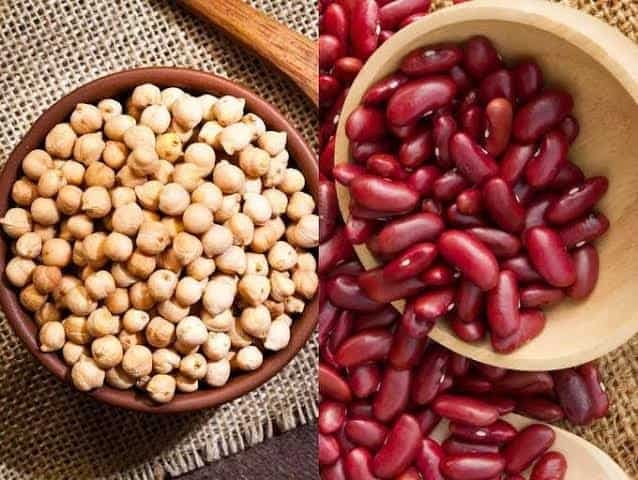
Chickpeas vs Kidney Beans: Quick Comparison
| Feature | Chickpeas | Kidney Beans |
|---|---|---|
| Common Indian name | Chana/Kabuli chana | Rajma |
| Protein | High for a pulse | High for a pulse |
| Fibre | High | High, often slightly more per comparable cooked portion |
| Carbohydrates | Mainly complex carbohydrates | Mainly complex carbohydrates |
| Fat | Low, but generally higher than kidney beans | Very low |
| Folate | Good source | Good source |
| Iron | Provides plant-based iron | Provides plant-based iron |
| Texture | Firm, nutty | Soft and creamy when cooked |
| Flavour | Mild, nutty | Mild, earthy |
| Indian dishes | Chole, chana masala, salads | Rajma masala, curries |
| Other uses | Hummus, chaat, soups | Salads, soups, wraps |
| Best approach | Include regularly | Include regularly |
What Are Chickpeas?
Chickpeas are legumes consumed in several forms in India.
Two familiar types are:
- Kabuli chana
- Desi or kala chana
Kabuli chickpeas are larger and lighter in colour and are commonly used for chole and hummus.
Desi chickpeas are smaller and darker and have their own nutritional and culinary characteristics.
Chickpeas can be eaten in dishes such as:
- Chole
- Chana masala
- Chana chaat
- Salads
- Soups
- Hummus
Their relatively firm texture also makes them useful when you want the pulse to retain its shape.
What Are Kidney Beans?
Kidney beans are the beans commonly known as rajma in India.
They are named for their characteristic kidney-like shape and come in different colours and varieties.
In Indian cooking, rajma is most famously prepared in a thick onion-tomato gravy and served with rice.
Kidney beans can also be added to:
- Soups
- Salads
- Wraps
- Mixed bean dishes
- Rice preparations
Proper cooking is particularly important with kidney beans, something we will cover later.
1. Protein
Winner: Very close
Cooked chickpeas and cooked kidney beans provide similar amounts of protein.
Typical cooked values are roughly:
| Food | Approximate Protein per 100 g Cooked |
|---|---|
| Chickpeas | Around 8–9 g |
| Kidney beans | Around 8–9 g |
Exact figures vary according to variety, cooking and water absorption.
This means there is little practical reason to select rajma instead of chickpeas—or vice versa—just to gain a tiny amount of protein.
Both are valuable plant-protein foods.
2. Fibre
Winner: Kidney beans, often slightly
Both foods are rich in dietary fibre.
Cooked kidney beans can provide somewhat more fibre per comparable weight than cooked chickpeas, although values vary.
A typical 100-gram cooked portion can provide roughly:
- Chickpeas: around 7–8 g fibre
- Kidney beans: around 6–9 g fibre depending on the variety and database
Because the figures overlap, the sensible conclusion is that both are excellent fibre-containing foods rather than that one dramatically outperforms the other.
The amount you actually eat matters more than a small difference per 100 grams.
3. Protein Quality
Winner: Tie
Chickpeas and kidney beans provide useful plant protein, but legumes have a different amino-acid balance from foods such as eggs or dairy.
This does not make their protein poor.
Traditional food combinations can complement the amino-acid profiles of different plant foods.
For example:
Rajma + rice
and
Chana + roti
combine pulses and grains.
There is also no requirement to perfectly combine complementary proteins at every individual meal when the overall diet contains adequate protein and variety.
4. Carbohydrates
Winner: Tie
Both chickpeas and kidney beans contain substantial carbohydrates.
But they are very different from foods made primarily from refined starch or sugar.
Pulses combine carbohydrates with:
- Protein
- Fibre
- Vitamins
- Minerals
This combination is one reason legumes can make meals satisfying.
Calling chickpeas or rajma “too high in carbs” while ignoring their protein and fibre gives an incomplete picture of the food.
5. Fat
Winner: Kidney beans if lower fat alone is the goal
Kidney beans naturally contain very little fat.
Chickpeas contain somewhat more, although they are still not usually considered a high-fat food.
This difference does not automatically make kidney beans healthier.
The fat in chickpeas is largely unsaturated, and the absolute amount remains modest.
Cooking can change the final dish much more.
Chole prepared with substantial oil and rajma prepared with a smaller quantity of oil, for example, will have different nutritional profiles regardless of the beans themselves.
6. Folate
Winner: Both are useful sources
Chickpeas and kidney beans can both contribute folate, a B vitamin needed for normal cell division and other functions.
Pulses in general are useful sources of several B vitamins and minerals.
Exact nutrient amounts vary according to the bean variety and preparation.
Rather than selecting one pulse based on a single vitamin, including several types of beans, lentils and dals across the week provides broader dietary variety.
7. Iron
Winner: Both
Both provide non-haem iron, the form of iron found in plant foods.
Iron absorption from plant foods is influenced by the rest of the meal.
Including vitamin C-rich foods can help the body absorb non-haem iron.
For example, a meal containing rajma or chickpeas might be accompanied by vegetables or other foods containing vitamin C.
Neither food should be treated as a medical treatment for iron deficiency. Anyone diagnosed with deficiency should follow appropriate healthcare advice.
8. Satiety
Winner: Tie
Protein and fibre both contribute to satisfying meals.
Chickpeas and kidney beans provide both.
That makes them useful additions to meals where the goal is balanced nutrition rather than simply obtaining calories from refined carbohydrates.
Examples include:
Chana + roti + vegetables
or:
Rajma + rice + salad or cooked vegetables
The portion and complete meal determine how filling it feels.
There is little reason to choose one solely for satiety.
9. Taste and Texture
Winner: Personal preference
Chickpeas have a firmer texture and slightly nutty flavour.
Even after cooking, they can retain a noticeable bite.
Kidney beans become much softer and creamier when properly cooked.
This makes them particularly suitable for thick gravies.
The difference explains why chole and rajma have such distinct eating experiences even though their basic nutritional profiles have similarities.
10. Cooking Time
Winner: Neither is particularly quick from dry
Dry chickpeas and kidney beans generally benefit from soaking before cooking.
They then need thorough cooking until properly softened.
A pressure cooker can make preparation considerably more convenient.
If time is limited, pre-cooked canned beans can also be practical where available. Check the label for added salt and rinse them when appropriate.
Unlike quick-cooking dals such as split moong or masoor, whole chickpeas and rajma require more planning.
11. Kidney Beans Need Proper Cooking
Important advantage: Food safety knowledge matters
Raw or inadequately cooked kidney beans should not be eaten.
Kidney beans naturally contain relatively high levels of phytohaemagglutinin, a lectin that can cause illness when the beans are eaten raw or undercooked.
Proper soaking and thorough cooking make kidney beans safe for normal consumption.
A slow cooker operating at a low temperature should not be relied upon to cook raw kidney beans safely unless the beans have first received appropriate high-temperature preparation.
Canned kidney beans have already been cooked during processing and can be used according to the package instructions.
Chickpeas also require proper preparation and cooking, but kidney beans deserve particular attention because of their naturally high lectin content when raw.
12. Digestion and Gas
Winner: Individual dependent
Both chickpeas and kidney beans contain fermentable carbohydrates and substantial fibre.
Some people therefore experience:
- Gas
- Bloating
- Abdominal discomfort
This does not mean beans are inherently bad for digestion.
Tolerance can improve for some people when pulses are introduced gradually and properly prepared.
Soaking dry beans and cooking them thoroughly can also improve their texture and preparation.
If someone has persistent or significant digestive symptoms, individual healthcare guidance is more appropriate than unnecessarily eliminating nutritious foods.
13. Chole vs Rajma: The Gravy Matters
Comparing plain cooked beans is one thing.
Comparing finished chole and rajma is different.
Restaurant or homemade recipes may contain varying quantities of:
- Oil
- Ghee
- Cream
- Butter
- Salt
Serving size also matters.
Rajma itself is a nutrient-rich pulse, but a large plate dominated by rice with a small spoonful of rajma creates a different nutritional balance from a meal with a substantial serving of beans and vegetables.
The same principle applies to chole.
Look at the entire plate rather than judging the meal from the pulse name.
Chickpeas or Kidney Beans: Which Should You Choose?
Choose chickpeas if:
- You enjoy a firm, nutty texture.
- You regularly make chole or chana masala.
- You want a pulse that also works well in salads.
- You make hummus.
- You want a highly versatile pantry ingredient.
Choose kidney beans if:
- You enjoy creamy beans.
- Rajma is part of your regular meals.
- You want another protein- and fibre-rich pulse.
- You enjoy beans with rice.
- You prefer their softer texture.
From a nutritional perspective, both deserve a place in a varied diet.
Which Has More Protein and Fibre?
If the question is strictly about the numbers, the result is close.
Protein: Chickpeas and kidney beans provide broadly similar amounts when equal cooked portions are compared.
Fibre: Kidney beans may have a small advantage in some nutritional datasets and varieties, but both are excellent fibre sources.
That small difference should not determine your entire choice.
Indian kitchens have access to a much wider family of pulses, including:
- Moong
- Masoor
- Toor
- Urad
- Chana
- Rajma
- Black chickpeas
- Other regional beans
Rotating these foods provides different flavours, textures and nutrient combinations.
A plate of rajma-chawal one day and chana with roti on another is more useful nutritionally and more interesting than trying to identify a single bean that must be eaten every day.
FAQs
Q1. Which has more protein, chickpeas or kidney beans?
A. Their protein content is very similar when equal cooked portions are compared. Both commonly provide around 8–9 grams of protein per 100 grams cooked, although exact values vary by variety and preparation.
Q2. Which has more fibre, chickpeas or kidney beans?
A. Both are high-fibre foods. Kidney beans may provide slightly more fibre in some comparisons, but values vary by variety and cooking, and the difference is usually not large enough to make either a clear universal winner.
Q3. Are chickpeas and kidney beans good sources of plant protein?
A. Yes. Both provide useful plant protein along with fibre, complex carbohydrates, folate, iron and other nutrients.
Q4. Why must kidney beans be cooked thoroughly?
A. Raw and undercooked kidney beans can contain high levels of a naturally occurring lectin called phytohaemagglutinin that can cause illness. Proper high-temperature cooking is therefore essential.
Q5. Can chickpeas and kidney beans both be included in regular meals?
A. Yes. Rotating chickpeas, kidney beans, dals and other pulses is a practical way to obtain plant protein, fibre and greater dietary variety without depending on a single type of bean.