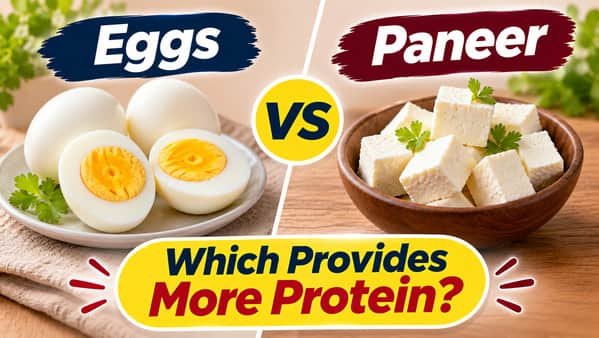
A protein comparison can change depending on whether you compare foods by 100 grams, one serving, or the number of calories eaten. Eggs and paneer are a good example. Paneer can provide more protein per 100 grams than whole eggs, but a typical paneer portion and two eggs are not nutritionally identical in calories, fat or micronutrients.
Both provide high-quality protein containing all essential amino acids. Their bigger differences are practical: eggs are portioned naturally and provide nutrients such as vitamin B12 and choline, while paneer is a vegetarian dairy option that also contributes substantial calcium.
So, paneer generally provides more protein per 100 grams, but eggs can offer a convenient amount of high-quality protein without requiring as many calories as full-fat paneer. The better choice depends on the complete meal rather than protein alone.
Eggs vs Paneer: Quick Comparison
| Feature | Eggs | Paneer |
|---|---|---|
| Protein | High-quality complete protein | High-quality complete protein |
| Approx. protein per 100 g | Around 12–13 g | Often around 18–20 g* |
| Typical serving | 1–2 eggs | Around 50–100 g |
| Calories | Moderate | Usually higher per 100 g |
| Fat | Moderate | Often higher, especially full-fat paneer |
| Calcium | Some | Much more significant source |
| Vitamin B12 | Good source | Provides some; varies |
| Choline | Particularly notable | Present in smaller amounts |
| Vegetarian suitability | Depends on dietary preference | Yes for lacto-vegetarians |
| Vegan | No | No |
| Cooking versatility | Very high | Very high |
Paneer composition varies substantially according to the milk and manufacturing method.
How Much Protein Is in Eggs?
One typical large egg provides roughly 6–7 grams of protein, although the exact amount varies with egg size.
That means:
- 1 egg: roughly 6–7 g protein
- 2 eggs: roughly 12–14 g
- 3 eggs: roughly 18–21 g
Egg protein is distributed between the white and yolk.
The egg white contains a substantial portion of the protein, while the yolk contributes protein along with fats and various micronutrients.
Discarding the yolk therefore changes much more than the calorie count.
How Much Protein Is in Paneer?
Paneer’s protein content varies more than many people realise.
The type of milk, fat content, moisture and production method can all affect its nutrition.
A typical full-fat paneer may provide approximately 18–20 grams of protein per 100 grams, though packaged products can differ.
That means a 50-gram portion might provide roughly half that amount.
This is why nutrition labels are particularly useful for packaged paneer.
Two brands can look nearly identical while having different amounts of:
- Protein
- Fat
- Calories
- Sodium
- Moisture
1. Protein Per 100 Grams
Winner: Paneer, generally
When exactly 100 grams of each food are compared, paneer commonly provides more protein than whole eggs.
A typical comparison may look approximately like this:
| Food | Approximate Protein per 100 g |
|---|---|
| Whole egg | 12–13 g |
| Paneer | 18–20 g, often |
However, 100 grams is not necessarily how people eat these foods.
Two eggs may weigh around 100 grams without shells, while a paneer serving can vary from a few cubes to a large restaurant portion.
Realistic serving sizes should therefore be considered alongside per-100-gram values.
2. Protein Quality
Winner: Tie
Both eggs and paneer provide complete proteins.
A complete protein supplies all nine essential amino acids that the body cannot produce in sufficient amounts on its own.
Egg protein is particularly well known for its high digestibility and amino-acid quality.
Paneer provides milk proteins, including casein and whey-related proteins, which also have a strong essential amino-acid profile.
For most people eating a varied diet, there is little reason to obsess over tiny differences in protein quality between the two.
Both are valuable protein foods.
3. Protein Relative to Calories
Winner: Eggs over typical full-fat paneer
Paneer can win the protein-per-100-gram comparison while providing substantially more calories because of its milk-fat content.
Whole eggs contain fat too, mainly in the yolk, but typical full-fat paneer can be considerably more energy-dense.
This distinction becomes useful when comparing foods realistically.
Someone does not necessarily need the food containing the highest absolute protein number. The goal is to obtain adequate protein as part of an overall nutritious diet.
For children and teenagers, this should not become an exercise in restricting calories. Growing bodies require adequate energy as well as protein.
4. Fat
Winner: Eggs if lower total fat is the priority
Full-fat paneer can contain substantial amounts of fat, including saturated fat.
Eggs contain both unsaturated and saturated fats, with most of the fat concentrated in the yolk.
The exact comparison depends on the paneer.
Lower-fat paneer products can have very different nutritional profiles from traditional full-fat paneer.
Cooking method also matters.
Boiled eggs are very different from eggs cooked in substantial butter or oil, just as plain paneer differs from paneer cooked in a cream-heavy gravy.
5. Calcium
Winner: Paneer
Paneer has a clear advantage when calcium is considered.
As a dairy product, it can contribute substantial calcium, although the exact amount varies with processing.
Eggs contain some calcium but are not generally considered a major dietary calcium source compared with dairy products.
This demonstrates why comparing foods only by protein can be misleading.
Paneer provides protein alongside dairy minerals, while eggs bring a different set of nutrients.
6. Vitamin B12
Winner: Eggs are a useful source; both can contribute
Vitamin B12 naturally occurs in animal-derived foods.
Eggs can contribute vitamin B12, particularly through the yolk.
Dairy foods such as paneer can also contribute B12, although quantities vary.
For people following lacto-vegetarian diets, dairy products can form part of their B12 intake.
People following vegan diets need appropriate reliable B12 sources because neither eggs nor paneer is vegan.
7. Choline
Winner: Eggs
Egg yolks are particularly notable for choline.
Choline is an essential nutrient involved in several normal body functions, including cell structure and nervous-system processes.
This is another reason whole eggs should not be viewed simply as protein whites plus an unnecessary yolk.
The yolk contains many of the egg’s micronutrients.
Paneer provides a different nutrient package and is particularly valuable for calcium and dairy protein.
8. Satiety
Winner: Both can be satisfying
Protein-containing foods can contribute to satisfying meals.
Eggs can make breakfast or a snack more substantial.
Paneer combines protein and fat, which can also make a meal filling.
But satiety depends on the complete meal.
For example:
Eggs + vegetables + roti
and
Paneer + vegetables + roti
both combine several food groups.
There is little nutritional value in turning the meal into a competition over which protein source keeps someone full for a few minutes longer.
9. Breakfast
Winner: Eggs for convenience
Eggs are particularly easy to use at breakfast.
They can be prepared as:
- Boiled eggs
- Omelette
- Egg bhurji
- Scrambled eggs
Cooking can take only a few minutes.
Paneer also works well at breakfast, particularly as paneer bhurji or in a stuffed paratha, but preparation may require more ingredients and time.
For someone who eats eggs, their convenience is a significant practical advantage.
10. Vegetarian Indian Meals
Winner: Paneer
Dietary definitions vary, but many Indian vegetarians who avoid eggs consume dairy.
For them, paneer is the obvious choice between these two foods.
It fits naturally into dishes such as:
- Palak paneer
- Matar paneer
- Paneer bhurji
- Paneer tikka
- Kadai paneer
Paneer can therefore provide high-quality protein without requiring meat or eggs.
However, vegetarian diets can also obtain protein from dal, chickpeas, rajma, soy foods and other sources.
11. Everyday Affordability
Winner: Depends on local prices and serving size
Eggs can be a relatively economical protein source in many parts of India, particularly when compared on a per-serving basis.
Paneer generally requires a larger quantity of milk to produce and can therefore cost more.
But prices vary by:
- City
- Brand
- Egg size
- Paneer quality
- Packaged versus local products
Cost per gram of protein can be useful for household budgeting, but nutritional variety should also be considered.
Dal, chickpeas, soy foods and other protein sources can complement either option.
12. Cooking Method Can Matter More Than the Choice
A boiled egg and paneer tikka cannot be compared only by looking at their base ingredients.
Neither can deep-fried eggs and lightly cooked paneer.
The final nutritional profile changes when you add:
- Oil
- Butter
- Cream
- Cheese
- Sauces
- Refined flour coatings
A simple egg curry can be quite different from a restaurant-style creamy paneer gravy.
Likewise, grilled paneer with vegetables differs considerably from heavily fried egg snacks.
Always consider the finished dish.
Eggs or Paneer: Which Should You Choose for Protein?
Choose eggs if:
- You eat eggs and want convenient high-quality protein.
- Quick breakfasts are important.
- You want protein without the higher energy density of typical full-fat paneer.
- You want nutrients such as choline and vitamin B12.
- You enjoy boiled eggs, omelettes or egg bhurji.
Choose paneer if:
- You follow a lacto-vegetarian diet.
- You want more protein per 100 grams in a typical comparison.
- Calcium intake is also important.
- You enjoy dairy foods.
- Paneer fits naturally into your regular Indian meals.
If you eat both, there is no need to choose permanently.
Eggs can work at breakfast while paneer appears in lunch or dinner on another day.
Protein Variety Is More Useful Than Finding One Winner
Protein requirements do not have to be met by repeatedly eating one “best” food.
Indian meals can obtain protein from many sources, including:
- Eggs
- Paneer
- Milk and curd
- Dal
- Rajma
- Chana
- Soy and tofu
- Nuts and seeds
- Other appropriate foods
Using several sources provides a broader mix of nutrients and keeps meals varied.
So, if the question is strictly which has more protein per 100 grams, paneer will generally come out ahead of whole eggs.
But if the question becomes which is better overall, there is no universal winner.
Eggs provide highly digestible protein in convenient portions along with nutrients such as choline. Paneer provides concentrated dairy protein and substantial calcium but can also contain considerably more fat and calories.
The better choice is the one that complements the rest of the meal and your overall dietary pattern.
FAQs
Q1. Which has more protein, eggs or paneer?
A. Paneer generally contains more protein per 100 grams than whole eggs. Typical paneer may provide around 18–20 grams per 100 grams, while whole eggs provide roughly 12–13 grams, although exact values vary.
Q2. How much protein is in two eggs?
A. Two typical large eggs provide roughly 12–14 grams of protein. The exact amount depends on the size of the eggs.
Q3. Is paneer better than eggs for protein?
A. Paneer generally provides more protein per 100 grams, but full-fat paneer can also contain substantially more fat and calories. Eggs provide high-quality protein in convenient portions, so neither is universally better.
Q4. Which is better for vegetarians, eggs or paneer?
A. For lacto-vegetarians who avoid eggs, paneer is the suitable choice. People who include eggs in their diet can use both foods to increase protein variety.
Q5. Can I eat both eggs and paneer as protein sources?
A. Yes, if both fit your dietary preferences and needs. Using different protein foods across meals can provide greater nutritional and culinary variety than relying on a single source.