Apples often get associated with everyday healthy eating, while guava is sometimes treated as a more seasonal, local fruit. Put their nutrient profiles side by side, however, and guava performs particularly well in two areas people frequently look for in fruit: fibre and vitamin C.
On an equal-weight basis, guava generally contains more than twice as much fibre as an apple with its skin and many times more vitamin C. That makes guava the clear winner if those two nutrients are the only criteria.
But that does not make apples nutritionally unimportant. Apples provide fibre, carbohydrates, potassium and plant compounds while being convenient, widely available and easy to carry. Guava wins the fibre-and-vitamin-C comparison, while both fruits can contribute to a varied diet.
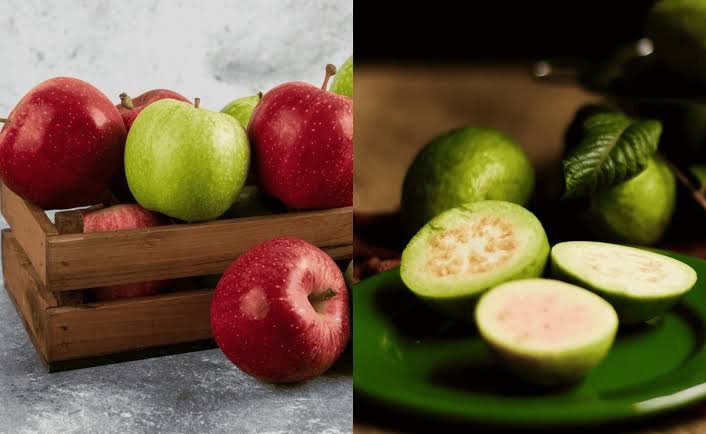
Apple vs Guava: Quick Comparison
| Feature | Apple | Guava |
|---|---|---|
| Fibre | Good source, especially with skin | Higher |
| Vitamin C | Relatively modest | Exceptionally high |
| Calories | Moderate | Moderate |
| Protein | Low | Higher than apple, though still a fruit |
| Fat | Very low | Low |
| Potassium | Provides some | Generally higher |
| Edible skin | Yes | Yes |
| Taste | Sweet to sweet-tart | Sweet, floral and sometimes tart |
| Portability | Excellent | Good |
| Main nutritional advantage | Convenient fruit with fibre | Fibre and vitamin C |
Values vary with variety, ripeness, growing conditions and serving size.
How Much Fibre Does an Apple Provide?
A raw apple with its skin typically provides approximately 2–3 grams of fibre per 100 grams.
A whole medium apple can provide more because it usually weighs considerably more than 100 grams.
The skin is important.
Removing it reduces some of the fruit’s fibre and plant compounds, so eating a properly washed apple with its skin generally retains more of the whole fruit’s nutritional value.
Apple contains both soluble and insoluble fibre.
One notable type of soluble fibre found in apples is pectin.
How Much Fibre Does Guava Provide?
Guava is particularly fibre-rich for a fresh fruit.
Raw guava can provide approximately 5 grams or more of fibre per 100 grams, depending on the variety and source of nutritional data.
That gives guava a substantial advantage over apple on an equal-weight basis.
Guava’s edible skin and numerous seeds contribute to its characteristic texture.
Eating the whole edible fruit rather than converting it into strained juice helps retain its fibre.
1. Fibre
Winner: Guava
When 100 grams of each fruit are compared, guava generally provides considerably more dietary fibre.
A typical comparison looks roughly like this:
| Fruit | Approximate Fibre per 100 g |
|---|---|
| Apple with skin | 2–3 g |
| Guava | Around 5 g or more |
This means guava can provide roughly twice the fibre of apple by weight.
However, actual intake depends on portion size.
A large apple may weigh much more than a single small guava, so comparing the amount you actually eat can produce a smaller difference than the per-100-gram figures suggest.
2. Vitamin C
Winner: Guava by a very large margin
This is where the nutritional difference becomes dramatic.
Apples contain vitamin C, but not in particularly large amounts compared with many other fruits.
Guava is naturally extremely rich in vitamin C.
Depending on the variety and ripeness, 100 grams of guava can provide well over 100 mg of vitamin C and often around 200 mg or more.
Apple generally provides only a few milligrams per 100 grams.
So if the question is specifically which fruit provides more vitamin C, guava is the decisive winner.
3. Why Is Vitamin C Important?
Vitamin C is an essential water-soluble vitamin.
It contributes to several normal functions in the body, including:
- Normal immune function
- Collagen formation
- Antioxidant protection
- Normal wound healing
- Improved absorption of non-haem iron from plant foods
The last point is particularly useful in Indian meals.
Plant foods such as dal, beans and leafy vegetables contain non-haem iron. Including vitamin C-containing foods in the overall meal can help improve its absorption.
Guava is therefore one of several useful fruits for dietary vitamin C.
4. Calories
Winner: No meaningful winner
Apple and guava are both relatively low-energy whole foods compared with many highly processed snacks.
Their calorie content per 100 grams is reasonably similar, although exact values vary.
There is little practical value in choosing between these fruits based on a small calorie difference.
Fruit also provides water, fibre, vitamins, minerals and plant compounds.
For children and teenagers in particular, fruit choices should not be driven by unnecessary calorie restriction.
Variety and adequate nutrition are more important.
5. Natural Sugar
Winner: Not a useful way to rank whole fruits
Apples and guavas naturally contain sugars.
That does not make them equivalent to sweets or sugary drinks.
In whole fruit, naturally occurring sugars are consumed along with:
- Water
- Fibre
- Vitamins
- Minerals
- Plant compounds
The physical structure of whole fruit also differs from a sweetened beverage.
People generally do not need to avoid ordinary whole fruit simply because it contains naturally occurring sugar.
Individual dietary needs can, of course, vary.
6. Potassium and Other Nutrients
Winner: Guava has an advantage in several comparisons
Guava’s nutritional strengths extend beyond vitamin C and fibre.
It can also contribute useful amounts of:
- Potassium
- Folate
- Other vitamins and minerals
- Various plant compounds
Apple provides potassium and beneficial plant compounds too, particularly when eaten with the skin.
The two fruits have different nutritional profiles, which is another reason dietary variety is preferable to eating only the fruit that ranks highest for one nutrient.
7. Antioxidant and Plant Compounds
Winner: Both
Fruits contain many compounds beyond the nutrients listed on a standard food label.
Apples contain various polyphenols, with some concentrated in or near the skin.
Guava contains vitamin C as well as carotenoids and other plant compounds, with the exact profile varying by variety.
Pink guava, for example, gets its colour partly from carotenoid pigments.
Rather than trying to rank fruits using a single antioxidant score, eating fruits of different colours and types is a more practical strategy.
8. Digestion
Winner: Individual dependent
Both fruits provide fibre.
Guava provides considerably more per equal weight, which can support normal digestive function as part of an adequate diet.
However, suddenly eating large quantities of fibre can cause digestive discomfort in some people.
Apple also contains fermentable carbohydrates that some individuals may tolerate differently.
There is no universal rule that one fruit is easier to digest for everyone.
Personal tolerance matters.
9. Eating the Skin
Winner: Both benefit from being eaten whole when suitable
Apple skin is edible and contributes fibre and plant compounds.
Guava skin is also edible.
Discarding edible portions can reduce some of the nutritional value of the whole fruit.
Wash fresh fruit thoroughly under clean running water before eating.
There is generally no need to remove edible fruit skin simply because the fruit was purchased from a market, although damaged or spoiled portions should not be eaten.
10. Whole Fruit vs Juice
Winner: Whole fruit
Turning either apple or guava into juice changes the eating experience significantly.
Juicing, particularly when pulp is strained out, removes much of the fibre.
It also becomes easier to consume the equivalent of several pieces of fruit quickly.
Whole fruit requires chewing and retains its natural fibre structure.
For routine fruit consumption, whole apple or whole guava generally provides a nutritional advantage over strained juice.
A smoothie that retains the entire edible fruit is different from filtered juice, although it is still consumed differently from chewing whole fruit.
11. Convenience
Winner: Apple
Apple has a practical advantage.
It can be washed and eaten with almost no preparation, is relatively sturdy and travels well in a school or travel bag.
Guava is portable too, but ripe guavas can soften and bruise more easily.
Depending on the variety, some people also prefer cutting guava before eating it.
Convenience matters because the fruit you actually eat regularly is more useful than a theoretically superior fruit that remains uneaten.
12. Availability and Price in India
Winner: Depends on season and location
Both apples and guavas are widely available in India, but their prices fluctuate according to:
- Season
- Variety
- Region
- Local production
- Storage
- Transport
Guava can be particularly economical when locally in season.
Apples benefit from widespread commercial distribution and storage, which can make them available for much of the year.
There is no nutritional requirement to purchase expensive imported fruit when affordable local fruit provides excellent nutrients.
Apple or Guava: Which Should You Choose?
Choose apple if:
- You want an easy, portable fruit.
- You enjoy its crisp texture.
- You want some fibre, particularly when eating the skin.
- Apples are readily available in your household.
- You want variety alongside other fruits.
Choose guava if:
- Vitamin C is a priority.
- You want a particularly fibre-rich fruit.
- You enjoy its flavour and texture.
- Guava is locally available and affordable.
- You want to diversify your fruit intake.
If both are available, there is no need to choose permanently.
Which Has More Fibre and Vitamin C?
For these two specific nutrients, the result is unusually clear.
Fibre: Guava wins.
Guava generally provides around twice or more the fibre of apple per 100 grams.
Vitamin C: Guava wins by a very large margin.
Guava can contain many times the vitamin C found in an equal weight of apple.
That makes guava particularly nutrient-dense in this comparison.
But nutrition is not a tournament in which the losing fruit becomes unnecessary.
Apples still contribute fibre and beneficial plant compounds and have the major practical advantage of convenience.
A varied fruit pattern might include guava, apple, oranges, papaya, banana, amla and other seasonal fruits available locally.
If you specifically want more fibre and vitamin C, choose guava. If you simply want a convenient nutritious fruit, both apple and guava are worthwhile choices.
FAQs
Q1. Which has more fibre, apple or guava?
A. Guava generally contains considerably more fibre per 100 grams. Guava often provides around 5 grams or more, while an apple with its skin commonly provides roughly 2–3 grams per 100 grams.
Q2. Which has more vitamin C, apple or guava?
A. Guava contains far more vitamin C than apple. Depending on its variety and ripeness, guava can provide well over 100 mg of vitamin C per 100 grams and often around 200 mg or more, while apple contains only a few milligrams.
Q3. Should apple be eaten with the skin?
A. Apple skin is edible and contains fibre and plant compounds. Eating a properly washed apple with its skin retains more of the whole fruit than peeling it.
Q4. Is guava good for everyday eating?
A. Guava can be included regularly as part of a varied diet. It provides fibre, vitamin C, potassium and other nutrients, but there is no need to rely on one fruit every day.
Q5. Is guava juice as nutritious as whole guava?
A. Whole guava generally has an advantage because it retains the fruit’s natural fibre. Strained juice removes much of that fibre and can make it easier to consume a larger amount of fruit quickly.