A ₹200 sealant failure around a window can remain a minor job—or eventually become peeling paint, damp plaster and damaged furniture if rainwater keeps entering unnoticed. Yet checking and servicing every component of a house constantly would also waste time and money. Good home maintenance sits between these two extremes.
This is the difference between preventive maintenance and reactive repair. Preventive maintenance involves inspecting, cleaning, servicing or fixing components before serious failure occurs. Reactive maintenance means waiting until something stops working or develops an obvious problem and then repairing it.
For most Indian homes, preventive maintenance is better for components where failure can cause expensive secondary damage, safety problems or major inconvenience. Reactive repair can still be reasonable for inexpensive, non-critical items that give little benefit from routine servicing.
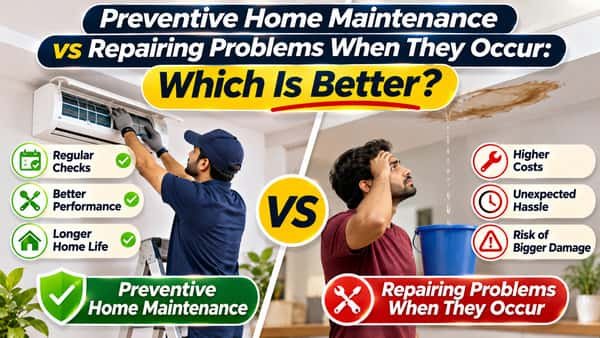
Preventive Maintenance vs Reactive Repairs: Quick Comparison
| Factor | Preventive Maintenance | Repair When Problem Occurs |
|---|---|---|
| Approach | Inspect/service before failure | Fix after failure |
| Upfront spending | Regular small costs | Lower until something fails |
| Emergency repairs | Can reduce them | More likely |
| Hidden problems | More likely to be detected early | May remain unnoticed |
| Planning | Easier | Often unpredictable |
| Appliance longevity | Can improve with proper servicing | Depends on failure |
| Secondary damage | Lower risk with early detection | Potentially higher |
| Suitable for critical systems | Yes | Less desirable |
| Best for | Plumbing, waterproofing, electrical and major equipment | Simple, low-risk items |
What Is Preventive Home Maintenance?
Preventive maintenance means taking planned action before a serious problem develops.
It can include:
- Cleaning AC filters
- Checking plumbing for leaks
- Inspecting roof drainage
- Cleaning exhaust fans
- Checking sealant around windows
- Inspecting visible electrical damage
- Cleaning water-storage systems as appropriate
- Lubricating suitable hardware
- Checking waterproofing warning signs
- Servicing appliances according to manufacturer guidance
The objective is not to prevent every possible failure.
It is to identify predictable deterioration early enough that a small issue does not become a large repair.
What Is Reactive Maintenance?
Reactive maintenance is the familiar:
“Fix it when it breaks.”
Examples include:
- Calling a plumber after a pipe starts leaking
- Repairing an AC after it stops cooling
- Fixing a switch after it fails
- Repainting after dampness damages the wall
- Calling a carpenter when a hinge breaks
This approach can make sense for some items.
There is little value in paying for frequent professional inspections of every inexpensive household component.
Problems arise when the same strategy is applied to systems where failure can damage the building or create safety concerns.
1. Upfront Cost
Winner: Reactive maintenance
If we consider only today’s spending, reactive maintenance appears cheaper.
You do nothing until something goes wrong.
Preventive maintenance may require spending on inspections, cleaning, servicing and minor replacement parts even when everything appears to work.
But upfront cost tells only part of the story.
The important question is whether preventive spending avoids a larger future expense.
2. Long-Term Repair Cost
Winner: Preventive maintenance for high-consequence problems
Early detection can prevent secondary damage.
Consider a slow plumbing leak beneath a sink.
Repairing the leaking connection early may be relatively simple.
Ignoring it can potentially damage:
- Cabinet boards
- Wall finishes
- Flooring
- Nearby stored items
The expensive part may eventually be repairing everything the water damaged rather than fixing the original leak.
Preventive inspection is particularly valuable where one failure can affect several other components.
3. Plumbing
Winner: Preventive maintenance
Not every plumbing failure gives dramatic warning signs.
Small leaks can continue for long periods.
Watch for:
- Damp patches
- Unexplained water marks
- Dripping faucets
- Moisture below sinks
- Reduced water pressure
- Running toilet cisterns
- Unusual increases in water consumption
Early investigation can reduce water waste and limit moisture damage.
Avoid waiting for a minor leak to become a flooded cabinet or ceiling complaint from the flat below.
4. Waterproofing
Winner: Preventive inspection
Waterproofing is one of the areas where early attention can be particularly valuable.
Inspect exposed areas and watch for warning signs before and during the monsoon.
Potential signs include:
- Damp patches
- Peeling paint
- Cracks around exposed joints
- Water staining
- Persistent moisture
- Blocked roof drains
Not every damp patch means waterproofing has failed; plumbing leaks and condensation can produce similar symptoms.
The cause should be identified before repairs are selected.
Simply repainting a damp wall is not preventive maintenance.
It hides the symptom.
5. Electrical Systems
Winner: Preventive attention
Electrical problems should not be managed purely with a “wait until it completely fails” strategy.
Warning signs such as:
- Burning smells
- Repeated breaker trips
- Unusually hot switches or sockets
- Sparking
- Damaged wiring
- Loose electrical fittings
should receive prompt attention from a qualified electrician.
Preventive electrical maintenance does not mean homeowners should open panels or attempt risky repairs themselves.
It means noticing abnormal conditions early and getting appropriate professional help.
6. Air Conditioners
Winner: Preventive maintenance
Air conditioners benefit from routine cleaning and appropriate servicing.
Dirty filters can restrict airflow and reduce performance.
Depending on the system and manufacturer guidance, maintenance can include:
- Filter cleaning/replacement
- Indoor-unit cleaning
- Outdoor-unit inspection
- Drainage checks
- Electrical inspection when needed
A useful strategy is to check cooling equipment before peak summer rather than discovering a failure on the hottest day of the year.
7. Ceiling and Exhaust Fans
Winner: Preventive basic maintenance
Fans are relatively simple but still benefit from basic attention.
Dust accumulation can reduce cleanliness and sometimes airflow performance.
Unusual wobbling, vibration or noise should not automatically be ignored.
For exhaust fans, dirty grilles can restrict airflow.
Basic cleaning and timely repair can keep these appliances working effectively without requiring elaborate maintenance schedules.
8. Doors, Windows and Hardware
Winner: Preventive maintenance
A loose hinge is usually easier to address than a door that has damaged its frame.
Likewise, deteriorating sealant around an exterior window may be easier to repair before monsoon rain begins entering the wall.
Periodic checks can cover:
- Hinges
- Handles
- Locks
- Sliding tracks
- Window seals
- Exterior joints
These are inexpensive components individually, but neglect can sometimes damage surrounding finishes.
9. Roof and Terrace
Winner: Preventive maintenance
For independent houses and top-floor properties, the roof deserves particular attention before heavy rain.
Inspect:
- Drain outlets
- Debris accumulation
- Visible cracks
- Damaged joints
- Signs of water ponding
- Existing waterproofed surfaces
A blocked drain can allow water to remain on the roof longer than intended.
Cleaning and inspection before monsoon conditions is usually easier than dealing with indoor leakage during heavy rain.
10. Appliances
Winner: Depends on the appliance
Not every appliance needs frequent professional servicing.
Follow manufacturer recommendations rather than assuming annual servicing is mandatory for everything.
Basic preventive tasks can include:
- Cleaning filters
- Maintaining ventilation around appliances
- Inspecting power cords for visible damage
- Cleaning accessible components
- Descaling equipment when appropriate
For a cheap appliance with no meaningful maintenance requirement, reactive replacement may actually be more economical.
Preventive maintenance should be proportional to the item’s value and failure consequences.
11. Safety
Winner: Preventive maintenance
This is one of the strongest arguments for prevention.
Certain household systems should not be allowed to deteriorate until complete failure.
Examples include:
- Electrical installations
- Gas-related equipment
- Structural components
- Balcony railings
- Water heaters
- Safety devices
Anything that could create a significant safety hazard deserves appropriate inspection and prompt professional attention when warning signs appear.
Cost savings should never come from postponing a known safety problem.
12. Convenience
Winner: Preventive maintenance
Planned maintenance lets you choose when work happens.
Emergency repair chooses for you.
An AC service can be scheduled before summer.
A leaking pipe at midnight cannot.
Preventive maintenance can reduce the likelihood of inconvenient breakdowns during:
- Heat waves
- Monsoon
- Festivals
- Family gatherings
- Travel
This planning value is difficult to measure in rupees but can matter greatly in everyday life.
13. Does Preventive Maintenance Always Save Money?
No.
This is an important limitation.
Over-maintenance can waste money.
For example, replacing a perfectly functional component far earlier than necessary may provide no financial benefit.
A better strategy is risk-based preventive maintenance.
Ask three questions:
- How likely is this component to deteriorate?
- How expensive is failure?
- Can failure damage something else or create a safety risk?
The greater the consequences, the stronger the case for prevention.
What Should Be Checked Before Indian Summer?
Before peak heat, useful household checks may include:
- AC filters and cooling performance
- Ceiling fans
- Exhaust ventilation
- Water-storage arrangements
- Window shading
- Refrigerator ventilation and condition
This is also a practical time to identify cooling problems before service demand becomes particularly high.
What Should Be Checked Before Monsoon?
Monsoon preparation can focus on water entry and drainage.
Consider inspecting:
- Roof/terrace drains
- Balcony drains
- Exterior window seals
- Visible wall cracks
- Existing damp patches
- Bathroom leakage
- Plumbing joints
- Areas with previous seepage
Problems already visible before the rains are easier to investigate than after several surfaces become wet simultaneously.
Preventive Maintenance or Repair When Needed: Which Should You Choose?
Use preventive maintenance for:
- Plumbing systems
- Waterproofing warning signs
- Electrical systems
- ACs and important cooling equipment
- Roof drainage
- Exterior weather seals
- Safety-related components
- High-value appliances where servicing is recommended
A repair-when-needed approach may be reasonable for:
- Simple decorative items
- Low-cost accessories
- Non-critical furniture components
- Items without meaningful service requirements
- Components whose failure causes little secondary damage
The goal is not to inspect everything constantly.
It is to concentrate preventive effort where failure matters.
A Simple Home Maintenance Strategy
Instead of waiting for failures or creating an unnecessarily complicated maintenance calendar, divide the home into three groups.
High priority:
Safety, electricity, gas-related equipment, active leaks and structural warning signs.
Preventive priority:
Plumbing, ACs, waterproofing, roof drainage, exterior seals and other components that can create secondary damage.
Repair as needed:
Low-risk decorative and inexpensive components where sudden failure causes little inconvenience or damage.
This approach makes preventive maintenance manageable.
Which Is Better?
For most homeowners, preventive maintenance is better than relying entirely on reactive repairs, but that does not mean every household item needs scheduled servicing.
Prevention delivers the greatest value when a small defect can become an expensive problem.
A blocked drain before monsoon, a slow pipe leak, a deteriorated exterior seal or an AC with restricted airflow is worth addressing early.
A loose decorative handle may simply be repaired when necessary.
The smartest strategy is therefore not “maintain everything” or “fix everything after it breaks.”
It is:
Prevent high-consequence failures, monitor important systems, and repair low-risk items when necessary.
That approach can reduce emergency expenses without turning home ownership into a constant maintenance project.
FAQs
Q1. Is preventive home maintenance cheaper than waiting for repairs?
A. It can be cheaper when early maintenance prevents expensive failures or secondary damage. However, unnecessary servicing or premature replacement of low-risk components can waste money, so maintenance should be prioritised according to risk.
Q2. What home maintenance should be done before monsoon in India?
A. It is useful to inspect roof and balcony drains, exterior seals, visible cracks, plumbing leaks, damp areas and locations with previous seepage. Existing problems should be investigated before heavy rain makes them worse.
Q3. Which household problems should never be ignored?
A. Electrical warning signs, gas-related concerns, active water leaks, structural cracks or movement, unsafe railings and other conditions that may affect safety deserve prompt professional attention.
Q4. Do all home appliances need preventive servicing?
A. No. Maintenance requirements vary by appliance. Follow the manufacturer’s instructions and prioritise cleaning, inspection or servicing where it meaningfully affects safety, efficiency, reliability or equipment life.
Q5. How can I create a simple home maintenance schedule?
A. Group tasks by frequency and season. Routine cleaning can be handled regularly, cooling systems can be checked before summer, and drainage and water-entry points can be inspected before monsoon. Safety-related or abnormal conditions should be addressed whenever they appear rather than waiting for a scheduled date.