Put paneer and firm tofu into the same curry and they may look surprisingly similar, but they come from completely different foods. Paneer is a fresh dairy cheese made from milk, while tofu is produced from soybeans. That difference affects their fat profile, protein, calcium, flavour and suitability for different diets.
Paneer has a familiar richness that fits naturally into dishes such as palak paneer, matar paneer and paneer tikka. Tofu has a milder flavour and readily takes on spices and sauces, making it easy to incorporate into many Indian recipes.
Paneer is an excellent choice when you want traditional dairy flavour, protein and a rich texture. Tofu is particularly useful when you want a plant-based protein or a generally leaner alternative, depending on the product. Neither needs to replace the other completely.
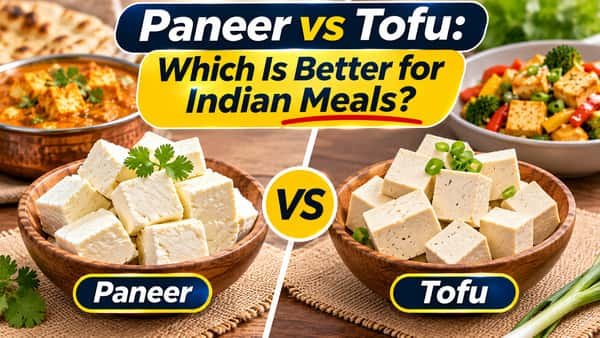
Paneer vs Tofu: Quick Comparison
| Feature | Paneer | Tofu |
|---|---|---|
| Main ingredient | Milk | Soybeans/soy milk |
| Food type | Fresh cheese | Soybean curd |
| Protein | Good source | Good plant-protein source |
| Fat | Often higher | Usually lower in many firm varieties |
| Calories | Generally higher | Often lower |
| Calcium | Good source; varies | Varies greatly with coagulant/product |
| Flavour | Milky and rich | Mild/neutral |
| Texture | Soft, firm and creamy | Soft to extra-firm |
| Vegan | No | Yes, if no animal-derived ingredients are added |
| Lactose | May contain small amounts | Naturally dairy-free |
| Indian cooking | Excellent | Highly adaptable |
| Best for | Traditional rich dishes | Plant-based and lighter preparations |
Nutrition varies significantly by brand, firmness, milk type and manufacturing method.
What Is Paneer?
Paneer is a fresh cheese widely used in Indian cooking.
It is generally prepared by heating milk and adding an acidic ingredient that causes the milk proteins to coagulate. The curds are separated from the liquid whey and pressed to form paneer.
Unlike many aged cheeses, paneer is fresh and has a mild flavour.
Its ability to hold its shape during cooking makes it suitable for dishes such as:
- Palak paneer
- Matar paneer
- Shahi paneer
- Kadai paneer
- Paneer tikka
- Paneer bhurji
Its dairy fat also contributes richness to the final dish.
What Is Tofu?
Tofu is made from soybeans.
Soybeans are processed into soy milk, which is then coagulated. The resulting curds are pressed into blocks.
Although this sounds somewhat similar to paneer production, the raw material is completely different.
Tofu comes in different textures, including:
- Silken
- Soft
- Firm
- Extra-firm
For many Indian curries, firm or extra-firm tofu is generally the easiest type to use because it holds its shape better during cooking.
1. Protein
Winner: Both are useful sources
Paneer and tofu can both contribute meaningful amounts of protein.
Paneer provides dairy protein.
Tofu provides soy protein, making it a useful plant-based option.
Exact protein content varies considerably according to the product. A dense firm tofu can have a very different nutritional profile from silken tofu, just as paneer made from different types of milk can vary.
Instead of assuming every paneer or tofu product contains the same amount, compare nutrition information per 100 grams when buying packaged products.
2. Calories
Winner: Tofu, generally
Paneer is often more energy-dense because it can contain substantial amounts of milk fat.
Many tofu products contain fewer calories per comparable serving.
However, calorie content varies with the type of paneer or tofu.
Cooking method also matters.
A lightly cooked tofu dish and deep-fried tofu are nutritionally different. The same applies to plain paneer compared with paneer cooked in a rich cream-and-butter gravy.
The finished meal matters more than the ingredient alone.
3. Fat
Winner: Tofu if lower saturated fat is the priority
Traditional full-fat paneer contains milk fat and therefore provides saturated fat.
Tofu contains predominantly unsaturated fats from soybeans and is generally lower in saturated fat.
That can make tofu useful when someone wants to change the fat profile of a meal.
But there is no need to treat paneer as a food that must always be avoided.
Portion size, frequency and the rest of the diet determine how it fits into an overall eating pattern.
4. Calcium
Winner: Depends heavily on the product
Paneer is a dairy food and can provide calcium, but the exact amount varies according to production.
Tofu presents an interesting case.
Some tofu is prepared using calcium-containing coagulants, which can make it a useful calcium source. Other tofu products may contain substantially less.
Therefore, tofu should not automatically be assumed to contain either more or less calcium than paneer.
Check the nutrition label and ingredients if calcium is an important reason for choosing it.
5. Carbohydrates
Winner: Neither needs to be chosen primarily for this reason
Both plain paneer and tofu are generally relatively low in carbohydrates compared with grain-based foods.
But carbohydrate content alone does not determine whether a food is nutritionally suitable.
Indian meals commonly combine paneer or tofu with carbohydrate-containing foods such as:
- Roti
- Rice
- Paratha
- Millet rotis
These combinations can form part of balanced meals when vegetables and other suitable foods are included.
There is no need to avoid normal carbohydrate foods simply because paneer or tofu itself contains relatively little carbohydrate.
6. Taste
Winner: Paneer for distinctive dairy richness
Paneer has a mild but recognisable milky flavour.
That flavour contributes to classic Indian paneer dishes.
Tofu is much more neutral.
Some people initially interpret that neutrality as blandness, but it can actually be useful.
Tofu absorbs the flavours of:
- Spices
- Marinades
- Gravies
- Chutneys
- Sauces
Good seasoning and cooking technique therefore make a major difference to tofu.
7. Texture
Winner: Paneer for traditional Indian dishes
Paneer has a distinctive combination of firmness and softness that is difficult to reproduce exactly with tofu.
It can be cubed, grilled, sautéed or crumbled.
Firm tofu can perform many of the same functions but has a different internal texture.
To improve tofu in curries, excess water can be drained before cooking. Firm tofu can also be marinated or lightly browned before adding it to a gravy.
The goal should not necessarily be to make tofu taste exactly like paneer.
It works better when treated as its own ingredient.
8. Vegan Diets
Winner: Tofu
Paneer is made from animal milk and is therefore not vegan.
Tofu is made from soybeans and is generally suitable for vegan diets, assuming the particular product contains no animal-derived additives.
This makes tofu one of the easiest paneer alternatives for plant-based Indian cooking.
It can be used in dishes inspired by:
- Palak paneer
- Paneer bhurji
- Kadai paneer
- Paneer tikka
The resulting dish will taste different, but the cooking format adapts well.
9. Lactose
Winner: Tofu for dairy avoidance
Tofu is naturally dairy-free.
Paneer is a dairy product. Its lactose content can be lower than milk because some lactose leaves with the whey during cheesemaking, but paneer should not automatically be described as lactose-free.
Individual tolerance varies.
Someone avoiding dairy because of milk-protein allergy has a different consideration from someone with lactose intolerance.
People with diagnosed allergies should follow appropriate medical guidance and check food labels carefully.
10. Indian Curries
Winner: Paneer for tradition; tofu for adaptability
Paneer has the clear culinary advantage in traditional paneer dishes.
Palak paneer tastes like palak paneer partly because paneer contributes its own dairy flavour and texture.
But tofu works surprisingly well with Indian spices.
Firm tofu can be added to:
- Palak-style gravy
- Tomato-onion masala
- Kadai gravy
- Mixed vegetable curry
- Tikka marinades
Strongly flavoured Indian gravies can complement tofu’s neutral taste particularly well.
11. Bhurji
Winner: Tie
Both ingredients can be crumbled.
Paneer bhurji has a rich dairy flavour and familiar texture.
Tofu bhurji can be prepared with many of the same ingredients:
- Onion
- Tomato
- Green chilli
- Turmeric
- Cumin
- Coriander
- Other preferred spices
Tofu’s neutral character allows it to take on the masala easily.
This is one of the simplest ways to introduce tofu into an Indian household without requiring an unfamiliar recipe.
12. Tikka and Grilling
Winner: Paneer for classic texture
Paneer works exceptionally well for tikka because it holds its shape and pairs naturally with yogurt-based marinades.
Firm or extra-firm tofu can also be grilled.
Removing excess water before marinating helps the tofu take on flavour.
For a vegan tofu tikka, the marinade can be adapted using a suitable plant-based alternative rather than dairy curd.
The finished result will not be identical to paneer tikka, but it can still provide a flavourful protein-containing dish.
13. Price and Availability in India
Winner: Paneer for availability
Paneer is deeply established in the Indian food market.
It is widely available from:
- Local dairies
- Supermarkets
- Grocery stores
- Packaged dairy brands
It can also be made at home from milk.
Tofu availability has improved considerably, especially in cities and larger supermarkets, but it may still be less common in some areas.
Prices vary according to brand, location and product quality.
For many households, paneer remains the easier ingredient to purchase locally.
Paneer or Tofu: Which Should You Choose?
Choose paneer if:
- You enjoy traditional Indian dairy dishes.
- Rich flavour is important.
- You want the familiar texture of paneer.
- Dairy fits comfortably into your diet.
- You regularly prepare tikka, bhurji or paneer curries.
Choose tofu if:
- You want a plant-based protein source.
- You follow a vegan diet.
- You need a dairy-free option.
- You want a generally lower-saturated-fat alternative.
- You enjoy experimenting with different ingredients.
You can also use both.
A household does not need to declare itself permanently “team paneer” or “team tofu.”
The Gravy Can Change the Comparison
It is easy to focus entirely on the protein ingredient and ignore everything surrounding it.
Consider two meals:
Tofu cooked in a heavily fried, rich gravy
and
Paneer cooked with vegetables in a relatively simple tomato-based gravy.
Calling the first meal automatically better just because it contains tofu would be misleading.
Oil, cream, butter, vegetables, serving size and accompaniments all affect the final meal.
A practical Indian plate could include paneer or tofu alongside vegetables, roti or rice and other suitable foods.
That is a more useful way to think about nutrition than searching for one universally superior ingredient.
Paneer brings dairy richness and traditional familiarity. Tofu brings plant-based protein and exceptional adaptability. Both can earn a place in Indian cooking for different reasons.
FAQs
Q1. Which has more protein, paneer or tofu?
A. Both are useful protein sources, but the exact amount varies by product. Paneer provides dairy protein, while tofu provides soy protein. Compare nutrition information per 100 grams for a precise packaged-product comparison.
Q2. Is tofu healthier than paneer?
A. Not automatically. Tofu is generally lower in saturated fat and can be less calorie-dense, while paneer provides dairy protein, calcium and a different nutrient profile. The better choice depends on the overall diet and meal.
Q3. Can tofu replace paneer in Indian curries?
A. Yes. Firm or extra-firm tofu can work in many paneer-style curries, including palak, kadai and tikka-style preparations. The taste and texture will differ from traditional paneer.
Q4. Which is better for a vegan diet, paneer or tofu?
A. Tofu is the suitable choice because it is made from soybeans and is generally plant-based. Paneer is made from animal milk and is not vegan.
Q5. Which is better for everyday Indian meals?
A. Both can fit into everyday meals. Paneer is ideal when traditional flavour and dairy richness are wanted, while tofu is useful for plant-based meals and when a generally lower-saturated-fat protein source is preferred.