A terrace that looks inviting in winter can become almost unusable at 2 p.m. in May. The floor heats up, outdoor furniture becomes uncomfortable, and direct sunlight makes even a large terrace difficult to enjoy. Adding shade solves part of the problem, but the type of shade determines how flexible and permanent the terrace becomes.
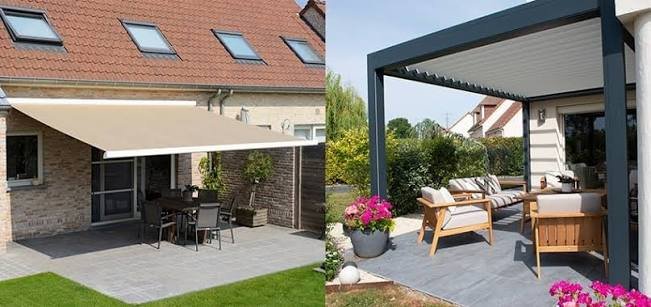
Two common options are a pergola and a retractable awning. A pergola creates a defined outdoor structure that can provide partial or substantial shade depending on its roof design. A retractable awning extends when shade is needed and folds away when you want an open terrace.
For a terrace where flexible, relatively lightweight shade is the priority, a retractable awning can be more practical. A pergola is generally better when you want a permanent architectural outdoor zone and are prepared for greater structural, installation, and maintenance requirements.
Pergola vs Retractable Awning: Quick Comparison
| Factor | Pergola | Retractable Awning |
|---|---|---|
| Structure | Permanent/semi-permanent | Retractable shade |
| Shade | Depends on roof design | Good when extended |
| Open-sky option | Depends on design | Excellent |
| Structural requirements | Higher | Generally lower |
| Wind sensitivity | Design-dependent | Extended fabric is wind-sensitive |
| Rain protection | Depends on roof | Product-dependent |
| Initial cost | Usually higher | Usually lower |
| Maintenance | Moderate | Fabric/mechanism maintenance |
| Design impact | Strong architectural feature | More discreet |
| Flexibility | Moderate | Excellent |
| Best for | Permanent outdoor living zone | Adjustable shade |
What Is a Pergola?
A pergola is an outdoor framework generally made with posts or other structural supports and an overhead arrangement of beams, slats, louvers, or another covering system.
Traditional pergolas may provide only partial shade.
Modern versions can incorporate:
- Fixed slats
- Adjustable louvers
- Fabric covers
- Polycarbonate or other suitable roofing
- Lighting
- Fans
- Plants
Therefore, the word “pergola” alone does not tell you how much sun or rain protection it provides.
Its roof design matters enormously.
What Is a Retractable Awning?
A retractable awning is a shade system that can extend outward over a terrace, balcony, patio, window, or door and retract when it is not required.
It commonly uses:
- Fabric
- Folding arms
- Rollers
- Manual controls
- Motorised controls
Its main advantage is flexibility.
You can create shade during intense afternoon sun and retract the awning when you want winter sunshine or an unobstructed view of the sky.
1. Protection From Direct Sun
Winner: Depends on coverage
Both options can provide effective shade when correctly designed.
A retractable awning creates a relatively solid overhead shaded area while extended.
A pergola with widely spaced open slats may still allow substantial sunlight through.
A pergola with:
- Closely spaced slats
- Adjustable louvers
- Suitable fabric
- A solid roof system
can provide much greater shade.
Therefore, compare the actual shaded area rather than assuming every pergola provides full sun protection.
2. Flexibility
Winner: Retractable awning
This is the strongest advantage of an awning.
Imagine a Delhi terrace in two seasons.
In June, you may want as much shade as possible.
On a pleasant January afternoon, you may actively want sunlight.
A fixed shade structure cannot easily respond to both situations.
A retractable awning can.
Extend it when the sun becomes uncomfortable and retract it when direct sunlight is desirable.
3. Creating an Outdoor Room
Winner: Pergola
A pergola does more than provide shade.
It defines a space.
With suitable furniture and design, a pergola can turn part of a terrace into an outdoor:
- Sitting area
- Dining area
- Tea corner
- Garden zone
- Entertainment space
The posts and overhead structure create a stronger architectural identity than an awning.
If your goal is to make the terrace feel like an extension of the living space, a pergola has an advantage.
4. Heat Reduction
Winner: Tie when comparable shade is provided
Shade can reduce direct solar exposure on people, furniture, doors, windows, and terrace surfaces.
This can improve comfort substantially.
However, neither a pergola nor an awning is an air conditioner.
Outdoor temperature, humidity, wind, surrounding surfaces, and roof heat still affect comfort.
The effectiveness also depends on the direction of the sun.
A purely overhead shade may not block low-angle morning or evening sunlight entering from the side.
5. Monsoon Rain
Winner: Product-specific
Neither option should automatically be considered a waterproof roof.
An open pergola provides little rain protection.
A pergola designed with a suitable weather-resistant roof and drainage can provide much greater coverage.
Retractable awnings vary significantly. Some fabrics and systems can tolerate light rain, while others are primarily intended for sun protection and should be retracted during unsuitable weather.
Rainwater also needs somewhere to go.
Before purchasing either system, check:
- Manufacturer’s rain-use instructions
- Roof/fabric slope
- Drainage
- Waterproof rating where applicable
- Installation details
Do not assume “outdoor” means “safe in every monsoon condition.”
6. Wind
Winner: Properly engineered pergola
Wind is an important consideration on exposed terraces, especially on upper floors.
A retractable awning creates a large surface when extended. Strong wind can place considerable forces on the fabric, arms, brackets, and supporting wall.
Many retractable systems therefore need to be closed during high winds.
Some motorised products can use compatible wind sensors to retract automatically.
A properly engineered pergola can provide a more permanent solution, but it too must be designed for site-specific wind loads.
A terrace structure should never be installed simply because it “looks heavy enough.”
7. Structural Load
Winner: Retractable awning, generally
A pergola may introduce significant loads through:
- Posts
- Beams
- Roof components
- Additional accessories
- Wind forces
Before installing one on an existing terrace, the structure and attachment method should be appropriately assessed.
This becomes even more important if the design includes heavy roofing, planters, glass, or other substantial elements.
A retractable awning is generally lighter, but its mounting brackets still transfer loads into the supporting structure.
Correct anchoring remains essential.
8. Waterproofing of the Terrace
Winner: Neither—installation quality matters
Terrace waterproofing should not be damaged casually while adding shade.
Pergola posts anchored through a finished terrace surface can create potential water-entry points if penetrations are poorly detailed.
Awning brackets attached to exterior walls also require correct weather sealing.
Before installation, determine:
- Where anchors will go
- Whether waterproof layers will be penetrated
- How penetrations will be sealed
- How future maintenance will be performed
Fixing a shade structure should not create a new leakage problem during the next monsoon.
9. Installation Cost
Winner: Retractable awning, generally
A straightforward awning is usually less expensive than constructing a substantial permanent pergola.
Pergola costs can include:
- Structural frame
- Fabrication
- Installation
- Roof/shade system
- Surface finishing
- Lighting
- Electrical work
- Drainage
- Structural assessment
A motorised premium awning can also become expensive, so actual quotations should be compared on equivalent size and specifications.
10. Maintenance
Winner: Depends on material and mechanism
Pergola maintenance depends heavily on construction material.
Different structures may require:
- Cleaning
- Fastener inspection
- Corrosion checks
- Repainting or recoating
- Roof/louver cleaning
- Drainage cleaning
Retractable awnings require attention to:
- Fabric
- Folding arms
- Roller mechanism
- Motor, if fitted
- Mounting brackets
Fabric may eventually fade, stain, or require replacement after prolonged exposure.
Neither system is completely maintenance-free.
11. Cleaning
Winner: Retractable awning for smaller/simple installations
Terraces in Indian cities can accumulate considerable dust.
Pergolas with numerous beams or louvers create more surfaces to clean.
Leaves can also accumulate around covered areas.
Awning fabric needs periodic cleaning but can be retracted when not required, potentially reducing some continuous exposure.
Always follow the material manufacturer’s cleaning instructions because aggressive chemicals can damage protective finishes or fabric.
12. Plants and Greenery
Winner: Pergola
A pergola can integrate beautifully with terrace landscaping.
Depending on the structure and plant selection, climbing plants can be trained around suitable supports.
Planters can also help define the pergola area.
However, greenery introduces additional considerations:
- Irrigation
- Drainage
- Root space
- Falling leaves
- Maintenance
- Structural load from large planters
Do not overload a terrace with heavy soil-filled containers without considering structural capacity.
13. Lighting and Fans
Winner: Pergola
A permanent overhead structure provides more opportunities for integrated features.
A suitably designed pergola may support:
- Lighting
- Decorative fixtures
- Outdoor-rated fans
- Selected electrical accessories
Any electrical installation exposed to outdoor weather needs appropriate equipment and professional installation.
An awning is primarily a movable shade device and generally offers fewer opportunities for permanently integrated services.
14. Appearance
Winner: Depends on design preference
A pergola becomes a significant visual feature.
It can make a terrace feel deliberately designed and create a focal point.
An awning has less architectural presence and can almost disappear when retracted.
Choose according to the desired result:
Pergola: “Create an outdoor room.”
Awning: “Give me shade when I need it.”
That distinction can simplify the decision.
15. Small Terraces
Winner: Retractable awning
On a compact terrace, permanent posts can consume useful floor area and affect movement.
A wall-mounted retractable awning can provide overhead shade without adding columns in some installations.
This can keep the floor plan more flexible.
For larger terraces, dedicating one section to a pergola may be easier without compromising circulation.
16. Year-Round Use
Winner: Depends on design
A retractable awning provides excellent seasonal flexibility.
A well-designed pergola can provide a more permanent outdoor living area.
For year-round use, however, shade is only one factor.
Also consider:
- Rain
- Wind
- Winter sun
- Summer heat
- Mosquitoes
- Lighting
- Drainage
No single overhead structure solves every outdoor-comfort problem.
Pergola or Retractable Awning: Which Should You Choose?
Choose a pergola if:
- You want a permanent outdoor seating zone.
- Architectural appearance matters.
- You have enough terrace space.
- The structure can safely support the installation.
- You want integrated lighting or other suitable features.
- You are prepared for higher installation costs.
Choose a retractable awning if:
- Your main objective is adjustable sun protection.
- You want winter sunlight when conditions are pleasant.
- Terrace space is limited.
- You prefer less structural intervention.
- You want to retract the shade when it is not required.
- A permanent outdoor structure is unnecessary.
Can You Combine a Pergola With Retractable Shade?
Yes.
A pergola does not have to use a permanently closed roof.
A structure can incorporate a retractable fabric or another adjustable shading solution where technically appropriate.
This provides:
Pergola structure + adjustable shade
It can be useful for homeowners who want a defined outdoor room without permanently blocking sunlight.
Such systems are generally more complex and expensive, so drainage, wind resistance, mechanism quality, and maintenance access need careful consideration.
Which Is Better for a Sunny Terrace?
For a homeowner whose main problem is strong summer sunlight, a retractable awning is often the simpler and more flexible solution. It provides shade when required while allowing the terrace to remain open during pleasant weather.
A pergola is better when the objective is broader: turning part of the terrace into a permanent outdoor living area rather than merely blocking the sun.
For an exposed Indian terrace, however, appearance should come after structural and weather considerations.
Before installing either system, evaluate wind exposure, anchoring, waterproofing, drainage, and the manufacturer’s weather limitations.
The most expensive mistake is not choosing the “wrong-looking” shade.
It is installing a terrace structure that works beautifully on a calm sunny day but was never properly designed for the wind and rain it will face throughout the year.
FAQs
Q1. Is a pergola better than an awning for a terrace?
A. A pergola is generally better for creating a permanent outdoor living zone, while a retractable awning is better when flexible shade is the main requirement. The right option depends on terrace size, weather exposure, structure, and budget.
Q2. Can a retractable awning be used during rain?
A. It depends on the specific product. Some awnings can tolerate certain rain conditions, while others are designed primarily for sun protection. Follow the manufacturer’s limits for rain, wind, slope, and drainage.
Q3. Does a pergola provide complete shade?
A. Not necessarily. Traditional open-slat pergolas provide partial shade. The amount of protection depends on the spacing and orientation of slats and whether the structure uses louvers, fabric, or another roof covering.
Q4. Which is cheaper, a pergola or retractable awning?
A. A straightforward retractable awning is generally cheaper than a substantial custom pergola. However, premium motorised awnings and sophisticated pergola systems can both be expensive, so equivalent quotations should be compared.
Q5. Do I need a structural check before installing a terrace pergola?
A. It is sensible to have the proposed structure, loads, anchoring, and existing terrace assessed appropriately, particularly for large or heavy pergolas and exposed upper-floor terraces. Waterproofing and wind loads should also be considered before installation.