The difficulty of owning something rarely ends at the checkout. A new item needs somewhere to be stored, may need cleaning or maintenance, and eventually has to be repaired, donated, sold, recycled or discarded. As possessions accumulate, these small responsibilities can become a significant part of managing a home.
Minimalist living tries to limit that accumulation by keeping possessions intentional and useful. Consumer-focused living places fewer restrictions on acquiring new products and may prioritise variety, upgrades, trends or convenience.
For many households, a moderate minimalist approach can be easier to maintain over time because there are fewer possessions to organise and replace. However, extreme minimalism can create its own work if people constantly count, declutter or restrict perfectly reasonable purchases. A practical middle ground is often easier than either extreme.

Minimalist vs Consumer-Focused Living: Quick Comparison
| Factor | Minimalist Living | Consumer-Focused Living |
|---|---|---|
| Number of possessions | Usually fewer | Usually more |
| Storage needs | Lower | Higher |
| Shopping frequency | More selective | Often more frequent |
| Variety | Lower | Higher |
| Organisation | Usually simpler | Can require more systems |
| Upfront decision-making | Higher | Often easier |
| Ongoing maintenance | Usually lower | Can increase with possessions |
| Trend participation | Selective | Often higher |
| Decluttering needs | Usually lower once established | Potentially higher |
| Best for | Simplicity and intentional ownership | Variety and frequent choice |
What Does Minimalist Living Mean?
Minimalism does not require living in an almost empty room with one chair and three shirts.
A practical minimalist approach means being more intentional about what enters and remains in your life.
Someone might ask:
- Do I actually use this?
- Do I already own something that serves the same purpose?
- Where will I keep it?
- Is it durable?
- Am I buying it because I need it or because it is temporarily appealing?
The objective is not necessarily to own the fewest possible things.
It is to avoid owning more than is useful or manageable for your circumstances.
What Is Consumer-Focused Living?
Consumer-focused living describes a lifestyle in which purchasing products plays a relatively larger role.
It can involve:
- Regular upgrades
- Following trends
- Collecting products
- Buying for convenience
- Frequently changing décor or clothing
- Owning multiple versions of similar items
This is not automatically irresponsible.
People buy products for legitimate reasons, including comfort, hobbies, work and enjoyment.
The practical issue appears when purchasing becomes faster than using, organising and maintaining what is already owned.
1. Fewer Possessions Usually Mean Less Organisation
Every possession requires some amount of space.
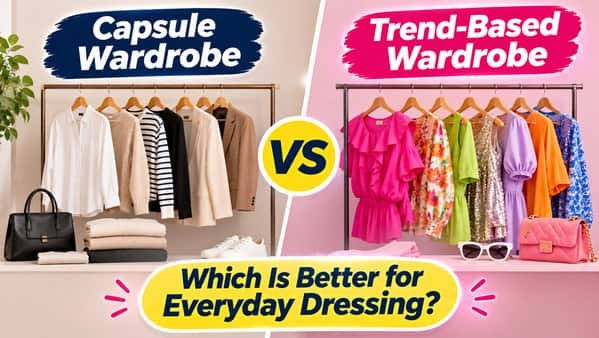
Imagine a wardrobe containing 40 regularly worn items compared with one containing 150 items, many of which are rarely used.
The larger wardrobe may require more:
- Storage
- Sorting
- Folding
- Cleaning
- Decision-making
- Decluttering
The same principle can apply to kitchen equipment, electronics, books, decorations and household supplies.
Having fewer useful possessions can simplify organisation.
Easier to organise: Minimalist living
2. Consumer-Focused Living Provides More Variety
Owning more can have genuine advantages.
A larger wardrobe provides more clothing choices. Multiple kitchen appliances can make particular cooking tasks easier. Different electronic devices may serve different purposes.
For people who enjoy collecting, fashion, technology or interior design, possessions can also be part of enjoyable hobbies.
Minimalism should not require removing things that are genuinely useful or meaningful merely to reach an arbitrary number.
Better for variety: Consumer-focused living
3. Minimalism Can Reduce Repeated Shopping
A practical minimalist mindset can change the question from:
“Do I like this?”
to:
“Do I like this enough to buy, store and use it?”
That extra step can prevent impulse purchases.
It can be particularly helpful during:
- Online sales
- Festival discounts
- Limited-time offers
- New product launches
- Fashion trends
A discount does not create savings when it persuades you to purchase something you otherwise would not have bought.
4. Buying Less Does Not Mean Buying Nothing
Minimalism is sometimes interpreted as avoiding purchases at all costs.
That can become impractical.
If your shoes are worn out, replacing them is reasonable.
If a tool would genuinely make a regular household task easier, buying it may be worthwhile.
The useful principle is:
Buy according to genuine needs and priorities rather than treating purchasing itself as the activity.
Minimalism works best as a decision-making framework, not a strict prohibition.
5. Consumer-Focused Living Can Increase Household Costs
Individual purchases may look small.
₹499 here and ₹799 there may not feel significant.
Over months, repeated purchases can add up.
There may also be secondary costs involving:
- Storage furniture
- Maintenance
- Repairs
- Accessories
- Subscriptions
- Replacements
Someone does not need to become a minimalist simply to manage money, but purchasing less frequently can naturally reduce certain expenses.
Better for limiting unnecessary spending: Minimalist living
6. Minimalism Can Have an Upfront Effort Cost
Moving from a cluttered home to a simpler one requires work.
You may need to:
- Sort belongings
- Decide what to keep
- Find appropriate places for items
- Donate usable products
- Recycle suitable materials
- Dispose of unusable items responsibly
That can take significant time.
Once a manageable system is established, however, maintaining it may become easier because fewer new items enter the home.
7. Extreme Decluttering Can Become Counterproductive
Decluttering should make life easier.
If you discard something useful and then buy it again a month later, little has been gained.
Avoid removing items merely because:
- You saw a minimalist home online.
- Someone recommends owning a specific number of objects.
- Your shelves are not visually empty enough.
- You feel pressure to match an aesthetic.
Keep things you genuinely use, need or value.
A functional home is more important than a photographically perfect minimalist one.
8. Storage Space Changes What Is Practical
A large home and a small apartment have different limits.
In a compact home, unnecessary possessions can quickly interfere with:
- Walking space
- Cleaning
- Storage
- Organisation
A larger home can accommodate more possessions, although extra storage can sometimes encourage people to keep things they never use.
Your available space should influence purchasing decisions.
Before buying a bulky item, ask:
Where will this actually go?
If there is no sensible answer, reconsidering the purchase may prevent a future storage problem.
9. Consumer-Focused Habits Can Be Encouraged by Digital Shopping
Online shopping has made purchasing extremely easy.
You can move from seeing a product to paying for it within minutes.
Recommendations, notifications and limited-time promotions can further reduce the pause between wanting and buying.
Creating a waiting period for non-essential purchases can help.
Instead of immediately ordering something, save it and reconsider later.
You may discover that the desire disappears once the initial excitement passes.
10. Minimalism Can Reduce Decision Fatigue
More options are not always more convenient.
Consider choosing an outfit from a wardrobe containing many items you rarely wear.
You may spend longer deciding because there are too many possibilities.
A smaller collection of items you genuinely like and use can simplify everyday decisions.
This principle can apply to:
- Clothing
- Kitchen supplies
- Digital subscriptions
- Personal care products
- Entertainment choices
The goal is not eliminating choice but removing choices that provide little value.
11. Consumer-Focused Living Can Make Upgrades Feel Necessary
Products are continuously replaced by newer versions.
A new:
- Phone
- Laptop
- Fashion trend
- Appliance
- Furniture style
can make an existing product feel outdated even when it still works.
Before upgrading, ask:
What specific problem will the new version solve?
If the answer is unclear, keeping the current product longer may be more practical.
This is particularly useful with electronics, where frequent upgrades can be expensive.
12. Minimalist Living Can Simplify Cleaning
More objects usually create more surfaces and obstacles to clean around.
Decorations need dusting. Extra clothing needs organising. Kitchen gadgets occupy counters or cupboards.
A home does not need to be empty to be easy to clean.
But keeping surfaces and storage reasonably uncluttered can reduce the time needed for routine household maintenance.
Easier for routine cleaning: Usually minimalist living
13. Sustainability Depends on How You Practise Minimalism
Minimalism can reduce waste when it encourages:
- Buying fewer items
- Using products longer
- Repairing when practical
- Avoiding unnecessary replacements
- Choosing durable products
However, constantly throwing away belongings to create a “minimalist aesthetic” is not necessarily sustainable.
Similarly, replacing all existing possessions with expensive products marketed as minimalist can create unnecessary consumption.
Often the most practical approach is:
Use what you have → maintain it → replace it when genuinely necessary.
14. Hobbies and Collections Can Still Fit Into Minimalist Living
You do not need to abandon hobbies to simplify your home.
Someone may intentionally own many:
- Books
- Art supplies
- Musical items
- Sports products
- Collectibles
because they genuinely enjoy and use them.
They might simultaneously own very little in categories that do not matter to them.
Intentional ownership is more useful than applying the same numerical limit to every category.
15. Avoid Comparing Your Lifestyle With Social Media
Both minimalism and consumer-focused lifestyles can become exaggerated online.
One creator may display an almost empty apartment.
Another may constantly show:
- Shopping hauls
- New outfits
- Gadgets
- Room makeovers
- Product collections
Neither presentation tells you what your own household needs.
You do not need to own more products to keep up with trends, nor do you need to discard useful possessions to appear organised.
A manageable lifestyle is personal.
Minimalist or Consumer-Focused Living: Which Is Easier?
Minimalist living may suit you if:
- Clutter makes organisation difficult.
- You want to reduce unnecessary shopping.
- You have limited storage.
- You prefer owning fewer, regularly used items.
- You want simpler cleaning and maintenance.
- You are comfortable ignoring frequent trends.
A more consumer-focused lifestyle may suit you if:
- Variety is genuinely important to you.
- Collecting is an enjoyable hobby.
- You have sufficient storage and budget.
- You regularly use what you purchase.
- New products add meaningful convenience or enjoyment.
A moderate approach may be best if:
You like variety but do not want possessions to become difficult to manage.
You can purchase things you genuinely enjoy while still setting limits on impulse buying and regularly reviewing items you no longer use.
How to Make Everyday Living Easier to Maintain
You do not need to label yourself a minimalist.
A few practical habits can provide many of the same benefits.
Use what you already own. Check your cupboards or wardrobe before purchasing another version of something.
Create a place for things. An item without a storage location often becomes clutter.
Pause before non-essential purchases. Give yourself time to decide whether the product is genuinely useful.
Replace rather than accumulate. When appropriate, finish or wear out an existing product before purchasing another.
Declutter responsibly. Donate, sell or recycle suitable items rather than automatically throwing everything away.
Do not chase perfection. A lived-in home will contain possessions and occasionally become untidy.
The easier lifestyle is usually not the one with the fewest or the most possessions. It is the one where what you own remains proportionate to your space, budget, needs and willingness to maintain it.
FAQs
Q1. Is minimalist living easier to maintain?
A. It often can be because fewer possessions generally mean less storage, cleaning and organisation. However, an overly strict minimalist lifestyle can become difficult if it requires constant decluttering or unnecessary restrictions.
Q2. Does minimalism mean you should stop shopping?
A. No. Practical minimalism focuses on intentional purchasing rather than avoiding every purchase. Replacing worn-out products and buying genuinely useful items are completely compatible with a minimalist approach.
Q3. Can minimalism save money?
A. It can reduce spending when it discourages impulse purchases, unnecessary duplicates and frequent upgrades. The amount saved depends on a person’s previous shopping habits and the products they choose.
Q4. Is owning a lot of things automatically bad?
A. No. A larger number of possessions can be manageable when they are useful, affordable and properly stored. Problems arise when purchases create financial pressure, clutter or more maintenance than a household can comfortably handle.
Q5. How can I start living more simply?
A. Start by buying more intentionally rather than immediately discarding large numbers of possessions. Use what you already own, organise frequently used items, reconsider unnecessary purchases and gradually deal with belongings you genuinely no longer need.