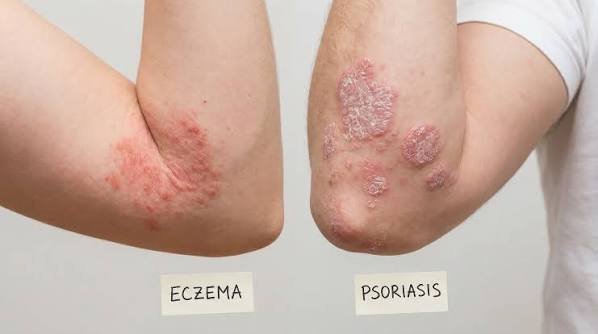
A red, itchy and flaky patch of skin can look like a simple case of dryness, but several skin conditions can produce a similar appearance. Two commonly confused conditions are eczema and psoriasis. Both can cause inflammation, itching and recurring flare-ups, yet they develop through different biological processes and may require different treatment approaches.
Eczema, particularly atopic dermatitis, is associated with problems involving the skin barrier and immune system. Psoriasis is an immune-mediated disease in which skin-cell turnover becomes unusually rapid, producing characteristic areas of inflamed, thickened and scaly skin.
Appearance can provide clues, but photographs and symptom lists are not always enough to distinguish them. A dermatologist can assess persistent or uncertain rashes and determine the appropriate treatment.
Eczema vs Psoriasis: Quick Comparison
| Factor | Eczema | Psoriasis |
|---|---|---|
| Common form | Atopic dermatitis | Plaque psoriasis |
| Typical appearance | Dry, inflamed, irritated skin | Well-defined, thickened, scaly plaques |
| Itching | Often prominent | Common, but varies |
| Scale | May be dry or flaky | Often thicker and more noticeable |
| Common areas | Varies with age; often skin folds | Commonly elbows, knees, scalp and trunk |
| Can affect children? | Yes, commonly | Yes, although often develops later |
| Contagious? | No | No |
| Immune system involved? | Yes | Yes |
| Treatment identical? | No | No |
| Can symptoms come and go? | Yes | Yes |
What Is Eczema?
“Eczema” describes several inflammatory skin conditions. One of the most common is atopic dermatitis.
Atopic dermatitis involves a combination of:
- Skin-barrier dysfunction
- Immune-system activity
- Genetic susceptibility
- Environmental influences
The skin barrier normally helps retain moisture and protects the body from environmental irritants.
When that barrier does not work effectively, skin can lose moisture more easily and become more vulnerable to irritation.
This can result in dryness, inflammation and significant itching.
What Is Psoriasis?
Psoriasis is a chronic immune-mediated condition.
Immune activity causes skin cells to turn over much faster than usual. The resulting accumulation contributes to characteristic plaques.
Plaque psoriasis, the most common type, often causes areas of skin that are:
- Raised
- Inflamed
- Well defined
- Covered with scale
Psoriasis is not simply “very dry skin.” It is a systemic immune-mediated disease that can sometimes be associated with health problems beyond the skin.
1. Eczema Often Causes Intense Itching
Itching is one of the hallmark symptoms of atopic dermatitis.
For some people, itching can become severe enough to interfere with sleep and normal activities.
Scratching then creates a cycle:
Itching → scratching → skin damage → greater inflammation → more itching
Repeated scratching can make skin thicker over time and increase the risk of skin injury or infection.
Reducing itch and repairing the skin barrier are therefore important parts of eczema management.
2. Psoriasis Often Produces More Defined Plaques
Plaque psoriasis often has relatively clear borders between affected and unaffected skin.
The plaques may feel thicker than the surrounding skin and develop visible scale.
Common locations include:
- Elbows
- Knees
- Scalp
- Lower back or trunk
However, psoriasis does not look identical in everyone.
Appearance can vary with psoriasis type, location, skin tone and previous treatment.
3. Eczema Commonly Affects Skin Folds
The distribution of atopic dermatitis can change with age.
In older children and adults, eczema commonly affects flexural areas such as:
- Inside the elbows
- Behind the knees
- Neck
- Hands
Infants may have a different distribution.
Psoriasis more classically affects extensor surfaces such as the outside of elbows and knees.
These patterns can help with diagnosis, but they are not absolute rules.
4. Both Can Affect the Scalp
An itchy, flaky scalp does not automatically mean dandruff.
Both eczema-related conditions and psoriasis can involve the scalp.
Scalp psoriasis can produce thicker, more defined areas of scaling and may extend beyond the hairline.
Several other scalp disorders can look similar, so persistent or severe scalp scaling may require a professional diagnosis before treatment.
5. Psoriasis Can Affect the Nails
Nail changes provide another clue.
Psoriasis can affect fingernails and toenails and may cause:
- Small pits
- Changes in colour
- Thickening
- Separation of the nail from its bed
Not everyone with psoriasis develops nail changes, and nail abnormalities have many other possible causes.
A dermatologist can distinguish psoriasis-related nail disease from fungal infections and other conditions.
6. Eczema Can Sometimes Ooze or Crust
During an eczema flare, inflamed skin may become very irritated.
Scratching can damage the skin and, in some cases, affected areas may become weepy or crusted.
This is important because damaged eczema-prone skin can also develop a secondary infection.
Increasing pain, warmth, swelling, pus, rapidly worsening redness or other signs of infection require medical attention.
7. What Triggers Eczema Flare-Ups?
Eczema triggers vary between individuals.
Possible triggers or aggravating factors include:
- Harsh soaps
- Fragranced skin products
- Dry weather
- Heat and sweating
- Certain fabrics
- Skin irritants
- Stress
- Allergens in some individuals
Not every person has the same triggers.
Trying to eliminate large numbers of foods without medical evidence is generally not a good eczema strategy, particularly for children and teenagers who need adequate nutrition for growth.
Suspected food allergy should be discussed with an appropriate healthcare professional.
8. What Can Trigger Psoriasis Flares?
Psoriasis can also fluctuate over time.
Potential triggers include:
- Infections
- Stress
- Skin injury
- Certain medicines
- Other individual factors
Skin trauma can sometimes cause psoriasis to appear at the site of injury, a phenomenon known as the Koebner phenomenon.
Understanding personal patterns can help with management, although not every flare has an obvious trigger.
9. Are Eczema and Psoriasis Contagious?
No.
You cannot catch either condition by:
- Touching affected skin
- Sharing a room
- Hugging someone
- Sitting next to them
- Using the same swimming pool
Visible skin conditions can unfortunately attract unnecessary stigma.
Neither eczema nor psoriasis reflects poor hygiene, and neither can be transmitted through ordinary contact.
10. How Is Eczema Treated?
Eczema treatment generally focuses on repairing the skin barrier, controlling inflammation and reducing triggers.
Moisturisers
Regular moisturising is a major part of eczema care.
Thicker, fragrance-free creams or ointments can help reduce water loss from the skin and support the damaged barrier.
Applying moisturiser after bathing can help retain moisture.
Topical corticosteroids
During inflammatory flares, doctors commonly prescribe or recommend topical corticosteroids of an appropriate strength.
Different areas of the body require different treatment considerations, so stronger is not automatically better.
Other prescription treatments
Depending on severity and location, clinicians may use other topical anti-inflammatory medicines.
Moderate or severe eczema that cannot be controlled adequately with topical treatment may sometimes require phototherapy, injectable biologic medicines or other systemic treatments under specialist care.
11. How Is Psoriasis Treated?
Psoriasis treatment depends on:
- Type of psoriasis
- Severity
- Body areas involved
- Age
- Other medical conditions
- Effect on daily life
Topical treatments
Mild or limited psoriasis may be treated with prescription topical medicines.
Options can include corticosteroids and other medicines that affect skin inflammation and cell turnover.
Phototherapy
Controlled ultraviolet-light treatment may be appropriate for some patients.
Medical phototherapy is different from simply spending excessive time in the sun.
Systemic medicines
Moderate-to-severe psoriasis may require medicines that work throughout the body.
These can include traditional systemic treatments and targeted biologic medicines.
Such treatments require medical supervision because their benefits, risks and monitoring requirements differ.
12. Why You Shouldn’t Use Someone Else’s Steroid Cream
A cream that helped another person’s rash may be completely inappropriate for yours.
Topical corticosteroids come in different strengths, and their safe use depends on factors such as:
- Body location
- Age
- Diagnosis
- Duration of treatment
- Severity
Using a potent steroid incorrectly can cause side effects.
More importantly, some infections can resemble eczema, and applying steroid medication without the correct diagnosis may complicate the problem.
13. Psoriasis Can Affect More Than the Skin
Some people with psoriasis develop psoriatic arthritis, an inflammatory condition affecting joints.
Possible symptoms can include:
- Joint pain
- Swelling
- Stiffness
- Changes involving fingers or toes
Not every person with psoriasis develops arthritis.
However, someone with psoriasis who develops persistent joint symptoms should tell their healthcare professional because earlier assessment can be important.
14. Can Eczema and Psoriasis Be Diagnosed From Appearance Alone?
Sometimes an experienced clinician can make the diagnosis by examining the skin and asking about symptoms.
However, there can be considerable overlap.
Other conditions can also mimic either disorder, including:
- Fungal infections
- Contact dermatitis
- Seborrhoeic dermatitis
- Other inflammatory skin conditions
Occasionally, additional testing or a small skin biopsy may be needed when the diagnosis remains uncertain.
This is why persistent rashes should not automatically be labelled eczema based on photographs found online.
Which One Do You Have?
Certain patterns provide clues.
Eczema may be more likely when:
- Itching is particularly intense.
- Skin is very dry and irritated.
- The rash commonly affects skin folds.
- Symptoms began during childhood.
- Irritants such as soaps repeatedly trigger flares.
Psoriasis may be more likely when:
- Patches are thicker and clearly defined.
- There is prominent scaling.
- Elbows, knees or scalp are affected.
- Nail pitting or other characteristic nail changes occur.
- There is a known family history of psoriasis.
These are tendencies rather than diagnostic rules.
Some people can even have features of more than one skin disorder.
When Should You See a Dermatologist?
Consider professional assessment if:
- A rash keeps returning.
- Symptoms are not improving with basic skin care.
- Itching interferes with sleep.
- Large areas of skin are affected.
- The diagnosis is uncertain.
- There are significant nail changes.
- Psoriasis is accompanied by joint pain or swelling.
- A child has persistent or severe eczema.
Prompt medical attention is appropriate if skin becomes rapidly more painful, swollen or warm, develops pus or extensive crusting, or is accompanied by fever or other signs suggesting infection.
Eczema and Psoriasis Need Different Management
Eczema and psoriasis share several visible features, but they are not interchangeable diagnoses.
Eczema commonly involves impaired skin-barrier function and often causes intense itching and dry, inflamed skin. Psoriasis is an immune-mediated condition that commonly produces more clearly defined, thickened and scaly plaques.
Both can recur, and neither is contagious.
Treatment also differs. Moisturising and barrier care are central to eczema management, while psoriasis treatment often focuses more directly on controlling abnormal immune activity and excessive skin-cell turnover. Prescription anti-inflammatory treatments can play roles in both, but the specific medicines and treatment plans differ.
If a rash is persistent, spreading, unusually painful or simply difficult to identify, getting the diagnosis right is more useful than repeatedly trying different creams.
FAQs
Q1. What is the main difference between eczema and psoriasis?
A. Eczema, particularly atopic dermatitis, involves skin-barrier dysfunction and immune inflammation and commonly causes very itchy, dry skin. Psoriasis is an immune-mediated disease that often produces well-defined, thickened, scaly plaques.
Q2. Which is itchier, eczema or psoriasis?
A. Both can itch, but intense itching is particularly characteristic of eczema. The severity varies considerably between individuals, so itching alone cannot establish the diagnosis.
Q3. Can eczema turn into psoriasis?
A. Eczema does not simply transform into psoriasis. They are different inflammatory skin conditions, although their appearances can sometimes overlap and a person can potentially have more than one skin disorder.
Q4. Are eczema and psoriasis contagious?
A. No. Neither eczema nor psoriasis can be transmitted through touching, hugging, sharing spaces or other ordinary contact.
Q5. When should I see a dermatologist for a skin rash?
A. See a dermatologist when a rash is persistent, recurrent, widespread, interfering with sleep or not responding to appropriate basic care. Prompt assessment is important when there are signs of infection, rapidly worsening symptoms or psoriasis accompanied by persistent joint pain or swelling.