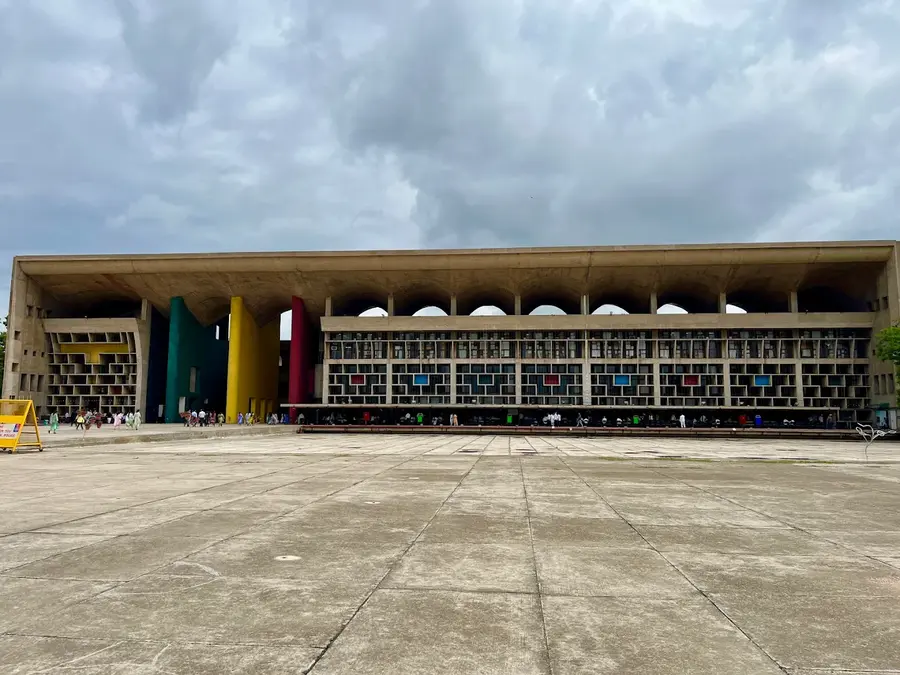
The Punjab and Haryana High Court — commonly referred to as the Chandigarh High Court owing to its location in India’s most architecturally celebrated planned city — is one of the most distinguished and historically significant superior courts in the Indian judicial system. Serving as the common High Court for the states of Punjab and Haryana and the Union Territory of Chandigarh, it exercises jurisdiction over a combined population of over 55 million citizens spread across two of India’s most agriculturally productive and economically dynamic states. The court’s building — the iconic Palace of Justice, designed by legendary French-Swiss architect Le Corbusier — is not only a judicial institution of the highest national importance but a UNESCO World Heritage Site recognised globally as one of the finest examples of modern architecture in the world. From its origins in pre-partition Lahore through a journey that passed through Shimla and ultimately arrived in Chandigarh, this court carries one of Indian judicial history’s most remarkable institutional stories.
History and Establishment
The roots of the Punjab and Haryana High Court trace back to March 21, 1919, when the Lahore High Court was established under the Government of India Act, 1915, with jurisdiction over undivided Punjab and Delhi. Following the partition of India in 1947, the East Punjab High Court was established at Shimla on August 15, 1947, under the Indian Independence Act. Due to challenging weather conditions that made Shimla inconvenient for litigants during winter, the court was relocated to Chandigarh, beginning operations at its present building on January 17, 1955 — with India’s first Prime Minister Jawaharlal Nehru inaugurating the new premises on March 19, 1955. Nehru famously declared at the inauguration that Chandigarh should be a new town symbolic of the freedom of India, unfettered by traditions of the past — a vision embodied by the court’s modernist Palace of Justice.
The Punjab Reorganisation Act of 1966 created the state of Haryana and the Union Territory of Chandigarh from November 1, 1966, and the High Court of Punjab was formally renamed the High Court of Punjab and Haryana from that date, serving both states and the Union Territory from its seat in Chandigarh. The court completed its Golden Jubilee — 50 years of existence — on March 19, 2005, marking five decades of distinguished judicial service.
Jurisdiction and Powers
The Punjab and Haryana High Court exercises appellate and supervisory jurisdiction over all courts and tribunals in Punjab, Haryana, and the Union Territory of Chandigarh. Its writ jurisdiction under Articles 226 and 227 of the Constitution empowers the court to issue writs of habeas corpus, mandamus, certiorari, prohibition, and quo warranto — the foundational constitutional instruments for protecting fundamental rights and ensuring governmental accountability across both states and the Union Territory simultaneously.
The court’s criminal jurisdiction extends across both states and Chandigarh under the Code of Criminal Procedure, hearing appeals, revisions, and bail matters in criminal cases. Its civil jurisdiction encompasses appeals from subordinate civil courts, and civil judges across Punjab, Haryana, and Chandigarh exercise unlimited pecuniary jurisdiction at the subordinate level — meaning any civil suit of any value can originate before the civil judge. The court also exercises jurisdiction over service matters of employees from both state governments and Chandigarh administration, intellectual property disputes, and arbitration matters arising within its territorial jurisdiction.
Structure, Composition, and Key Facts
|
Dimension |
Detail |
|
Present form operational since |
November 1, 1966 |
|
Historical origin |
Lahore High Court — March 21, 1919 |
|
Location |
Sector 1, Chandigarh |
|
Building name |
Palace of Justice |
|
Architect |
Le Corbusier — French-Swiss |
|
UNESCO recognition |
World Heritage Site — July 2016 |
|
Sanctioned judge strength |
85 (64 Permanent + 21 Additional including Chief Justice) |
|
Courtrooms |
40 spacious courtrooms |
|
Jurisdiction |
Punjab, Haryana, UT of Chandigarh |
|
Bar rooms |
3 dedicated bar rooms |
|
Library |
Well-equipped Judges’ library |
The court operates through Division Benches for constitutional matters and larger appeals, and Single Benches for first instance matters and routine writ petitions. Judges are appointed through the Supreme Court collegium process from senior advocates of the bar and from the judicial services of Punjab and Haryana. The court has produced judges elevated to the highest judicial offices in India — including Justice Sarv Mittra Sikri, who was the first advocate directly elevated from the Punjab and Haryana High Court bar to the Supreme Court in 1964 and subsequently became Chief Justice of India in 1971.
Architectural Magnificence and Public Interest
|
Architectural Feature |
Significance |
|
Designed by Le Corbusier |
World-renowned French-Swiss architect — Chandigarh Capitol Complex project |
|
UNESCO World Heritage Site |
Declared July 2016 — celebrates contribution to modern architecture |
|
Symbol of India’s freedom |
Supported by PM Nehru as an expression of independent India’s aspirations |
|
Elevation |
365 metres above sea level — foothills of the Shivalik Range |
|
Museum within premises |
Displays rare documents and artifacts of the court’s history |
|
Tourist destination |
Visited by architecture students and enthusiasts from across the world |
The Palace of Justice is one of the most visited architectural landmarks in Chandigarh — a city celebrated globally as the first planned city of independent India. Architecture students from across the world visit the court building to study its modernist design principles — the bold concrete brise-soleil sun shades, the sweeping roof structure, and the integration of art, symbolism, and judicial function that Le Corbusier wove into every dimension of the building. The official emblem of Chandigarh displayed in metal beside the High Court represents the city’s spirit — Open to give, Open to receive — a philosophy that the court’s judicial service to millions of citizens across two states and one Union Territory embodies.
Frequently Asked Questions
Q1. What is the Chandigarh High Court officially called?
It is officially known as the Punjab and Haryana High Court. It is commonly called the Chandigarh High Court because it is located in Chandigarh.
Q2. When was the Punjab and Haryana High Court established in its present form?
The court has been operating in its present form since November 1, 1966, when the Punjab Reorganisation Act created Haryana and the Union Territory of Chandigarh.
Q3. Where is the Chandigarh High Court located?
It is located in Sector 1 of Chandigarh, on the foothills of the Shivalik Range, approximately 365 metres above sea level.
Q4. Who designed the Punjab and Haryana High Court building?
The court building, known as the Palace of Justice, was designed by world-renowned French-Swiss architect Le Corbusier as part of the Capitol Complex project for Chandigarh.
Q5. Is the Punjab and Haryana High Court a UNESCO World Heritage Site?
Yes. The court building and several other Le Corbusier works in Chandigarh were inscribed as UNESCO World Heritage Sites in July 2016 for their architectural significance.
Q6. What is the sanctioned judge strength of the Punjab and Haryana High Court?
The sanctioned strength is 85 judges — comprising 64 Permanent Judges and 21 Additional Judges, including the Chief Justice.
Q7. Which states and territories fall under the court’s jurisdiction?
The court exercises jurisdiction over the states of Punjab and Haryana and the Union Territory of Chandigarh, making it a common High Court for three distinct constitutional entities.
Q8. How many courtrooms does the Punjab and Haryana High Court have?
The court has 40 spacious and well-furnished courtrooms alongside 3 bar rooms, a Judges’ library, dispensary, and canteen.
Q9. What is the historical origin of the court before 1966?
The court traces its origins to the Lahore High Court established in 1919, then the East Punjab High Court at Shimla from 1947, before shifting to Chandigarh in 1955 and being renamed the Punjab and Haryana High Court in 1966.
Q10. Can judgments of the Punjab and Haryana High Court be appealed?
Yes. Judgments of the court can be appealed to the Supreme Court of India through statutory appeal where provided by law, or through a Special Leave Petition under Article 136 of the Constitution.