The District Court Dehradun — the apex trial court for the Dehradun district in the state of Uttarakhand and the most significant district court in the state capital — is the judicial hub of a city that simultaneously serves as the state capital of Uttarakhand, the home of the Uttarakhand High Court at nearby Nainital, and one of India’s most important centres of education, defence research, and survey institutions. Under the administrative and supervisory control of the High Court of Uttarakhand at Nainital, the Dehradun District Court exercises civil and criminal jurisdiction over the state’s largest and most populous district. The court derives its civil jurisdiction primarily from the Bengal, Agra and Assam Civil Courts Act of 1887 — one of the oldest pieces of civil court legislation still in active application in independent India. In a significant development, the construction of a new District Court Complex at Dehradun with 59 courtrooms is now almost complete — a forthcoming infrastructure milestone that will establish Dehradun with one of the largest dedicated district court complexes in the Himalayan state.
History
Uttarakhand — carved out of the hill districts of Uttar Pradesh on November 9, 2000 — brought with it a district judiciary whose history is rooted in the judicial infrastructure established under the United Provinces before the state’s bifurcation. The city of Dehradun carries a colonial administrative pedigree befitting a city that was the Survey of India headquarters, the Forest Research Institute campus, and the location of major defence academic institutions. The District Court Dehradun has been the primary trial court for the region spanning from the Doon Valley to the high altitude Chakrata sub-division — a geography that encompasses tea gardens, cantonments, academic campuses, and mountain terrain within a single judicial jurisdiction.
Uttarakhand district courts are established by the State Government in consultation with the High Court, taking into account the number of cases, topography of the place, and population distribution — a tripartite consideration that reflects the unique challenges of judicial administration in a state where mountain geography makes case filing and court attendance genuinely physically demanding for many litigants. The three-tier court structure across Uttarakhand — District and Sessions Judge at the apex, Additional District and Sessions Judges at the intermediate level, and Civil Judges and Judicial Magistrates at the base — mirrors the standard national pattern while being particularly shaped by Dehradun’s role as the state’s administrative capital with the greatest diversity of institutional litigation.
Structure and Composition
| Dimension | Detail |
| State created | November 9, 2000 — carved from Uttar Pradesh |
| Location | Dehradun, Uttarakhand — state capital |
| High Court supervision | High Court of Uttarakhand at Nainital |
| Civil jurisdiction legislation | Bengal, Agra and Assam Civil Courts Act, 1887 |
| Court structure | Three-tier — DSJ, Additional DSJ, Civil Judge/Judicial Magistrate |
| Civil Judge (S.D.) pecuniary jurisdiction | Unlimited |
| Family Court | Established at Dehradun — one of five districts |
| Labour Courts | Established at Dehradun — industrial and employment disputes |
| State Consumer Commission | Located in Dehradun |
| State Transport Appellate Tribunal | Located in Dehradun |
| Commercial Court | Established at Dehradun |
| New Complex | 59 courtrooms — construction near complete |
| Legal Aid | District Legal Services Authority — under District Judge’s chairmanship |
| Digital services | eCourts — video conferencing, SMS/email alerts, e-filing |
Architecture — New 59-Courtroom Complex
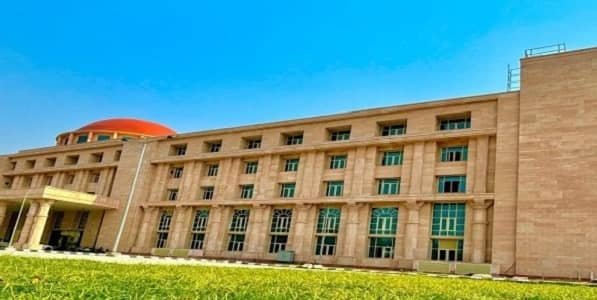
The current District Court Dehradun complex has served the judicial needs of Uttarakhand’s capital district across the decades since the state’s formation in 2000, with courts distributed across the district headquarters and outlying tehsil courts at Vikasnagar and other sub-divisional areas. A landmark development is imminent — the construction of a new District Court Complex at Dehradun with 59 courtrooms is almost complete and its inauguration is proposed, according to the High Court of Uttarakhand’s Infrastructure Development updates. This new complex — in addition to the completion of a two-courtroom complex at Vikasnagar — will represent the most significant upgrade to Dehradun’s district court physical infrastructure since the state’s formation.
Dehradun’s unique institutional character as the seat of the State Consumer Disputes Redressal Commission, the State Transport Appellate Tribunal, the Commercial Trade Tax Tribunal, the Cooperative Tribunal, and the Public Services Tribunal — all located within the same city — gives the Dehradun judicial ecosystem a depth and complexity unmatched in any other Uttarakhand district. The State Legal Services Authority is also situated in the premises of the High Court at Nainital but administers legal aid work across all district courts including Dehradun through the District Legal Services Authority chaired by the District Judge.
Frequently Asked Questions
Q: Which state’s district court system does the Dehradun District Court belong to?
A: Uttarakhand — the state carved from Uttar Pradesh on November 9, 2000.
Q: Which legislation governs civil court jurisdiction in Dehradun?
A: The Bengal, Agra and Assam Civil Courts Act of 1887 — one of India’s oldest continuing civil court statutes.
Q: Which High Court supervises the Dehradun District Court?
A: The High Court of Uttarakhand at Nainital.
Q: What is the significant upcoming infrastructure development?
A: A new District Court Complex with 59 courtrooms is near completion and awaiting inauguration.
Q: Where is the Family Court at Dehradun located?
A: Within the Dehradun district judicial campus — one of five Uttarakhand districts with a dedicated Family Court.
Q: What state-level tribunals are located in Dehradun?
A: The State Consumer Disputes Redressal Commission, State Transport Appellate Tribunal, Commercial Trade Tax Tribunal, Cooperative Tribunal, and Public Services Tribunal.
Q: What digital facilities are available?
A: Video conferencing under the Uttarakhand High Court Video Conferencing Rules-2020, SMS and email case alerts, and eCourts Mission Mode Project services.