A small packet of roasted chana and a handful of peanuts are two of the simplest snacks available in India. Neither needs refrigeration, both travel easily, and both provide considerably more nutritional value than snacks made mainly from refined flour or added sugar. Yet they are not nutritionally interchangeable.
Roasted chana is a pulse-based snack that provides plant protein, fibre and carbohydrates with relatively little fat. Peanuts are technically legumes too, but nutritionally they behave more like nuts: they contain substantial protein along with much more fat, mostly unsaturated, and are therefore more energy-dense.
Roasted chana is particularly useful when you want a crunchy, fibre-rich everyday snack, while peanuts provide protein, healthy fats and more energy in a smaller portion. Which is better depends on what you want from the snack.
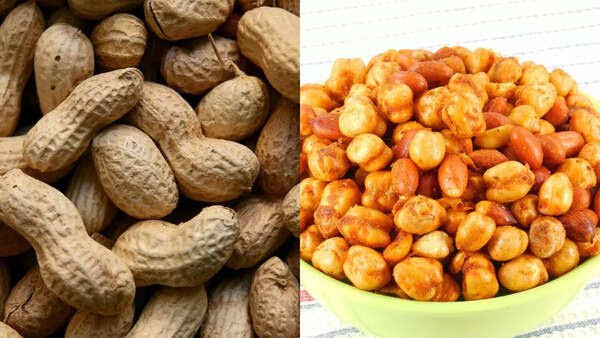
Roasted Chana vs Peanuts: Quick Comparison
| Feature | Roasted Chana | Peanuts |
|---|---|---|
| Food type | Roasted chickpea/Bengal gram | Legume commonly used like a nut |
| Protein | Good plant source | High for a plant food |
| Fibre | High | Good source |
| Fat | Relatively low | High, mainly unsaturated |
| Energy density | Lower | Higher |
| Carbohydrates | Higher | Lower |
| Portability | Excellent | Excellent |
| Preparation needed | None | None if roasted |
| Common concern | Added salt/seasoning | Added salt, frying and allergy |
| Best for | Fibre-rich everyday snacking | Protein, fats and energy |
Exact nutrition varies according to variety, processing, roasting method and added ingredients.
What Is Roasted Chana?
Roasted chana is generally made from Bengal gram/chickpeas that are roasted until dry and crunchy.
It is widely available across India and may be sold:
- Plain
- Salted
- With the outer skin
- Without the skin
- With masala seasoning
Plain roasted chana is a relatively simple snack.
Because much of its water has been removed during roasting, its nutrients become concentrated compared with cooked chickpeas.
It provides a combination of:
- Plant protein
- Fibre
- Complex carbohydrates
- Iron
- Folate
- Other minerals
The exact nutrient content depends on the type of chana and processing.
What Are Peanuts?
Despite their name and culinary treatment, peanuts are legumes rather than true tree nuts.
They grow underground and belong to the same broad botanical family as beans and peas.
Nutritionally, however, peanuts differ significantly from most beans because they contain much more fat.
Most peanut fat is unsaturated.
Peanuts also provide:
- Protein
- Fibre
- Vitamin E
- Niacin
- Magnesium
- Other micronutrients
They can be eaten roasted, boiled or incorporated into dishes, chutneys and spreads.
1. Protein
Winner: Peanuts per 100 grams, generally
Peanuts are particularly protein-rich for a plant food.
Roasted chana also provides substantial protein, making it a useful pulse-based snack.
Per 100 grams, peanuts commonly contain more protein than roasted chana, although exact numbers vary by product.
However, 100 grams of peanuts is a fairly substantial serving because peanuts are energy-dense.
A more realistic snack comparison should therefore consider the amount actually eaten rather than protein per 100 grams alone.
Both can contribute useful plant protein.
2. Fibre
Winner: Roasted chana, generally
Roasted chana is particularly useful as a fibre-containing snack.
Chana with its outer covering intact can retain considerable fibre.
Peanuts provide fibre too, but roasted chana commonly has the advantage when fibre is the main comparison.
This is one reason roasted chana can feel surprisingly substantial despite its simple appearance.
Fibre contributes to normal digestive function and can help make meals and snacks satisfying.
3. Fat
Winner depends on what you mean by “better”
This is where the two snacks differ dramatically.
Roasted chana is relatively low in fat.
Peanuts naturally contain a large amount of fat.
But describing peanuts simply as “high fat” misses an important point: much of their fat is unsaturated.
Unsaturated fats can form part of a balanced diet.
Therefore:
Roasted chana is useful when you want a lower-fat pulse snack.
Peanuts are useful when you want a food providing plant protein plus unsaturated fats.
Neither characteristic automatically makes one healthier than the other.
4. Calories and Energy Density
Winner: Depends on your needs
Peanuts contain considerably more energy per gram because of their high fat content.
Fat provides more energy per gram than protein or carbohydrate.
This makes peanuts a compact source of energy.
Roasted chana is generally less energy-dense and provides more of its energy through carbohydrates and protein.
That does not mean everyone should automatically select the lower-calorie option.
Children, teenagers, active people and others need adequate dietary energy as well as nutrients.
The sensible approach is choosing a suitable portion and looking at the overall diet rather than treating calories as something that must always be minimised.
5. Carbohydrates
Winner: Neither
Roasted chana contains considerably more carbohydrate than peanuts.
Peanuts contain fewer carbohydrates because a much larger proportion of their energy comes from fat.
But lower carbohydrate does not automatically mean better.
Chana’s carbohydrates come packaged with protein, fibre and micronutrients.
Carbohydrates are also a normal energy source.
The important distinction is between nutrient-rich foods containing carbohydrates and foods dominated by refined starches or added sugars.
6. Satiety
Winner: Both can be satisfying
Roasted chana combines protein and fibre.
Peanuts combine protein, fibre and substantial fat.
All of these can contribute to a satisfying snack.
The experience is slightly different.
Roasted chana allows a relatively substantial crunchy portion without the energy density of peanuts.
Peanuts pack considerably more energy into a smaller quantity.
Your appetite and the time until your next meal can help determine which snack makes more sense.
7. Micronutrients
Winner: Both, but for different nutrients
Neither food should be viewed only as protein.
Chana can contribute nutrients such as:
- Iron
- Folate
- Magnesium
- Other minerals
Peanuts can contribute:
- Vitamin E
- Niacin
- Magnesium
- Other B vitamins and minerals
Exact amounts depend on the product and processing.
Eating different plant foods is therefore more useful than expecting one snack to supply every micronutrient.
8. Salted vs Unsalted
Winner: Plain or lightly seasoned versions
The base ingredient is only half of the comparison.
Commercial roasted chana and peanuts may contain considerable added salt.
Flavoured varieties can also contain:
- Added oils
- Sugar
- Seasoning mixes
- Other additives
Check the ingredient list rather than assuming every roasted product has the same nutritional profile.
Plain roasted peanuts and plain roasted chana make the comparison much simpler.
If salt intake is a consideration, compare sodium on the nutrition label.
9. Dry-Roasted vs Fried
Winner: Dry-roasted for simpler everyday snacking
Roasting and frying are not the same thing.
Dry-roasted peanuts or chana can be prepared without large quantities of added oil.
Fried versions absorb or carry additional cooking fat.
This does not mean fried foods can never be eaten, but it changes the nutritional comparison.
When choosing an everyday packaged snack, look for how the product has actually been prepared.
Words such as “chana” or “peanut” on the front of the packet do not tell the complete story.
10. Convenience
Winner: Tie
Both are excellent portable snacks.
They require:
- No cooking when purchased roasted
- No refrigeration for short-term carrying when properly stored
- Very little space
- No cutlery
That makes them convenient for school, travel or an afternoon snack where appropriate.
They can also be combined.
A homemade mixture of roasted chana and peanuts gives you the different nutritional strengths and textures of both foods.
11. Cost
Winner: Depends on local prices
Both roasted chana and peanuts are widely available in India and can be relatively economical compared with many heavily marketed packaged snacks.
Prices depend on:
- Region
- Quality
- Brand
- Package size
- Seasoning
- Processing
Buying plain products in larger economical packs can sometimes cost less than purchasing small branded flavoured packets.
Price per serving is more useful than simply comparing package prices.
12. Peanut Allergy Is an Important Difference
Important consideration: Peanuts
Peanuts are a major food allergen.
For someone with a peanut allergy, peanuts are not an appropriate snack regardless of their nutritional benefits.
Allergic reactions can be serious.
People with diagnosed food allergies should follow their healthcare professional’s advice and carefully check ingredient and cross-contamination information on packaged foods.
Roasted chana is not a substitute that can automatically be assumed safe for every person with allergies either, because individual allergies and manufacturing cross-contact can vary.
Roasted Chana or Peanuts: Which Should You Choose?
Choose roasted chana if:
- You want a fibre-rich snack.
- You prefer a relatively lower-fat option.
- You enjoy a crunchy pulse-based snack.
- You want plant protein plus complex carbohydrates.
- You want something easy to carry.
Choose peanuts if:
- You want a protein-rich snack.
- You want unsaturated fats.
- You need a compact source of dietary energy.
- You enjoy peanuts as part of Indian snacks or meals.
- You do not have a peanut allergy.
For many people, there is no reason to choose only one.
Can You Eat Roasted Chana and Peanuts Together?
Yes.
In fact, combining them can make a practical snack mix.
Roasted chana contributes plenty of crunch, fibre, carbohydrates and protein, while peanuts contribute additional protein and unsaturated fats.
Other ingredients can be added according to preference, such as suitable spices or other foods.
The advantage of a simple homemade mixture is that you control the amount of added salt, oil and seasoning.
The combination also demonstrates why snack foods do not always need a single winner.
What Makes the Better Everyday Snack?
If the priority is fibre and a relatively lower-fat snack, roasted chana has the advantage.
If the priority is protein combined with unsaturated fats and compact energy, peanuts have the advantage.
For an ordinary everyday diet, both can be useful.
What matters more is replacing the idea of a “perfect snack” with a varied eating pattern. Fruit, curd, roasted pulses, nuts, peanuts and other appropriate foods can all provide different nutrients.
A plain roasted chana snack one day and peanuts on another can provide more variety than repeatedly eating either simply because it wins one nutritional category.
FAQs
Q1. Which has more protein, roasted chana or peanuts?
A. Peanuts generally contain more protein per 100 grams than roasted chana. However, peanuts are also much more energy-dense because they contain substantially more fat, so realistic serving sizes should be considered.
Q2. Which has more fibre, roasted chana or peanuts?
A. Roasted chana generally has an advantage for fibre, particularly when the outer covering is retained. Peanuts also provide dietary fibre.
Q3. Are peanuts unhealthy because they are high in fat?
A. No. Peanuts naturally contain substantial fat, but much of it is unsaturated. They also provide protein, fibre and micronutrients. Portion size and the overall diet are more useful considerations than labelling a food unhealthy simply because it contains fat.
Q4. Is roasted chana good for everyday snacking?
A. Plain roasted chana can be a practical everyday snack because it provides plant protein, fibre and carbohydrates and is easy to carry. Packaged versions should be checked for added salt, oil and seasonings.
Q5. Can roasted chana and peanuts be eaten together?
A. Yes. Combining them creates a simple snack containing protein, fibre, carbohydrates and unsaturated fats. A plain or lightly seasoned homemade mix also allows better control over added salt and oil.