The District Court Gurugram — the apex trial court for the Gurugram Sessions Division in Haryana — is one of India’s most commercially strategic district courts, serving India’s most prominent corporate and technology hub. Under the oversight of the Punjab and Haryana High Court at Chandigarh, the court exercises civil and criminal jurisdiction across a district that hosts hundreds of Fortune 500 companies, dozens of multinational technology campuses, the National Capital Region’s most extensive residential developments, and a rapidly growing population generating sophisticated commercial, property, and criminal litigation that demands a well-resourced and digitally progressive district judiciary.
History
In the early twentieth century, the district forming today’s Gurugram was part of Delhi Division. The Deputy Commissioner was subordinate to the Commissioner and Superintendent of Delhi Division in revenue and general administration, while criminal work fell under the Divisional and Sessions Judge, Delhi. In 1910, the District Judge was assisted by two Extra Assistant Commissioners functioning as Munsifs of the first class, with one Munsif stationed at Gurgaon. All Tehsildars were vested with Munsif powers of the third class.
Following territorial and administrative changes from 1912 to 1950, the district fell under the Hisar Sessions Division, with the District and Sessions Judge Hisar visiting Gurgaon for disposal of appellate civil and criminal work. In 1950, the district transferred to Karnal Sessions Division, and in 1955 to Rohtak Sessions Division, remaining there until October 1966. On November 1, 1966, the district became a full-fledged Sessions Division. Shri H.D. Loomba was posted as the first District and Sessions Judge at Gurgaon on November 1, 1966.
Gurugram was among the five districts of the then Punjab State where separation of judiciary from the executive was introduced in 1954 on an experimental basis — an experiment so successful it was extended to all remaining districts by 1964. The Judicial courts at Gurgaon shifted to the present building in 1975. District Mewat with headquarters at Nuh was declared a separate district on April 4, 2005, and Nuh became a separate Sessions Division from July 2013.
Structure and Composition
| Dimension | Detail |
| Sessions Division established | November 1, 1966 |
| First District and Sessions Judge | Shri H.D. Loomba |
| Present building occupied | 1975 |
| Location | Gurugram, Haryana |
| Jurisdiction | Gurugram Sessions Division |
| High Court supervision | Punjab and Haryana High Court, Chandigarh |
| Separation of judiciary | Experimental 1954 — extended statewide 1964 |
| Nuh separated | July 2013 — as separate Sessions Division |
| Court types | Civil, Criminal, Family, Special Courts |
| Bar Association | Gurugram District Bar Association |
| Digital infrastructure | e-Courts Mission Mode Project — e-filing, SMS alerts, CIS |
| Mediation | District Mediation Centre with Child Counsel and General Counsellors |
| Legal Aid | District Legal Services Authority — SBI Collect online portal |
Architecture and Modern Facilities
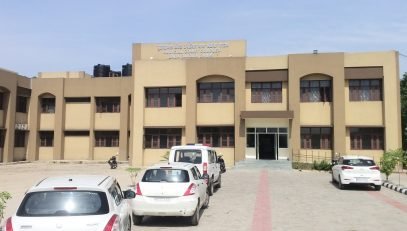
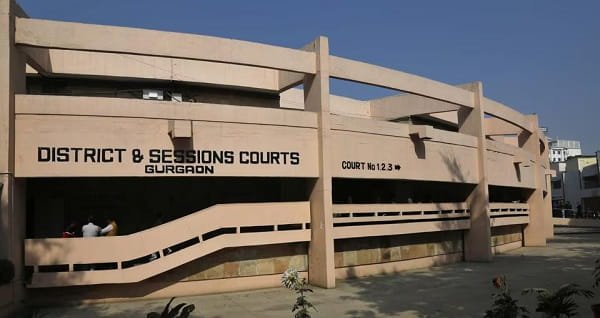
The District Court Gurugram complex is situated in the heart of the city and has been progressively developed since the courts shifted to the present building in 1975. The complex houses civil courts, criminal courts, family courts, and the District Legal Services Authority within a comprehensive judicial campus. The court’s setting in a city that has grown from a modest agricultural district to India’s largest corporate hub creates a unique jurisdictional character — the courts handle everything from rural agricultural land disputes to multi-crore commercial property litigation, from domestic violence cases in newly developed residential sectors to complex employment disputes involving multinational corporations.
The court has fully embraced the eCourts Mission Mode Project — providing litigants and advocates with SMS-based case status alerts, automated generation of summons, notices, and warrants through the Case Information System, and mandatory e-filing implemented from November 2024. The District Mediation Centre at Gurugram — staffed with Child Counsellors and General Counsellors — reflects the court’s commitment to alternative dispute resolution in a district where family and commercial disputes particularly benefit from mediation-based resolution. The District Legal Services Authority Gurugram has established an online cost deposit system through SBI Collect, enabling citizens to access legal aid services digitally without physical visits to the court premises.
Frequently Asked Questions
Q: When did Gurugram become an independent Sessions Division?
A: November 1, 1966.
Q: Who was the first District and Sessions Judge?
A: Shri H.D. Loomba — November 1, 1966.
Q: When did the courts shift to the present building?
A: 1975.
Q: Which High Court supervises the Gurugram District Court?
A: The Punjab and Haryana High Court, Chandigarh.
Q: When was Nuh carved out as a separate Sessions Division?
A: July 2013.
Q: What was historically significant about Gurugram’s judiciary?
A: It was one of only five Punjab districts where separation of judiciary from the executive was experimentally introduced in 1954 — a successful pilot extended statewide in 1964.
Q: What digital services are available?
A: e-Filing (mandatory from November 2024), SMS case alerts, automated summons generation via CIS, and online DLSA cost deposit through SBI Collect.
Q: What alternative dispute resolution facilities exist?
A: A District Mediation Centre with dedicated Child Counsellors and General Counsellors for family and civil dispute mediation.