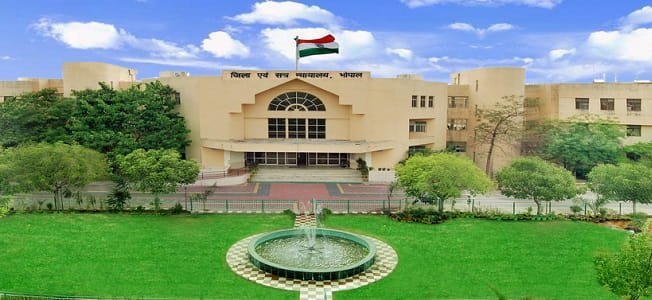
The District and Sessions Court Bhopal — the apex trial court for the Bhopal district in the state of Madhya Pradesh — serves the state capital of Madhya Pradesh, the City of Lakes, and one of India’s most historically layered cities whose identity spans Mughal-era Nawabi heritage, colonial administration, and the tragedy of the 1984 Bhopal gas disaster whose legal aftermath generated decades of consequential litigation. Bhopal district was carved out of the erstwhile Sehore District of Bhopal Division vide M.P. Government Notification No. 2477/1977/Sa/One/ dated September 13, 1972. The Bhopal District was officially carved out of the Sehore District on October 2, 1972. After separation from Sehore, the District and Sessions Court was established in Bhopal and its building was situated at Shahjahanabad. The court’s new building inaugurated in 2005 at Arera Hills has been hailed as one of the finest court buildings not only in India but also in Asia — a distinction that makes Bhopal’s district court architecture a landmark achievement in Indian judicial infrastructure. Under the Madhya Pradesh High Court, whose permanent Indore Bench serves the western districts, Bhopal falls directly under the principal seat at Jabalpur.
History
The judicial history of Bhopal is inseparable from the history of the Bhopal Nawabi State — a princely state that merged with the Union of India in 1950. Before Bhopal district was formally constituted in 1972, the region was part of the Sehore District, which itself carried a complex administrative history spanning the Bhopal Nawab’s rule. Under the Nawabi administration, Munsifi and Sub-judge courts functioned in the district — handling civil and criminal matters with revenue disputes resolved through Bhopal Land Revenue arrangements. When Madhya Pradesh was formed on November 1, 1956, the district’s judicial structure was reorganised within the new state’s court framework.
The formal constitution of Bhopal as a separate district on October 2, 1972 — with the District and Sessions Court initially housed in the historic Shahjahanabad area — marked the beginning of the court’s independent institutional identity. The decision to construct a new purpose-built judicial complex at Arera Hills reflected both the inadequacy of the Shahjahanabad premises and the ambition to give Madhya Pradesh’s capital city a district court commensurate with its administrative and political significance.
In 2005, a new court building was inaugurated at Arera Hills, Bhopal. This court, spread over approximately 7 acres, is a splendid work of architecture, hailed as one of the best court buildings not only in India but also in Asia.
Structure and Composition
| Dimension | Detail |
| Bhopal district carved out | October 2, 1972 — from Sehore District |
| Government notification | M.P. Govt. Notification No. 2477/1977/Sa/One/ dated September 13, 1972 |
| Original court building | Shahjahanabad area, Bhopal |
| New building inaugurated | 2005 — Arera Hills, Bhopal |
| New building area | Approximately 7 acres |
| New building distinction | Hailed as one of the best court buildings in India and Asia |
| High Court supervision | Madhya Pradesh High Court — principal seat Jabalpur |
| City identity | Capital of Madhya Pradesh — City of Lakes — Nawabi heritage |
| Historical context | Bhopal Nawabi State — merged with India on June 1, 1950 |
| Court types | District and Sessions Court, Additional District Courts, CJM Courts, Civil Judge Courts, Family Courts, POCSO Courts |
| Digital services | eCourts Mission Mode — e-filing, virtual hearings, CIS, NJDG data upload |
Architecture — Asia’s Finest Court Building
The Bhopal District Court’s new building at Arera Hills is one of India’s most celebrated examples of purpose-built judicial architecture — a 7-acre complex that has earned the recognition of being among the finest court buildings in Asia. The Arera Hills location — in one of Bhopal’s most prestigious residential and governmental zones — gives the court a setting befitting a state capital’s district court, with the city’s characteristic topography of hills and lakes creating a distinctive natural backdrop.
The complex’s architectural ambition reflects the scale of Bhopal’s judicial needs — as the state capital, Bhopal handles not only the district’s general civil and criminal litigation but also matters involving state government ministries, regulatory bodies, and the significant special court proceedings connected to the city’s prominent governance and industrial roles. The special Bhopal Gas Leak Disaster courts — constituted to adjudicate the civil and criminal proceedings arising from the December 1984 Union Carbide disaster — added a layer of nationally significant litigation to Bhopal’s district court landscape that few district courts in India have experienced.
The court’s digital infrastructure under the eCourts Mission Mode Project includes virtual hearing capabilities, e-filing, and case management systems that serve both the regular district court litigant population and the specialised court users engaged in the complex multi-party litigation that has characterised Bhopal’s judicial landscape.
Frequently Asked Questions
Q: When was the Bhopal District Court formally established?
A: October 2, 1972 — when Bhopal district was officially carved out of Sehore District.
Q: What was the government notification that created Bhopal district?
A: M.P. Government Notification No. 2477/1977/Sa/One/ dated September 13, 1972.
Q: Where was the original District Court building at Bhopal?
A: In the Shahjahanabad area of Bhopal.
Q: When was the new court building at Arera Hills inaugurated?
A: 2005.
Q: What is the area of the new Bhopal District Court complex?
A: Approximately 7 acres.
Q: What is the architectural distinction of the Bhopal District Court building?
A: It is hailed as one of the best court buildings not only in India but also in Asia.
Q: Which High Court supervises the Bhopal District Court?
A: The Madhya Pradesh High Court — with its principal seat at Jabalpur.
Q: What was the judicial structure before Bhopal became a separate district?
A: It was under the Sehore District, which itself was part of the Bhopal Nawabi State before the merger with India on June 1, 1950.