Nine square kilometres. That is all of Mahe — India’s smallest district by area, its sixth least populous, and arguably its most historically layered for its size. Wedged between Kannur district on three sides and Kozhikode on the fourth, sitting at the mouth of the Mahe River where it meets the Arabian Sea, Mahe is one of four districts of the Union Territory of Puducherry, though it is geographically rooted in Kerala’s Malabar coast.
The French called it Mahé. The Malayalam speakers who have always inhabited it call it Mayyazhi. It spent 232 years under French colonial rule — longer than any other territory in what is now India — and did not complete its merger with independent India until 1954, seven years after the rest of the country. The traces of that distinctive history are visible everywhere: in St. Teresa’s Church, built by missionaries in 1737; in the statue of Marianne at Tagore Park where approximately 70 French citizens still gather on Bastille Day; in the Museum at Government House where colonial relics and records survive. And they are invisible in a way too — in the tax structures that make Mahe a Union Territory enclave within Kerala, giving it different commercial rules that draw visitors from Kannur and Kozhikode for reasons that have nothing to do with history.
Mahe District, Puducherry — Quick Overview
| Feature | Details |
| Union Territory | Puducherry |
| Local Name | Mayyazhi (Malayalam) |
| Area | 8.69 sq km — India’s smallest district |
| Population | ~41,816 (2011 Census) |
| Location | North Malabar coast; between Kannur and Kozhikode |
| Borders | Kannur district (three sides), Kozhikode district (one side) |
| River | Mahe River (Mayyazhi Puzha) |
| Nearest Airport | Kannur International Airport (~35 km); Kozhikode International Airport (~86 km) |
| Nearest Railway Station | Thalassery (TLY) — 9 km from Mahe |
| Best Time to Visit | October to February |
| Summer Temperature | 28°C – 38°C |
| Monsoon | June to September — heavy |
| Winter Temperature | 20°C – 28°C |
| Language | Malayalam (primary); Tamil and Telugu also spoken |
| Key Festivals | Fete de Mahe, Thirayattam, Vishu, Onam |
History of Mahe District
The name Mahe itself carries historical debate. The most commonly accepted view is that it derives from Mayyazhi — the local Malayalam name for both the river and the town. An alternative theory credits the name to Bertrand François Mahé de La Bourdonnais (1699–1753), the French naval commander and administrator. The earliest French records from the mid-1720s spell it “Maye,” with “Mahe” and “Mahie” appearing on subsequent maps and documents before “Mahe” became standard.
Before the French, Mahe was part of Kolathu Nadu — a historic kingdom of the Malabar coast. The East India Company established a presence in the surrounding area, and British soldiers occupied Mahe at various points. The Rajah of Kadathanadu held control in 1761. The French returned in 1785 and held the territory through the colonial period.
What makes Mahe historically distinctive from other French Indian territories is the depth of French influence despite the town’s miniature size. The mission established by Christian missionary Ignatius A.S. Hippolytes in 1757 produced St. Teresa’s Church — one of the oldest Catholic churches on Kerala’s Malabar coast. The town became a formal French administrative post with a Governor’s residence, a treasury, and the full apparatus of French colonial governance applied to a territory of nine square kilometres.
The French left a physical and cultural imprint that persists. The Museum at Government House preserves relics, colonial records, and historical artifacts from the French period. And the roughly 70 French citizens who remain in Mahe — mostly retired soldiers and their descendants, organised as the “Union Des Françaises de Mahé” — continue to mark Bastille Day (July 14) with a procession from St. Teresa’s Church to the statue of Marianne at Tagore Park.
Top Attractions in Mahe District
St. Teresa’s Church (Mahe Church)
One of the most visited religious sites in the region, St. Teresa’s Church was built by Ignatius A.S. Hippolytes in 1737 as part of the Mahe Mission, and reconstructed in later years. Also called the Church of St. Theresa of Avila, it is formally known as the St. Teresa’s Shrine and draws pilgrims of all religions, particularly during the annual Fete de Mahe festival. The church’s history is directly tied to the French colonial period and its conversion legacy on the Malabar coast. Believers flock to the shrine year-round and it is described as among the most visited churches in Kerala’s northern region.
Hillock (Mooppenkunnu) — Heritage Sunset Viewpoint
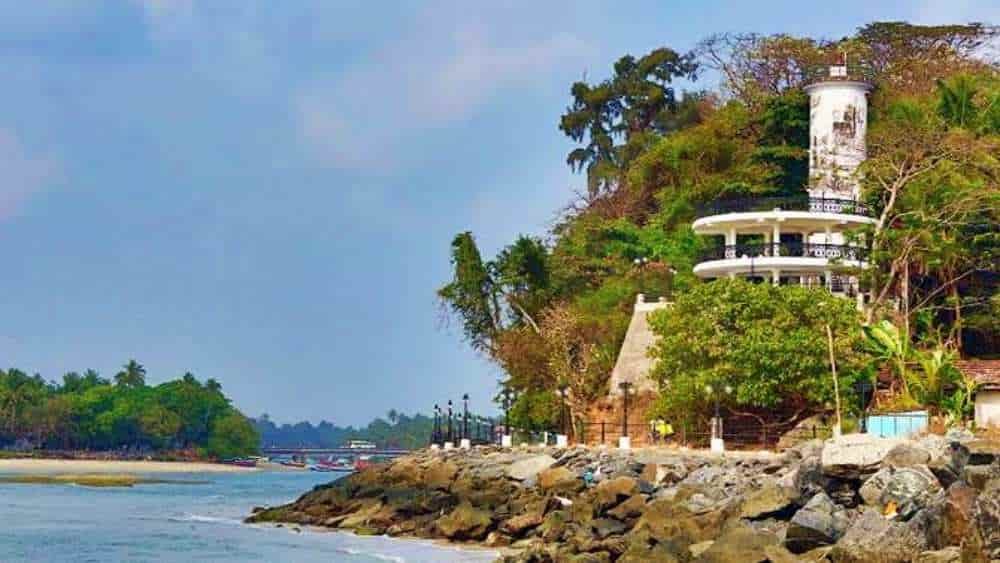
The Mooppenkunnu, known simply as the Hillock, is Mahe’s most scenic spot — an Arabian Sea-facing heritage picnic point with walkways, benches, and restroom facilities. The hillock contains a historic lighthouse and is Mahe’s most celebrated sunset viewpoint. The combination of the sea horizon, the river estuary below, and the quiet hill atmosphere gives it a quality that locals and visitors from Kannur and Kozhikode return to regularly.
Azhimukham — River Meets Sea
The Azhimukham is the estuary where the Mahe River meets the Arabian Sea — one of the most scenic locations in the town. A 2 km walkway has been developed along the riverbank from the estuary towards Mahe Bridge, with Tagore Park situated at the estuary itself. The marianne statue associated with the French community stands here. The walkway with its park benches offers a peaceful riverside stroll that is the most accessible daily attraction in Mahe for residents and visitors alike.
Mahe River Walkway
The walkway along the banks of the Mahe River extends through the town and surrounds much of the Mahe landscape. It is a central feature of town life — couples, families, and solitary walkers use it throughout the day. The river at Mahe is wide enough to offer genuine water views without the overcrowded infrastructure of tourist-developed riverbanks.
Puthalam Bhagavathy Temple
The Sri Puthalam Bhagavathy Temple is Mahe’s most historically significant Hindu temple. It is ancient in origin and is directly connected to the historical conflict between the French and Indian armies — local tradition holds that the temple’s deity protected the area during these confrontations. The temple hosts the annual Thirayattam — a ritual performance art festival that draws large crowds from surrounding districts of Kerala. Thirayattam is an ancient ritual of the North Malabar tradition, involving elaborate costumes, elaborate face masks, and ceremonial performances that merge dance, martial art, and religious ritual. The temple is a living example of how Mahe’s cultural identity has been simultaneously shaped by French colonialism and deep-rooted Malabar Hindu tradition.
Museum at Government House
The Heritage Museum at Government House provides a direct window into Mahe’s 232 years of French colonial history. The museum houses colonial-era relics, historical belongings, records, and artifacts from the French period — material evidence of what it meant to be France’s smallest colony in India. The building itself — Government House — is a heritage structure.
Water Sports Complex, Manjakkal
Located approximately 2 km from the Mahe River, the Water Sports Complex offers motorboating, pedal boating, and other water recreational activities. It is Mahe’s primary adventure attraction and draws visitors from the surrounding Kerala districts who come specifically for the water sports offerings not commonly available in the immediate area.
Temples of Mahe District
| Temple | Deity/Tradition | Key Feature |
| Sri Puthalam Bhagavathy Temple | Goddess Bhagavathi | Ancient; connected to French-Indian conflict history; annual Thirayattam ritual |
| St. Teresa’s Church | Catholic (Mahe Mission) | Built 1737; one of oldest Catholic churches on Malabar coast; Fete de Mahe centre |
| Tagore Park Marianne Statue | French secular tradition | Bastille Day gathering point for Mahe’s French community |
Fete de Mahe — The Annual Festival
The Fete de Mahe is the district’s most significant annual event. Celebrated at St. Teresa’s Church, this festival draws pilgrims and visitors from all religious backgrounds across Kerala, Puducherry, and neighbouring states. The combination of religious significance and the lingering French cultural association makes it unique among festival events in southern India. People of all faiths attend, reflecting the genuinely syncretic character of Mahe’s small but layered community.
Weather in Mahe District
Mahe has a tropical coastal climate typical of Kerala’s Malabar coast.
October to February — Best Time: Cool, pleasant coastal weather between 20°C and 28°C. The sea breeze at the Hillock and Azhimukham is at its most refreshing. October and November are post-monsoon with intensely green landscapes.
June to September — Monsoon: Heavy, continuous rainfall as the Southwest Monsoon arrives on the Kerala coast. The river swells, the estuary becomes dramatic, and the town takes on a lush character. Not recommended for first-time visitors but genuinely beautiful for those who appreciate coastal monsoon atmosphere.
March to May — Summer: Rising humidity and temperatures reaching 38°C. The sea view from the Hillock is still beautiful but outdoor exploration is more tiring.
Things to Do in Mahe District
Walk the Azhimukham and Tagore Park at Sunset — Arrive at the river estuary by 5 PM, walk the 2 km riverside path with the sea horizon ahead, and settle at the park as the sunset begins. This is Mahe’s single most complete atmospheric experience.
Attend Fete de Mahe at St. Teresa’s Church — The festival calendar at the church is worth tracking; the main Fete de Mahe celebration is the year’s cultural centrepiece.
Watch Thirayattam at Puthalam Temple — The annual festival here is one of North Malabar’s most vivid ritual performance traditions — genuinely worth timing a visit around.
Climb the Hillock at Dusk — The lighthouse at the summit and the panoramic Arabian Sea view at dusk is Mahe’s finest viewpoint experience.
Try Water Sports at Manjakkal — A morning of motorboating or pedal boating adds adventure to what is otherwise a peaceful heritage town experience.
How to Reach Mahe District
By Rail: Thalassery (TLY) station, 9 km from Mahe, is on the main Mangalore–Kozhikode railway line. Trains from Mumbai, Chennai, Trivandrum, and Bengaluru stop here.
By Road: Mahe is on NH 66 (formerly NH 17), 27 km from Kannur and 58 km from Kozhikode. Regular KSRTC and private buses connect Mahe to both cities throughout the day.
By Air: Kannur International Airport is 35 km away; Kozhikode International Airport is 86 km away. Taxis from both airports reach Mahe comfortably.
Conclusion
Mahe is the kind of place that rewards the traveller who arrives knowing something about what happened here — and returns home knowing considerably more. Nine square kilometres of French colonial legacy, Malabar Hindu tradition, Syrian Christian mission history, and the daily rhythms of a Kerala rivermouth town all coexist in a space that most visitors cross in under fifteen minutes without looking. Those who stop and look find a town that holds its own entirely disproportionate weight of history.
FAQs About Mahe District, Puducherry
Q1. What is Mahe famous for?
Mahe is famous for being India’s smallest district (8.69 sq km), its 232 years of French colonial history, St. Teresa’s Church (one of the oldest Catholic churches on the Malabar coast), the Puthalam Bhagavathy Temple and its annual Thirayattam ritual, the Fete de Mahe festival, and the scenic Azhimukham estuary where the Mahe River meets the Arabian Sea.
Q2. Is Mahe part of Kerala or Puducherry?
Mahe is geographically located within Kerala’s North Malabar region — surrounded on three sides by Kannur district and on one side by Kozhikode district. Administratively, however, it is one of the four districts of the Union Territory of Puducherry. This unique status gives it different commercial and tax rules from Kerala.
Q3. Why is Mahe called Mayyazhi?
Mayyazhi is the Malayalam name for both the river (Mayyazhi Puzha) and the town, used by the local population long before French colonisation. The name Mahe, used by the French and in English-language records, is believed to derive from Mayyazhi, though some historians also attribute it to the French naval commander Bertrand François Mahé de La Bourdonnais.
Q4. When is the best time to visit Mahe?
October to February is the best time. The post-monsoon period (October–November) brings lush green landscapes; winter (December–February) offers pleasant coastal temperatures between 20°C and 28°C.
Q5. What is Thirayattam?
Thirayattam is an ancient ritual performance art tradition of North Malabar, combining dance, martial art, elaborate costumes, and ceremonial masks. The annual Thirayattam at the Puthalam Bhagavathy Temple in Mahe draws large crowds from surrounding Kerala districts and is one of the most authentic expressions of the region’s pre-colonial ritual culture.