The High Court of Kerala — seated at Ernakulam, Kochi, in the city that has historically been the commercial and judicial heart of the southwestern Indian coast — is one of India’s most respected and socially progressive superior courts, exercising jurisdiction over the state of Kerala and the Union Territory of Lakshadweep. Established on November 1, 1956, the same day as the state of Kerala itself, the court inherited 3,409 main cases from the Travancore-Cochin High Court and 1,504 cases from the High Court of Madras, carrying forward two distinct judicial traditions into a unified institution. The Kerala High Court holds the extraordinary national distinction of being associated with two historic judicial firsts — Justice Anna Chandy, the first woman High Court Judge in India, and Justice M. Fathima Beevi, the first woman Judge of the Supreme Court of India, both carried their professional roots from this court.
History
The Kerala High Court’s origins trace through two predecessor institutions — the Travancore High Court and the Cochin High Court — reflecting the region’s history as two distinct princely states before integration. The State of Travancore had its High Court at Thiruvananthapuram, established in 1887 by Maharaja Visakham Thirunal with five judges, one serving as Chief Justice alongside a Pandit advising on Hindu law. Mr. Ramachandra Iyer, then aged 35, was its first Chief Justice.
In the State of Cochin, graded law courts were first established in 1812 under the Diwanship of Colonel Munro. The Raja’s Court of Appeal was reconstituted as the Chief Court of Cochin in 1900, with Mr. S. Locke as the first Chief Judge. During the Diwanship of Sri Shanmukham Chettiyar, this Chief Court became the High Court of Cochin.
After India gained independence on August 15, 1947, the kingdoms of Travancore and Cochin integrated to form the Travancore-Cochin State on July 1, 1949. The High Court of Travancore-Cochin was inaugurated with its seat at Ernakulam on July 7, 1949 — with Mr. Puthupally Krishna Pillai as the last Chief Justice of this transitional court. Under the States Reorganisation Act of 1956, the Travancore-Cochin State and Malabar were integrated to form the State of Kerala on November 1, 1956, and the High Court of Kerala was established on that day and inaugurated on November 5, 1956. Justice K.T. Koshi was appointed the first Chief Justice of the Kerala High Court.
Structure and Composition
| Dimension | Detail |
| Established | November 1, 1956 — under States Reorganisation Act, 1956 |
| Inaugurated | November 5, 1956 |
| First Chief Justice | Justice K.T. Koshi |
| Predecessor courts | High Court of Travancore-Cochin + Madras HC jurisdiction |
| Location | Ernakulam, Kochi, Kerala |
| Sanctioned judge strength | 47 judges (35 Permanent + 12 Additional) |
| Jurisdiction | Entire state of Kerala + UT of Lakshadweep |
| New building inaugurated | February 11, 2006 — by CJI Justice Y.K. Sabharwal |
| New building foundation stone | March 14, 1994 — by CJI Justice M.N. Venkatachaliah |
| New building area | 5 acres — 550,000 sq ft — nine floors |
| First woman HC judge in India | Justice Anna Chandy — from this court |
| First woman SC judge in India | Justice M. Fathima Beevi — from this court |
Architecture — A Modern Judicial Campus
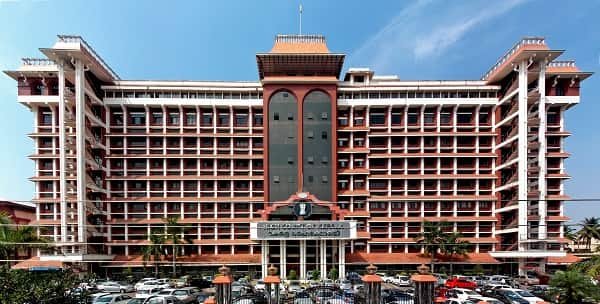
The foundation stone for the current multi-storied High Court building at Ernakulam was laid on March 14, 1994 by then Chief Justice of India Justice M.N. Venkatachaliah, with an estimated construction cost of Rs 10 crore. The building was completed in 2005 at an actual cost of Rs 85 crore and was inaugurated by then Chief Justice of India Justice Y.K. Sabharwal on February 11, 2006 — a modern judicial complex built on 5 acres with a built-up area of 550,000 square feet spread across nine floors.
The building is equipped with modern amenities including videoconferencing facilities, air-conditioned courtrooms, an intranet, digital facilities for retrieval of order copies, and online case status publishing through the internet. Cases are heard by Single Benches, Division Benches of two judges, Full Benches of three judges, and larger benches as the Chief Justice determines. The Kerala High Court’s motto — Access to Justice for All — is reflected in its investment in digital infrastructure and accessibility initiatives that have consistently made it one of India’s more litigant-friendly superior courts.
Frequently Asked Questions
Q: When was the Kerala High Court established?
A: November 1, 1956 — the same day the state of Kerala was formed.
Q: Who was the first Chief Justice?
A: Justice K.T. Koshi was the first Chief Justice of the Kerala High Court.
Q: Where is the court located?
A: Ernakulam, Kochi, Kerala.
Q: What historic firsts are associated with the Kerala High Court?
A: Justice Anna Chandy was India’s first woman High Court Judge, and Justice M. Fathima Beevi was India’s first woman Supreme Court Judge — both from the Kerala High Court.
Q: What is the sanctioned judge strength?
A: 47 judges — 35 permanent including the Chief Justice, and 12 additional.
Q: When was the current building inaugurated?
A: February 11, 2006, by then Chief Justice of India Justice Y.K. Sabharwal.
Q: What does the new High Court building offer?
A: Nine floors, 550,000 sq ft, air-conditioned courtrooms, videoconferencing, intranet, digital case status and order copy facilities.
Q: Which territory other than Kerala does the court serve?
A: The Union Territory of Lakshadweep.