The High Court of Rajasthan at Jodhpur — the apex judicial institution for India’s largest state by area — stands as a remarkable symbol of institutional unification, judicial heritage, and architectural ambition in the heart of Rajasthan’s Blue City. Established on August 29, 1949, through the Rajasthan High Court Ordinance, 1949, the court was born out of the complex political integration of India’s Rajputana princely states into the modern state of Rajasthan — unifying five separate High Courts that had been operating across Jodhpur, Jaipur, Bikaner, and the former Rajasthan and Matsya Union into a single, unified superior court. Today, with a sanctioned strength of 50 judges, a magnificent new building inaugurated by the President of India in 2019, and a permanent bench at Jaipur, the Rajasthan High Court serves over 80 million citizens across 50 districts with a motto — Truth Alone Triumphs — that has guided its constitutional mission for over seven decades.
History
The formation of the Rajasthan High Court is inseparable from the larger political story of Rajasthan’s creation. When the State of Rajasthan was inaugurated on March 30, 1949, the five separate High Courts operating across Jodhpur, Jaipur, Bikaner, Udaipur, and Alwar were abolished by the Rajasthan High Court Ordinance, 1949. The ordinance established a single unified High Court for the entire state with its principal seat at Jodhpur. On August 29, 1949, His Highness Maharaja Sawai Man Singh — the Rajpramukh — inaugurated the High Court of Judicature for Rajasthan at Jodhpur, administering oaths to Justice Kamala Kant Verma as first Chief Justice alongside 11 other judges. Initially the court also sat at Jaipur, Udaipur, Bikaner, and Kota.
When the Constitution of India came into force on January 26, 1950, Rajasthan’s category changed and judge strength was reduced to six. The benches at Bikaner, Kota, and Udaipur were abolished with effect from May 22, 1950, while the Jaipur Bench continued. Under the States Reorganisation Act, 1956, a new High Court was constituted as the High Court of Rajasthan with its principal seat confirmed at Jodhpur — a decision supported by the committee of P. Satyanarayana Rao, V. Vishwanathan, and B.K. Gupta. The Jaipur Bench was abolished in 1958 but re-established on January 31, 1977, when the President issued the Rajasthan High Court (Establishment of a Permanent Bench at Jaipur) Order, 1976 — mandating a minimum of five judges for the Jaipur Permanent Bench.
Structure and Composition
| Dimension | Detail |
| Established | August 29, 1949 — Rajasthan High Court Ordinance, 1949 |
| First Chief Justice | Justice Kamala Kant Verma |
| Principal Seat | Jodhpur, Rajasthan |
| Permanent Bench | Jaipur — re-established January 31, 1977 |
| Sanctioned judge strength | 50 judges |
| Working strength (2025) | 42 judges |
| Jurisdiction | Entire state of Rajasthan — 50 districts |
| New building inaugurated | December 7, 2019 — by President of India Ram Nath Kovind |
| Total courtrooms (Jodhpur + Jaipur) | 46 courtrooms combined |
| Jodhpur new building | 22 courtrooms |
| Motto | Truth Alone Triumphs |
| Rules | Rajasthan High Court Rules, 1952 — effective October 1, 1952 |
Architecture — The Magnificent New Building
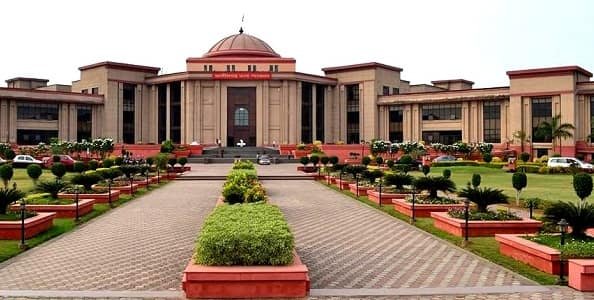
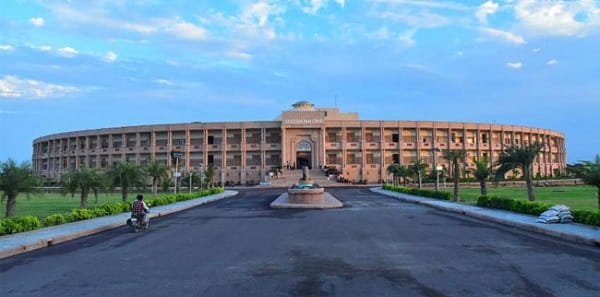
The Rajasthan High Court’s architectural story encompasses two distinct phases — the heritage building at the city centre where the court functioned from its 1949 founding until 2019, and the magnificent new building inaugurated by President Ram Nath Kovind on December 7, 2019, on the outskirts of Jodhpur on the Jodhpur-Jaipur National Highway at Jhalamand.
The new building is architecturally extraordinary — constructed on a campus of 22.61 bighas, its main dome rises 35 metres or 120 feet above ground level, with a dome diameter of 118 feet that creates a visual landmark visible from considerable distances across Jodhpur’s desert skyline. The building rests on 288 columns — a structural achievement that combines engineering precision with aesthetic grandeur suited to a superior court of a state famous for its fortress architecture and regal construction heritage. Land was allotted for this building in 2006 and the foundation was laid in 2007 — reflecting over a decade of planning and construction that produced one of India’s most architecturally distinguished modern High Court buildings.
The Jaipur Bench currently functions from a building constructed in 2006, adjacent to the old heritage building — providing continuity between the permanent bench’s historic premises and modern judicial infrastructure. Together, the Jodhpur and Jaipur buildings offer a combined 46 courtrooms serving Rajasthan’s lawyers and litigants across the state’s vast geography.
Frequently Asked Questions
Q: When was the Rajasthan High Court established?
A: August 29, 1949 — under the Rajasthan High Court Ordinance, 1949.
Q: Who was the first Chief Justice?
A: Justice Kamala Kant Verma, inaugurated on August 29, 1949.
Q: Where is the principal seat located?
A: Jodhpur — the new building on the Jodhpur-Jaipur National Highway at Jhalamand, inaugurated December 7, 2019.
Q: What is the sanctioned judge strength?
A: 50 judges — as of 2025, 42 judges are working.
Q: Does the Rajasthan High Court have a bench in Jaipur?
A: Yes — a permanent bench re-established on January 31, 1977.
Q: What is notable about the new court building’s architecture?
A: Its central dome rises 120 feet and has a diameter of 118 feet, resting on 288 columns.
Q: What is the court’s motto?
A: Truth Alone Triumphs.