Sabarmati Central Jail is Gujarat’s main high-security prison, standing on the banks of the Sabarmati river in Ahmedabad since 1895. Built during the British era, it briefly held Mahatma Gandhi in 1922 and has since housed everyone from spiritual leader Asaram to accused in the 2008 Ahmedabad serial blasts case. More than 125 years old, this maximum-security facility remains fully operational today, functioning as both a working correctional institution and a site tied closely to Gujarat’s colonial and post-independence history.
| Quick Facts | Details |
|---|---|
| Full name | Sabarmati Central Jail |
| Location | Sabarmati, Ahmedabad, Gujarat |
| Established in | 1895 |
| Built by | British colonial administration |
| Rated capacity | 530 inmates |
| Actual population | Often runs well above capacity, at times over 3,700 inmates |
| Security class | Maximum |
| Status | Operational, functioning central prison |
| Managed by | Gujarat Prisons Department |
Where Exactly Is It Located
Sabarmati Central Jail sits in the Sabarmati neighbourhood on the western bank of the Sabarmati river, in the northern part of Ahmedabad city. It’s close to Sabarmati Railway Station and only a few kilometres from landmarks like Sabarmati Ashram and Motera Stadium.
- Address: Near Sabarmati Railway Station, Keshav Nagar, Ranip Road, Sabarmati, Ahmedabad – 380005, Gujarat
- Nearby landmark: Close to Sabarmati Railway Station and the Sabarmati riverfront
- Access: Well served by Ahmedabad’s city bus network and the Ahmedabad Metro’s Sabarmati station, with easy auto or cab access from most parts of the city
The jail sits in a part of Ahmedabad that has changed dramatically over the decades — what was once a quieter riverside stretch is now a busy residential and transit hub, thanks largely to the metro line and railway station nearby.
The Origins: A 19th-Century Colonial Prison
British authorities established the jail in 1895, making it one of the oldest correctional facilities still functioning in western India. Like most prisons of its time, it was built using thick stone walls, high perimeter boundaries, and a design meant purely for containment rather than comfort — a stark contrast to the reform-oriented programs the jail runs today.
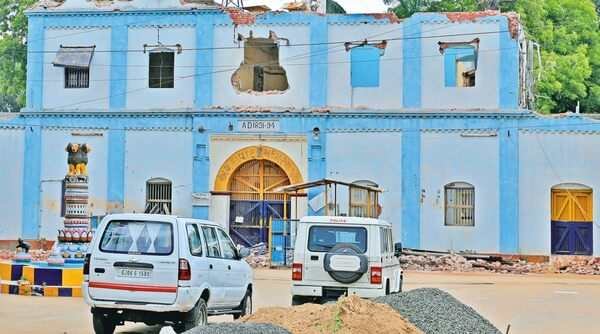
For over a century, the jail’s basic structure remained untouched. It was only in more recent years that renovation work began on parts of the original facade and infrastructure, as the building started showing its age both physically and functionally.
- Originally built to hold a few hundred prisoners, its capacity has been repeatedly outstripped by actual inmate numbers over the decades.
- The jail has operated continuously since its founding, without ever being relocated or rebuilt from scratch.
Gandhi’s Brief Imprisonment in 1922
Sabarmati’s most well-known historical connection is to Mahatma Gandhi, who was imprisoned here for a short period in 1922. Unlike Yerawada in Pune, where Gandhi spent extended years, his time at Sabarmati was brief — but symbolically significant, given the jail’s proximity to the Sabarmati Ashram, where Gandhi lived and ran his movement for social reform. That closeness between his home and his prison cell has made Sabarmati jail an enduring part of Gujarat’s freedom-struggle memory, even decades later.
The 2013 Tunnel Escape Plot
One of the most dramatic chapters in the jail’s modern history came in February 2013, when authorities discovered an escape tunnel nearly 200 feet long, allegedly dug by undertrial prisoners accused in the 2008 Ahmedabad serial blasts case.
- The tunnel was found after guards grew suspicious of inmates loitering near the prison garden.
- Some of the accused involved reportedly held engineering and MBA degrees, and had studied tunnelling techniques from books available in the prison library.
- The Gujarat High Court later allowed the state to proceed with charges against 24 prisoners linked to the escape attempt.
The incident triggered a major security review at the jail, given that it was housing dozens of undertrials linked to the 2008 blasts case alongside the general prison population.
Notable Inmates Over the Years
Sabarmati has held a mix of political detainees, spiritual figures, and high-profile accused individuals over its long history.
- Mahatma Gandhi – briefly imprisoned in 1922
- Asaram Bapu – the self-styled spiritual guru was lodged here in 2013 during his rape case proceedings before being moved to Jodhpur Central Jail
- Accused in the 2008 Ahmedabad serial blasts – dozens of undertrials linked to the case, including alleged SIMI and Indian Mujahideen members, were housed in a dedicated high-security wing
- Atiq Ahmed – the gangster-politician was briefly held at Sabarmati before his transfer and subsequent killing in Uttar Pradesh custody in 2023
Reform, Rehabilitation, and Present-Day Programs
Unlike many older prisons that function purely as detention centres, Sabarmati has built a reputation for running an unusually active rehabilitation program.
- Correspondence courses through institutions like IGNOU and Babasaheb Ambedkar Open University for inmates pursuing education
- Spiritual and wellness workshops conducted by organisations including Art of Living, ISKCON, and the Ramakrishna Mission
- Vocational and IT training programs, including computer literacy classes for female inmates
- A prison radio initiative and inmate-written publications, including a poetry collection produced by prisoners
- Regular graduation ceremonies recognising inmates who complete educational courses while incarcerated
These programs sit somewhat uneasily alongside the jail’s history of security breaches and overcrowding, but they’ve become a defining part of how the facility presents itself today.
Can You Visit Sabarmati Jail
Sabarmati Central Jail is not open for general public visits, since it remains an active maximum-security prison. Access is typically restricted to official visitors, legal representatives, and approved family members of inmates, along with occasional organised groups permitted for educational or reform-related programs.
FAQs
Q1: How old is Sabarmati Central Jail?
A. It was established in 1895, making it well over 125 years old and one of the oldest continuously operating prisons in western India.
Q2: Was Mahatma Gandhi imprisoned at Sabarmati Jail?
A. Yes, briefly in 1922, though his stay here was much shorter than his multiple imprisonments at Yerawada Central Jail in Pune.
Q3: What happened during the 2013 tunnel escape attempt?
A. Prisoners accused in the 2008 Ahmedabad blasts case dug an underground tunnel nearly 200 feet long in an attempt to escape; it was discovered before completion, and 24 inmates later faced charges over the plot.
Q4: Can family members visit inmates at Sabarmati Jail?
A. Yes, family visits are permitted under jail rules and scheduling, though the general public cannot enter the facility, since it operates as an active high-security prison.