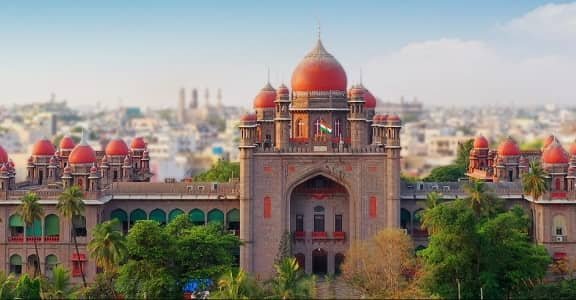
The High Court for the State of Telangana — seated at Hyderabad, the City of Pearls on the banks of the Musi River and one of India’s most historically layered and culturally magnificent cities — is a superior court of extraordinary institutional longevity and architectural distinction. Its history spans over a century — from its founding as the High Court of Hyderabad by the 7th Nizam Mir Osman Ali Khan in 1919, through the Andhra Pradesh era as the unified state’s High Court from 1956 to 2014, through a transitional common court period, to its present form as the High Court for the State of Telangana established on January 1, 2019. The court’s building — a magnificent Indo-Saracenic structure rising from the southern bank of the Musi River, constructed between 1915 and 1919 in pink and white granite — is recognised as an architectural heritage landmark and was included in the World Monuments Fund 2025 World Monuments Watch.
History
The Telangana High Court’s origins reflect Hyderabad’s extraordinary historical position as one of British India’s most important and independently governed princely states. The court was founded by the 7th Nizam, His Exalted Highness Mir Osman Ali Khan, as the Adalatul Aaliya Osmania — the High Court of Hyderabad for the Princely State of Hyderabad Deccan — and inaugurated on April 20, 1919. The construction of the building had commenced on April 15, 1915 and was completed by March 31, 1919. The plan was drawn by Shankar Lal of Jaipur, and the building was executed by engineer Mehar Ali Fazil.
The court began with six judges and achieved a historic milestone in 1921 when Chief Justice Mirza Yar Jung accomplished the separation of the executive and judiciary — a constitutional achievement that the rest of India would not formalise until after independence in 1947. After Hyderabad’s accession to the Indian Union in 1948, the court transitioned to the Indian constitutional framework.
On November 5, 1956, following the States Reorganisation Act, the court was renamed the High Court of Andhra Pradesh, serving the unified state with its principal seat at Hyderabad. The number of judges grew from 12 in 1956 to 61 by 2014. The Golden Jubilee of the court was celebrated in 2006 in the presence of then President of India Dr. A.P.J. Abdul Kalam.
After bifurcation of Andhra Pradesh under the Andhra Pradesh Reorganisation Act, 2014, the court was renamed the High Court of Judicature at Hyderabad and served as the common court for both Telangana and Andhra Pradesh from June 2, 2014. On December 26, 2018, the President of India issued orders bifurcating the court. From January 1, 2019, the High Court for the State of Telangana came into existence with its principal seat at Hyderabad, and a separate High Court of Andhra Pradesh was constituted at Amaravati.
Structure and Composition
| Dimension | Detail |
| Originally established | 1919 — as High Court of Hyderabad by 7th Nizam |
| Building construction | April 15, 1915 to March 31, 1919 |
| Building inaugurated | April 20, 1919 |
| Building plan | Shankar Lal of Jaipur — executed by Mehar Ali Fazil |
| Present form established | January 1, 2019 — as Telangana HC |
| Location | High Court Road, Ghansi Bazaar, Hyderabad |
| Building setting | Southern bank of the Musi River — 9 acres |
| Architectural style | Indo-Saracenic — pink and white granite |
| Heritage recognition | INTACH heritage structure + WMF 2025 World Monuments Watch |
| Sanctioned judge strength | 42 judges (32 Permanent + 10 Additional) |
| Working strength (2025) | 29 judges |
| Chief Justice (from July 2025) | Justice Aparesh Kumar Singh |
| Jurisdiction | All 33 districts of Telangana |
Architecture — A Century-Old Heritage Monument
The Telangana High Court building is one of Hyderabad’s most iconic architectural landmarks and one of India’s finest examples of Indo-Saracenic architecture — the style that blends Mughal decorative traditions, Persian geometric elegance, and European structural engineering into a distinctively Indian institutional aesthetic. Constructed in pink and white granite, the building features imposing domes, arches, minarets, and intricate jali work that reflect the rich architectural culture of the Nizam era — a style known as the Osmanian style after Nizam VII Mir Osman Ali Khan.
The building’s riverside location on the southern bank of the Musi River gives it a prominence that few judicial buildings in India match — visible from the Naya Pul Bridge and surrounding areas, particularly stunning at sunset when the pink granite glows against the river and cityscape. Spanning approximately 9 acres, the building has been in continuous judicial service for over 105 years, making it one of the longest continuously functioning High Court buildings in South Asia.
Its recognition by the Indian National Trust for Art and Cultural Heritage as a heritage structure, and its inclusion in the World Monuments Fund 2025 World Monuments Watch, affirm the international community’s recognition of its exceptional architectural and historical significance — and the need to preserve this century-old masterpiece for future generations.
Frequently Asked Questions
Q: When was the Telangana High Court originally established?
A: 1919 — as the High Court of Hyderabad by the 7th Nizam Mir Osman Ali Khan.
Q: When did it become the High Court for Telangana specifically?
A: January 1, 2019 — following Presidential Orders of December 26, 2018.
Q: Where is the court located?
A: High Court Road, Ghansi Bazaar, Hyderabad — on the southern bank of the Musi River.
Q: What is the sanctioned judge strength?
A: 42 judges — 32 permanent and 10 additional, including the Chief Justice.
Q: What is the architectural style of the building?
A: Indo-Saracenic — pink and white granite, blending Mughal, Persian, and European elements, constructed between 1915 and 1919.
Q: Who designed the Telangana High Court building?
A: The plan was drawn by Shankar Lal of Jaipur and executed by engineer Mehar Ali Fazil.
Q: Is the building a heritage structure?
A: Yes — recognised by INTACH and included in the World Monuments Fund 2025 World Monuments Watch.
Q: How many states has this court served over its history?
A: Three — the princely Hyderabad State, unified Andhra Pradesh (1956–2014), and the State of Telangana from 2019 onwards.