The High Court of Uttarakhand at Nainital — the 18th High Court of India, established on November 9, 2000, under the Uttar Pradesh Reorganisation Act, 2000 — is the apex judicial institution for the Himalayan state of Uttarakhand, carved out of Uttar Pradesh on the same day. Seated in Nainital, one of India’s most breathtakingly beautiful hill stations in the Kumaon Himalayas, the court functions from a magnificent Gothic-style heritage building constructed in 1900 that is widely regarded as one of India’s most scenically situated and architecturally distinctive High Court buildings. The Uttarakhand High Court has built an extraordinary reputation in its relatively short 25-year history for pioneering environmental jurisprudence — including its internationally discussed 2017 declaration of legal personhood for the rivers Ganges and Yamuna — and has produced several distinguished jurists elevated to the Supreme Court of India, including two who subsequently became Chief Justices of India.
History
The Uttarakhand High Court’s history begins with the political formation of the state itself. Parliament enacted the Uttar Pradesh Reorganisation Act, 2000, carving out the hill districts of Uttaranchal — later renamed Uttarakhand — from Uttar Pradesh. On November 9, 2000, the state of Uttarakhand came into existence, and simultaneously, Part IV of the Act provided for the establishment of a High Court for the new state. The Uttarakhand High Court thus began functioning on its very first day of existence at the old Secretariat building in Mallital, Nainital.
Justice Ashok A. Desai, transferred from the Allahabad High Court, became the founder Chief Justice, joined by Justice P.C. Verma as Senior Judge and Justice M.C. Jain. The sanctioned judge strength at creation was seven, later increased to nine in 2003 and subsequently to eleven. Former Chief Justices of the Uttarakhand High Court, Justices Sarosh Homi Kapadia and Jagdish Singh Khehar, subsequently became Chief Justices of India — a remarkable distinction for a relatively young High Court. Justices V.S. Sirpurkar, Cyriac Joseph, and K.M. Joseph, who served as Chief Justices of the Uttarakhand High Court, were also elevated to the Supreme Court.
Structure and Composition
| Dimension | Detail |
| Established | November 9, 2000 — Uttar Pradesh Reorganisation Act, 2000 |
| Founder Chief Justice | Justice Ashok A. Desai — transferred from Allahabad HC |
| Location | Mallital, Nainital, Uttarakhand |
| Building constructed | 1900 — by Santoni MacDonald |
| Building original name | Old Secretariat — Gothic style |
| Sanctioned judge strength | 11 judges |
| Working strength (2025) | 10 judges |
| Jurisdiction | All 13 districts of Uttarakhand |
| Chief Justices of India produced | Justice Sarosh Homi Kapadia + Justice Jagdish Singh Khehar |
| Rank in India | 18th High Court of India |
| Naina Peak elevation | 2,611 metres — visible behind the court building |
| Chief Justice (2025) | Justice Ritu Bahari — first woman Chief Justice of this HC |
| Academy | Uttarakhand Judicial and Legal Academy (UJALA) — since June 14, 2008 |
Architecture — India’s Most Beautifully Situated High Court
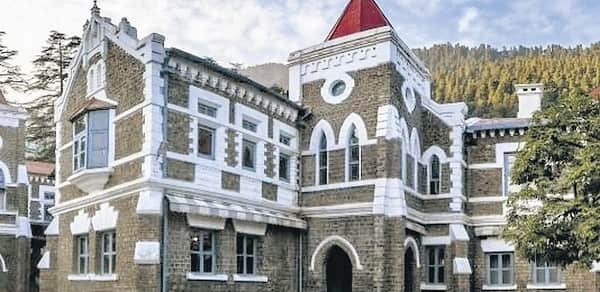
The High Court of Uttarakhand occupies a building that is consistently described as one of India’s most beautiful and picturesque judicial premises — a distinction earned not only by the architectural quality of the structure itself but by the extraordinary natural setting that surrounds it. The building was originally constructed in 1862 by the British as a summer palace for the North West Province. After India’s independence, the North West Province became Uttar Pradesh and Nainital served as the state’s summer capital. The current building was constructed in 1900 by Santoni MacDonald — a magnificent earthquake-resistant structure in the Gothic style that was originally known as the old Secretariat.
The building’s setting is uniquely dramatic — in front of the building is a well-maintained park, and in the background stands Naina Peak, the highest peak of Nainital town at an altitude of 2,611 metres. This visual combination — Gothic architecture framed by Himalayan peaks against the clean mountain sky — makes the Uttarakhand High Court building a genuinely extraordinary architectural and natural composition that photographs have made familiar to millions of Indians who have never visited Nainital.
Originally designed with five courtrooms, additional courtrooms have been added over time. In 2007, a large Chief Justice Court Block and a Lawyers’ Chambers Block were constructed as significant expansions to the original heritage complex.
Frequently Asked Questions
Q: When was the Uttarakhand High Court established?
A: November 9, 2000 — simultaneously with the creation of Uttarakhand state.
Q: Where is the court located?
A: Mallital, Nainital — in a heritage Gothic-style building constructed in 1900.
Q: Who was the founder Chief Justice?
A: Justice Ashok A. Desai, transferred from the Allahabad High Court.
Q: What is the sanctioned judge strength?
A: 11 judges.
Q: Has the Uttarakhand High Court produced Chief Justices of India?
A: Yes — Justices Sarosh Homi Kapadia and Jagdish Singh Khehar both became Chief Justices of India.
Q: Who built the court building and in which year?
A: Santoni MacDonald built the current building in 1900 in the Gothic style. The original building dates to 1862.
Q: What is the Uttarakhand High Court internationally known for?
A: Its 2017 environmental ruling declaring the rivers Ganges and Yamuna as living legal entities — one of the world’s most discussed river rights judgments.