The High Court of Sikkim — seated at Gangtok, the capital of India’s smallest state by area and second smallest by population, perched in the Himalayas at an elevation of over 1,600 metres — holds a uniquely distinguished position in India’s judicial system for two remarkable reasons. It is the smallest High Court in India by sanctioned judge strength, with only three judges — the Chief Justice and two puisne judges — serving a state of approximately 700,000 citizens. Yet its judicial heritage is among India’s most historically unusual and philosophically interesting — tracing through a monarchical era when the Chogyal was the fountainhead of all justice and lawyers were not permitted to appear in courts, through the transitional period of a judicature established by Royal Proclamation in 1955, to its current constitutional status established under Article 371F following Sikkim’s merger with India in 1975 as the country’s 22nd state.
History
The judicial history of Sikkim is a journey of remarkable transformation. Under Sikkim’s monarchy, the Chogyal exercised supreme authority over all judicial matters — the administration of justice was carried out by Feudal Landlords through Adda Courts, Jongpons as District Officers, Pipons as Headmen, and Mandals, with the Chogyal at the apex. In 1909, Kazis, Thikadars, and Lamas were invested with judicial powers by a State Council resolution. Lawyers were not permitted to appear in court — a restriction that reflected the traditional, non-adversarial approach to dispute resolution that prevailed under the monarchy.
In 1953, a judge of a High Court was appointed in Sikkim. On April 17, 1955, the Chogyal Tashi Namgyal issued the High Court of Judicature (Jurisdiction and Powers) Proclamation, 1955, formally establishing a High Court in Sikkim. This court was made the final court in all judicial matters — civil or criminal — subject only to the Maharaja’s prerogative to grant mercy, pardon, remission, commutation, and reduction of sentence. The Maharaja also retained the prerogative to set up a Special Tribunal for review of any case.
The historical watershed arrived in 1975. The Constitution (Thirty-sixth Amendment) Act, 1975, merged Sikkim with the Union of India as the 22nd state on May 16, 1975. Under Clause (i) of Article 371F, the High Court functioning immediately prior to the date of merger became the High Court for the State of Sikkim under the Constitution — like any other High Court in the country. The restriction on lawyers appearing in courts was lifted, the institution of lawyers as it exists today came into existence, and the process of separating the judiciary from the executive commenced formally.
In 1978, the Sikkim Civil Courts Act was passed to consolidate laws relating to civil courts subordinate to the High Court. The Sikkim State Judicial Service Rules, 1975, and Sikkim Superior Judicial Service Rules, 1980, created a separate cadre of judicial officers. The Code of Criminal Procedure, 1973, was extended to Sikkim in 1994, completing the separation of the judiciary from the executive.
Structure and Composition
| Dimension | Detail |
| High Court first established | April 17, 1955 — by Royal Proclamation |
| Sikkim’s merger with India | May 16, 1975 — 22nd state |
| Constitutional HC under Article 371F | 1975 |
| Location | Forest Colony, Baluwakhani, Gangtok — 737101, East Sikkim |
| Sanctioned judge strength | 3 judges (Chief Justice + 2 Puisne Judges) |
| Jurisdiction | Entire state of Sikkim — 6 districts |
| Districts served | Gangtok, Gyalshing, Mangan, Namchi, Pakyong, Soreng |
| National distinction | Smallest High Court in India by judge strength |
| Museum | High Court of Sikkim Museum — inaugurated December 8, 2017 |
| Mobile app | Android — launched August 15, 2017 |
Architecture and the High Court Museum
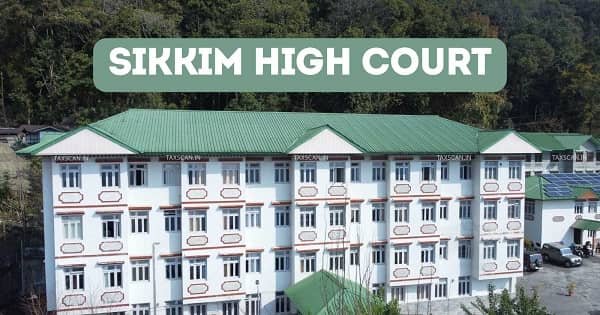
The Sikkim High Court at Baluwakhani, Gangtok, is set within one of India’s most breathtaking natural environments — the Himalayan terrain of East Sikkim, surrounded by mountain ranges and lush forests. The court complex has been developed progressively to accommodate the judicial and administrative needs of India’s smallest High Court.
Perhaps the most remarkable aspect of the Sikkim High Court’s architectural heritage is its Museum — the High Court of Sikkim Museum — housed in what was once the Chief Justice’s bungalow, a building established in 1910 whose first occupants were Civil Surgeons appointed to Sikkim. After Sikkim’s merger, this bungalow served as the Chief Justice’s residence until 2016, before being converted into the Museum and inaugurated on December 8, 2017, by Supreme Court Justice Kurian Joseph. The museum contains historical documents, photographs, old judgments of the Chief Court and High Court of Judicature at Gangtok prior to 1975, the Dewan’s Court records, and artifacts spanning the pre-monarchy, monarchy, and modern periods of Sikkim’s history. Documentary films on Sikkim are screened, and a library with law books, non-fiction, and religious texts is accessible to visitors — creating one of India’s most intimate and culturally rich judicial museums.
Frequently Asked Questions
Q: When was the Sikkim High Court established as a constitutional court?
A: 1975, when Sikkim merged with India as the 22nd state under Article 371F.
Q: When was the High Court first established in Sikkim?
A: April 17, 1955 — by the High Court of Judicature (Jurisdiction and Powers) Proclamation issued by Chogyal Tashi Namgyal.
Q: Where is the Sikkim High Court located?
A: Forest Colony, Baluwakhani, Gangtok, East Sikkim — 737101.
Q: What is the sanctioned judge strength?
A: 3 judges — the Chief Justice and 2 puisne judges, making it India’s smallest High Court.
Q: What was unique about Sikkim’s judicial system before 1975?
A: The Chogyal was the fountainhead of justice, lawyers were not permitted in courts, and justice was dispensed through feudal administrative structures.
Q: What is the High Court of Sikkim Museum?
A: A judicial heritage museum inaugurated December 8, 2017, in the former Chief Justice’s bungalow built in 1910, housing historical documents, old judgments, and Sikkimese legal artifacts.
Q: How many districts fall under its jurisdiction?
A: 6 districts — Gangtok, Gyalshing, Mangan, Namchi, Pakyong, and Soreng.