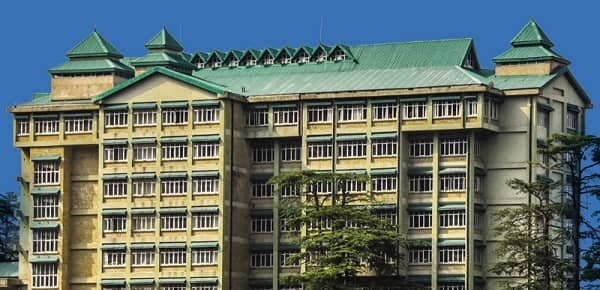
The High Court of Himachal Pradesh — seated at Ravenswood in Shimla, the state capital and one of India’s most spectacularly beautiful hill cities — is the apex judicial institution for the mountain state of Himachal Pradesh, serving a population of over 7 million citizens spread across 12 districts and some of India’s most geographically challenging terrain. Established on January 25, 1971, when Himachal Pradesh attained full statehood under the State of Himachal Pradesh Act, 1970, the court is one of India’s more recently established High Courts — yet its judicial heritage is considerably older, rooted in the Court of Judicial Commissioner that began functioning at Shimla on August 15, 1948, and the Himachal Bench of the Delhi High Court that preceded it from 1967 to 1971. Though compact in sanctioned judge strength compared to the High Courts of larger Indian states, the Himachal Pradesh High Court carries a place of exceptional pride in India’s judicial landscape — having produced two Chief Justices of India and one judge who served on the International Court of Justice at The Hague. Its elevation of distinguished jurists to the Supreme Court and to the world’s highest court demonstrates that size is no measure of a court’s contribution to the highest standards of justice.
History and Establishment
The story of judicial administration in Himachal Pradesh begins with the very formation of the state itself. Himachal Pradesh came into existence on April 15, 1948, as a Centrally Administered Area formed by the integration of 26 Shimla hill districts and four Punjab hill states into a unified administrative unit. Before this integration, the former princely states had varied and often arbitrary systems of administration where the word of the ruler or Wazir was itself the law — and the integration represented a fundamental transformation toward constitutional rule of law.
On August 15, 1948, the Central Government promulgated the Himachal Pradesh Courts Order, 1948, establishing the Court of Judicial Commissioner for Himachal Pradesh. This court was housed at Harvingtan in the Kelston area of Bharari, Shimla, and was vested with the powers of a High Court under the Judicial Commissioner’s Court Act, 1950. Simultaneously, two Courts of District and Sessions Judges and 27 subordinate courts were set up across the territory. The Punjab High Court rules and orders with suitable amendments were made applicable to these courts — giving the new judicial system the benefit of an established procedural framework from day one.
A significant institutional evolution came on May 1, 1967, when the Government of India extended the operation of the Delhi High Court Act, 1966 to the Union Territory of Himachal Pradesh. The Court of Judicial Commissioner was replaced by the Himachal Bench of Delhi High Court at Shimla, which began functioning in the building known as Ravenswood. Justice K.S. Hegde was then the Chief Justice of the Delhi High Court, and Justices S.K. Kapoor and Hardayal Hardy constituted the first circuit bench that held court at Shimla in the Ravenswood building.
The defining moment in the court’s history arrived when Himachal Pradesh attained full statehood on January 25, 1971, under the State of Himachal Pradesh Act, 1970. The new state established its own independent High Court with headquarters at Ravenswood, Shimla, comprising one Chief Justice and two judges. Justice M.H. Beg was appointed the first Chief Justice of the High Court of Himachal Pradesh, with Justice D.B. Lal and Justice C.R. Thakur as the first puisne judges — a modest beginning from which a distinguished judicial institution has grown across more than five decades of service.
Jurisdiction and Powers
The Himachal Pradesh High Court exercises the complete constitutional jurisdiction granted to High Courts under Articles 214 to 231 of the Constitution over the entire state of Himachal Pradesh — all 12 districts including Shimla, Kangra, Mandi, Kullu, Solan, Sirmaur, Chamba, Hamirpur, Una, Bilaspur, Kinnaur, and Lahaul and Spiti. Its writ jurisdiction under Articles 226 and 227 empowers the court to issue constitutional writs — habeas corpus, mandamus, certiorari, prohibition, and quo warranto — as the primary protector of fundamental rights for all citizens of Himachal Pradesh.
The court exercises original jurisdiction in high-value civil suits, appellate jurisdiction over all subordinate civil and sessions courts, and supervisory jurisdiction over every district court, tribunal, and lower judiciary institution in the state. Given Himachal Pradesh’s mountainous geography — with districts like Lahaul and Spiti, Kinnaur, and Chamba accessible only through mountain passes that are snowbound for several months each year — the High Court’s supervisory and appellate function serves communities whose access to higher judicial authority was, for much of India’s history, severely limited by physical geography. The court’s progressive adoption of digital technologies has been particularly impactful in bridging the geographic isolation that characterises much of Himachal Pradesh’s territory.
Structure, Composition, and Key Facts
| Dimension | Detail |
| Established | January 25, 1971 — with Himachal Pradesh statehood |
| Predecessor institutions | Court of Judicial Commissioner (1948–1967); Himachal Bench of Delhi HC (1967–1971) |
| First Chief Justice | Justice M.H. Beg |
| Location | Ravenswood, Shimla — Himachal Pradesh |
| Sanctioned judge strength | 17 judges (including Chief Justice) |
| Working strength (2025) | 13 judges including Chief Justice |
| Jurisdiction | All 12 districts of Himachal Pradesh |
| No. of committees (2024) | 23 committees for court administration |
| Principal Seat | Shimla — single seat, no permanent benches |
| Original subordinate courts at formation | 27 subordinate courts (1948) |
The court operates through Division Benches for constitutional matters, letters patent appeals, and significant criminal appeals, and Single Benches for writ petitions, bail matters, revisions, and first instance cases. Judges are appointed through the Supreme Court collegium process from senior advocates and from Himachal Pradesh’s Higher Judicial Service. The court administers 23 institutional committees covering areas from case management, legal aid, and e-courts to welfare of district judiciary judges, mediation and arbitration, disaster management, and library services — reflecting a comprehensive administrative governance structure for an institution whose relatively small bench manages a geographically dispersed and topographically demanding jurisdiction.
Distinguished Legacy — Two Chief Justices of India
| Distinguished Alumnus | Achievement | Significance |
| Justice M.H. Beg | First Chief Justice of HP HC; elevated to CJI | Became Chief Justice of India — 16th CJI |
| Justice R.S. Pathak | Chief Justice of HP HC; elevated to CJI and ICJ | 18th Chief Justice of India; also Judge of International Court of Justice at The Hague |
| Justice N.M. Kasliwal | Chief Justice of HP HC; elevated to Supreme Court | Supreme Court Judge |
| Justice M. Srinivasan | Chief Justice of HP HC; elevated to Supreme Court | Supreme Court Judge |
| Justice D. Raju | Chief Justice of HP HC; elevated to Supreme Court | Supreme Court Judge |
| Justice Lokeshwar Singh Panta | Judge of HP HC; elevated directly to Supreme Court | Direct elevation from HP HC to Supreme Court |
| Justice Leila Seth | Chief Justice of HP HC | First woman Chief Justice of a state High Court in India |
The Himachal Pradesh High Court’s contribution to India’s apex judiciary is extraordinary given its small size — producing two Chief Justices of India in Justice M.H. Beg and Justice R.S. Pathak, the latter also achieving the singular distinction of serving as a Judge of the International Court of Justice at The Hague. Justice Leila Seth’s tenure as Chief Justice of the Himachal Pradesh High Court holds its own historic significance — she was the first woman to become Chief Justice of any state High Court in India, a milestone in judicial history that reflects the HP High Court’s forward-thinking approach to judicial leadership. Justice Lokeshwar Singh Panta was directly elevated from the HP High Court to the Supreme Court — a distinction that reflects the quality of jurisprudence produced at this court.
Digital Transformation and Access to Justice
The Himachal Pradesh High Court has embraced digital transformation with particular urgency given the state’s geographic realities — mountains, remote valleys, and seasonal road closures make physical access to justice genuinely difficult for citizens in Kinnaur, Lahaul and Spiti, and Chamba. The court’s Computer, e-Courts, Artificial Intelligence, AI-Assisted Legal Translation Advisory Committee, and e-Law Reports Committee reflects the comprehensive approach the institution has taken to technological modernisation — treating e-courts not merely as a pandemic-era adaptation but as a fundamental structural solution to the geographic barriers that Himachal Pradesh’s terrain creates for litigants.
Virtual hearings have made it possible for parties from Kaza in Lahaul and Spiti or Chitkul in Kinnaur to appear before the High Court at Shimla without traversing high mountain passes — a transformation in access to justice that would have been unimaginable a decade ago. E-filing systems, online case management, and digital cause lists mean that advocates and litigants across the state can track their cases and participate in proceedings without the logistical challenge of reaching Shimla in person.
Frequently Asked Questions
Q: When was the Himachal Pradesh High Court established?
A: The HP High Court was established on January 25, 1971, when Himachal Pradesh attained full statehood under the State of Himachal Pradesh Act, 1970.
Q: Where is the Himachal Pradesh High Court located?
A: The court is located at Ravenswood, Shimla — the state capital of Himachal Pradesh.
Q: Who was the first Chief Justice of the Himachal Pradesh High Court?
A: Justice M.H. Beg was the first Chief Justice of the Himachal Pradesh High Court. He was subsequently elevated to become the 16th Chief Justice of India.
Q: What is the sanctioned judge strength of the HP High Court?
A: The sanctioned strength is 17 judges — comprising 13 permanent judges and 4 additional judges including the Chief Justice. As of 2025, 13 judges including the Chief Justice are sitting.
Q: What was the predecessor court before the HP High Court was established?
A: Two predecessor institutions served before 1971 — the Court of Judicial Commissioner at Harvingtan, Shimla (1948–1967), and the Himachal Bench of the Delhi High Court at Ravenswood, Shimla (1967–1971).
Q: Has the HP High Court produced Chief Justices of India?
A: Yes — two Chief Justices of India came from the HP High Court. Justice M.H. Beg became the 16th Chief Justice of India and Justice R.S. Pathak became the 18th Chief Justice of India. Justice Pathak also served as a Judge of the International Court of Justice at The Hague.
Q: What is historically significant about Justice Leila Seth at the HP High Court?
A: Justice Leila Seth served as Chief Justice of the Himachal Pradesh High Court and was the first woman to become Chief Justice of any state High Court in India — a landmark in Indian judicial history.
Q: How many districts fall under the HP High Court’s jurisdiction?
A: The court exercises jurisdiction over all 12 districts of Himachal Pradesh — including Shimla, Kangra, Mandi, Kullu, Solan, Sirmaur, Chamba, Hamirpur, Una, Bilaspur, Kinnaur, and Lahaul and Spiti.
Q: Does the HP High Court have benches in other cities?
A: No. The Himachal Pradesh High Court operates from a single principal seat at Shimla with no permanent benches in other cities.
Q: What makes the HP High Court significant despite its small size?
A: Despite being one of India’s smaller High Courts by sanctioned judge strength, it has produced two Chief Justices of India, one ICJ judge, five Supreme Court judges, and India’s first woman High Court Chief Justice — a record of judicial distinction that places it among the proudest institutions in India’s judicial landscape.