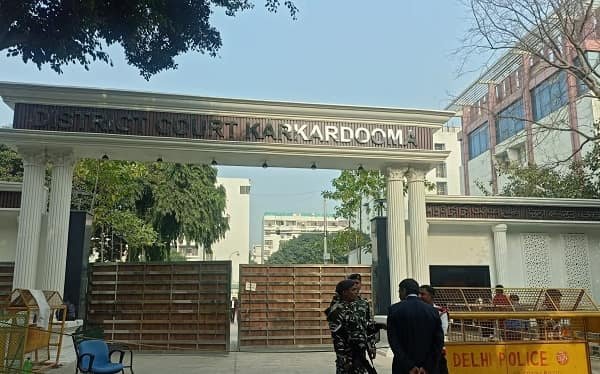
The Karkardooma Courts Complex — located in the heart of East Delhi along Vikas Marg in the Karkardooma area — is one of the most significant and historically pioneering district court complexes in India. Established on May 15, 1993, and serving the rapidly growing population of East, North-East, and Shahdara districts of Delhi, this court complex holds a place of singular national pride in India’s digital judicial history — it is the site where India’s first district-level paperless e-court was inaugurated on February 8, 2010, an achievement that fundamentally transformed the country’s understanding of what modern justice delivery could look like at the grassroots level. Spread across a total area of 60,200 square metres with a covered area of 48,086.25 square metres, the Karkardooma Courts Complex is not merely a collection of courtrooms but a comprehensive judicial township that houses civil courts, criminal courts, family courts, labour courts, motor accident claims tribunals, mediation facilities, residential quarters for judicial officers, a bank branch, a post office, and multiple welfare amenities for litigants, advocates, and court staff. Under the administrative oversight of the Delhi High Court, the Karkardooma Courts Complex serves millions of Delhi’s eastern residents as their primary and most accessible gateway to justice.
History and Establishment
The establishment of the Karkardooma Courts Complex in 1993 was a direct response to Delhi’s explosive population growth in its eastern districts — an expansion that had made the original centralised judicial arrangement at Tis Hazari Courts in North Delhi practically inaccessible for vast numbers of litigants from East and North-East Delhi. Before the Karkardooma complex came into existence, citizens from Shahdara, Laxmi Nagar, Preet Vihar, Krishna Nagar, Dilshad Garden, Seelampur, Seemapuri, Vivek Vihar, Yamuna Vihar, and surrounding areas were required to travel across the city to access the district courts — a logistical burden that fell disproportionately on working-class families with the most urgent need for affordable, accessible justice.
The Karkardooma Courts Complex was inaugurated on May 15, 1993, by Shri G.C. Mittal, the then Chief Justice of the Delhi High Court — a ceremony that formally recognised the complex as the dedicated judicial infrastructure for Delhi’s eastern population. The building of the complex was completed in 1997-98, with a residential block constructed alongside the court building to house judicial officers and staff — comprising four Type-VI duplex flats, seven Type-VI flats, thirty Type-V flats, and fourteen Type-IV flats for judicial officers, alongside Type-III and Type-II flats for staff. This residential provision reflects the understanding that judicial officers working in eastern Delhi should be able to live proximate to their courts rather than commuting long distances — a practical investment in the quality of justice that the complex delivers.
Jurisdiction and Areas Served
The Karkardooma Courts Complex handles civil, criminal, and matrimonial cases relating to three Delhi districts — East Delhi, North-East Delhi, and Shahdara. Its geographic jurisdiction covers one of Delhi’s most densely populated regions, encompassing areas including Shahdara, Laxmi Nagar, Preet Vihar, Krishna Nagar, Dilshad Garden, Seelampur, Seemapuri, Vivek Vihar, and Yamuna Vihar — communities that together represent several million residents of the National Capital Territory.
The courts functioning at Karkardooma span the full spectrum of district-level judicial functions — civil courts for property disputes, recovery suits, injunctions, and declaratory matters; sessions courts for serious criminal trials including murder, robbery, and other offences under the Indian Penal Code and Bharatiya Nyaya Sanhita; magistrate courts for lesser criminal matters, bail applications, and remand hearings; family courts for matrimonial disputes, divorce, maintenance, and child custody; Motor Accident Claims Tribunals for accident compensation matters; labour courts for employment disputes; and special courts under various statutes including POCSO, NDPS, and economic offence legislation.
Structure, Facilities, and Key Facts
| Dimension | Detail |
| Inaugurated | May 15, 1993 — by Chief Justice Delhi HC Sh. G.C. Mittal |
| Building completed | 1997–98 |
| Location | Vikas Marg, Karkardooma, East Delhi |
| Total area | 60,200 square metres |
| Covered area | 48,086.25 square metres |
| Districts served | East Delhi, North-East Delhi, Shahdara |
| Courts functioning | Civil, Criminal, MACT, Family, Labour, Special Courts |
| Residential block | Judicial officers and staff quarters within complex |
| Bank branch | UCO Bank — for court staff, litigants, and advocates |
| Post office | Within complex for court-related postal needs |
| Mediation Cell inaugurated | May 5, 2006 — by Justice S.B. Sinha, Supreme Court |
| Facilitation Centre established | January 18, 2007 — by CJ M.K. Sharma, Delhi HC |
| Conference Hall inaugurated | July 3, 2008 — by CJ A.P. Shah, Delhi HC |
A National Pioneer — India’s First District-Level E-Court
The Karkardooma Courts Complex’s most celebrated distinction is one that belongs to it permanently and uniquely in India’s judicial history — on February 8, 2010, India’s first district-level paperless e-court was inaugurated at District East, Karkardooma Courts, by then Delhi High Court Chief Justice A.P. Shah. This landmark moment was one of the most significant milestones in India’s digital judicial transformation — demonstrating for the first time that a district court, functioning at the grassroots level where ordinary citizens most frequently encounter the justice system, could operate on a fully digital, paperless infrastructure.
The e-court at Karkardooma was designed with a vision that Chief Justice A.P. Shah articulated explicitly at the inauguration — that e-courts would bring more transparency and efficiency to the justice delivery system. Justice Badar Durrez Ahmed elaborated on the court’s capabilities — noting that it was connected to hospitals and police stations through the internet, enabling witnesses to depose and be cross-examined while remaining at their own locations rather than physically attending court. Additional Sessions Judge Sanjay Garg presided over the inaugural proceedings, demonstrating that the technology was operational and ready for real judicial work rather than a ceremonial demonstration.
The e-court’s stated aims — quick disposal of cases, reliability of evidence recorded, and greater transparency in district court functioning — captured precisely the three dimensions of justice delivery where technology could make the most transformative difference at the level where the most citizens interact with the courts daily.
Vulnerable Witness Deposition Courts — A Landmark in Victim Protection
| Digital and Access Initiative | Date | Inaugurated By |
| Mediation Cell | May 5, 2006 | Justice S.B. Sinha — Supreme Court of India |
| Facilitation Centre | January 18, 2007 | CJ M.K. Sharma — Delhi High Court |
| Conference Hall | July 3, 2008 | CJ A.P. Shah — Delhi High Court |
| India’s first district e-court | February 8, 2010 | CJ A.P. Shah — Delhi High Court |
| Modern Lock Up and Tihar Jail shop | March 11, 2011 | CJ Dipak Misra — Delhi High Court |
| First Vulnerable Witness Deposition Court | February 10, 2012 | Justice Altamas Kabir — Supreme Court of India |
| Second Vulnerable Witness Deposition Complex | September 11, 2013 | CJ N.V. Ramana — Delhi High Court |
Beyond the e-court breakthrough, the Karkardooma Courts Complex has been the site of another deeply significant innovation in victim-centred justice — the establishment of India’s first Vulnerable Witness Deposition Court in Court No. 77 on February 10, 2012, inaugurated by Supreme Court Justice Altamas Kabir. This dedicated facility allows victims, particularly children and sexual assault survivors, to give their testimony in a secure, specially designed environment where they are protected from direct confrontation with accused persons — a reform that reflects the courts’ commitment to ensuring that the experience of seeking justice does not compound the trauma of those who have already suffered.
A second Vulnerable Witness Deposition Complex was established in Court No. 78 on September 11, 2013, inaugurated by then Delhi High Court Chief Justice N.V. Ramana — who subsequently became the 48th Chief Justice of India.
Frequently Asked Questions
Q: When was the Karkardooma Courts Complex established?
A: The Karkardooma Courts Complex started functioning on May 15, 1993, and was inaugurated by then Delhi High Court Chief Justice Sh. G.C. Mittal.
Q: Where is the Karkardooma Courts Complex located?
A: It is located in the Karkardooma area of East Delhi on Vikas Marg — accessible from multiple parts of East and North-East Delhi.
Q: What is the total area of the Karkardooma Courts Complex?
A: The total area is 60,200 square metres with a covered area of 48,086.25 square metres.
Q: Which districts does the Karkardooma Courts Complex serve?
A: It serves three Delhi districts — East Delhi, North-East Delhi, and Shahdara.
Q: What was India’s first district-level e-court?
A: India’s first district-level paperless e-court was inaugurated on February 8, 2010, at District East, Karkardooma Courts, by Delhi High Court Chief Justice A.P. Shah.
Q: What types of courts function at Karkardooma?
A: Civil courts, sessions courts, magistrate courts, family courts, Motor Accident Claims Tribunals, labour courts, POCSO courts, NDPS courts, and other special courts all function within the complex.
Q: What is a Vulnerable Witness Deposition Court?
A: It is a specially designed court where vulnerable witnesses including children and assault survivors can testify in a secure environment protected from direct confrontation with accused persons. India’s first such court was established at Karkardooma on February 10, 2012.
Q: What facilities are available for litigants at Karkardooma?
A: The complex provides a Facilitation Centre, Mediation Cell, UCO Bank branch, post office, e-filing services, online case status tracking, a bar room and library, and residential facilities for judicial officers and staff.
Q: Is there e-filing available at Karkardooma Courts?
A: Yes. Delhi District Courts have a digitised e-filing system through which lawyers and litigants can register and upload petitions, affidavits, and annexures for civil, criminal, and miscellaneous matters.
Q: Under which court’s supervision does Karkardooma function?
A: The Karkardooma Courts Complex functions under the administrative supervision of the Delhi High Court, which exercises superintendence over all subordinate courts in the National Capital Territory of Delhi.