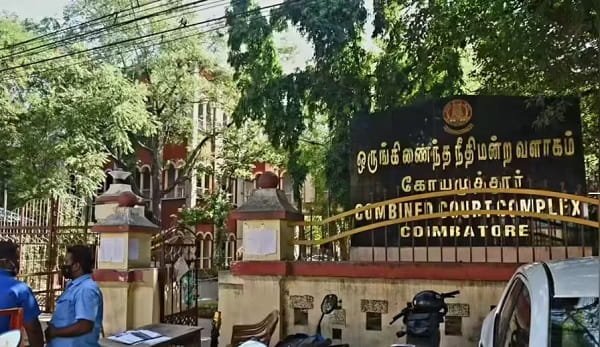
The District Court Coimbatore — the apex trial court for Coimbatore district in the state of Tamil Nadu, under the supervision of the Madras High Court — serves the Manchester of the South, India’s textile capital and one of South India’s most industrialised and commercially significant cities. The district’s history stretches back to antiquity — Coimbatore existed even prior to the 2nd or 3rd century AD, with early connections to the Chola period as well as subsequent rule by the Rashtrakutas, Chalukyas, Pandyas, Hoysalas, Vijayanagara kings, the Madurai Sultanate, and the Madurai Nayaks. The court’s most celebrated asset is its heritage building at Avinasi Road — the Kuthirai Vandi Court — a magnificent 1863 colonial structure that has been painstakingly restored to its original glory using traditional construction techniques, standing as one of Tamil Nadu’s finest examples of colonial civic judicial architecture.
History
Coimbatore district’s judicial history reflects the layered civilisational heritage of the Kongunadu region — the western Tamil Nadu territory bounded by the Western Ghats and the River Noyyal. In early days, the area was inhabited by tribes, the most predominant being the Kosars, who had their headquarters at Kosampathur — which probably later became the present Coimbatore. The tribal predominance gave way to the Rashtrakutas, then the Cholas who were prominent during the reign of Raja Raja Chola, followed by the Chalukyas, Pandyas, and Hoysalas. Due to internal strife in the Pandyan kingdom, the Muslim rulers from Delhi interfered, bringing the area under the Madurai Sultanate. The Vijayanagara rulers wrested the region during 1377-78 after overthrowing the Madurai Sultanate, followed by the Madurai Nayaks. When Kongunadu fell to the British along with the rest of the state, the name was formalised as Coimbatore — known in Tamil as Kovai.
The heritage court building — popularly called the Kuthirai Vandi Court, meaning Horse Carriage Court — was built in 1863 on a prominent plot of approximately 2.6 acres on Avinasi Road, Coimbatore. This building served as the primary judicial premises for Coimbatore’s colonial-era district court and represents one of Tamil Nadu’s most significant examples of British Indian institutional architecture. In the 1990s, through official neglect and the absence of regular repair work by the PWD, the building fell into a state of ruins with cracks developing in walls and ultimately the cave-in of the ceiling. Following protests by heritage lovers and historians, funds were allocated and restoration work was undertaken with advice from INTACH Coimbatore Chapter.
The Public Works Department carried out restoration using the old conventional methods — maintaining the building’s heritage value and aesthetic. Engineers employed the same construction materials used by Nayak and Maratha rulers in the Delta region of Thanjavur — ground lime mortar, Kadukai (myrobalan), and jaggery, which are described as highly carbon-rich binders that provide exceptional structural durability. The building is a Madras terraced structure with ceilings supported by closely spaced quality wooden rafters and beams. In July 2022, a delegation of six Madras High Court judges inspected the renovation work, and the restoration was completed to wide appreciation from the heritage conservation community.
Structure and Composition
| Dimension | Detail |
| Heritage building constructed | 1863 — on Avinasi Road, Coimbatore |
| Heritage building name | Kuthirai Vandi Court — Horse Carriage Court |
| Heritage building plot | Approximately 2.6 acres |
| Architecture style | Madras terraced building — colonial institutional style |
| Restoration material | Ground lime mortar, Kadukai, jaggery — traditional methods |
| Restoration supervised by | INTACH Coimbatore Chapter + PWD Tamil Nadu |
| Madras HC inspection | July 2022 — six-judge delegation inspected |
| High Court supervision | Madras High Court — Chennai |
| Location | Coimbatore, Tamil Nadu — known as Kovai in Tamil |
| Jurisdiction | Entire Coimbatore district |
| District identity | Manchester of the South — textile capital of South India |
| Special courts | Bomb blast court, Coimbatore — for 1998 serial blast cases |
| Sub-courts | Mettupalayam, Valparai, and other taluka courts |
| Digital infrastructure | eCourts Mission Mode Project — Virtual Justice Clock, e-filing, case status |
Architecture — The Kuthirai Vandi Court Restoration
The Coimbatore District Court’s architectural story is one of India’s most compelling judicial heritage conservation narratives. The Kuthirai Vandi Court building — constructed in 1863 and representing over 160 years of continuous judicial use on the same Avinasi Road plot — came close to irreversible loss in the 1990s through institutional neglect. The restoration, completed with INTACH guidance using traditional Madras terraced building construction techniques, demonstrates that historical judicial buildings can be preserved without compromising their heritage character.
The use of Kadukai and jaggery as binding agents — following the construction traditions of Nayak and Maratha rulers in the Thanjavur Delta region — rather than modern cement gives the restoration an authenticity that standard PWD repair work rarely achieves. The long covered corridor, high ceiling supported by wooden rafters, and thick masonry walls that characterise Madras terraced buildings create an interior environment that remains naturally cool — a practical virtue of pre-air-conditioning colonial institutional architecture that makes the building genuinely comfortable despite Tamil Nadu’s climate.
Frequently Asked Questions
Q: What is the heritage building of Coimbatore District Court called?
A: The Kuthirai Vandi Court — meaning Horse Carriage Court — built in 1863 on Avinasi Road.
Q: What architectural style is the heritage court building?
A: A Madras terraced building — colonial institutional style with thick masonry walls, a long covered corridor, and high ceilings with wooden rafters and beams.
Q: How was the building restored after its deterioration?
A: Using traditional construction methods with ground lime mortar, Kadukai (myrobalan), and jaggery — under the guidance of INTACH Coimbatore Chapter.
Q: When was the restoration completed?
A: The work was completed in 2022-23, following a July 2022 inspection by a six-judge delegation from the Madras High Court.
Q: What is Coimbatore known as in Tamil?
A: Kovai.
Q: What special court exists at Coimbatore District Court?
A: A Bomb Blast Court functioning for the 1998 Coimbatore serial blast cases.
Q: Which High Court supervises the Coimbatore District Court?
A: The Madras High Court, Chennai.
Q: How old is Coimbatore’s history?
A: Coimbatore existed even prior to the 2nd or 3rd century AD, with ancient rulers including the Cholas, Rashtrakutas, Chalukyas, Pandyas, Hoysalas, and the Vijayanagara Empire.