The High Court of Judicature at Madras — one of the oldest, most architecturally magnificent, and historically significant superior courts in India — stands as a living testament to the continuity of judicial tradition across more than 160 years of Indian legal history. Established by Letters Patent dated June 26, 1862, granted by Her Majesty Queen Victoria under the Indian High Courts Act of 1861, the Madras High Court is one of only three Charter High Courts in India — institutions created by royal charter rather than subsequent Indian legislation — the others being the Bombay and Calcutta High Courts. Located in Chennai along the Bay of Bengal, the court exercises appellate jurisdiction over the state of Tamil Nadu and the Union Territory of Puducherry, and original jurisdiction over the city of Chennai — a breadth of constitutional authority served from one of the world’s largest court complexes, a breathtaking Indo-Saracenic building inaugurated in 1892 that has stood as one of the defining architectural landmarks of India’s judicial heritage for over 130 years. With a sanctioned strength of 75 judges and a permanent bench at Madurai established in 2004, the Madras High Court serves over 80 million people across Tamil Nadu and Puducherry with a legal tradition that is simultaneously among India’s oldest and most forward-thinking.
History and Establishment
The history of organised judicial administration in Madras stretches back to the early 18th century, when a Major’s Court was established to administer English law for British settlements at Fort St. George. The great Supreme Court of Judicature at Madras was established at Fort St. George on December 26, 1801 — building the judicial foundations on which the High Court would eventually rise. Between 1817 and 1862, this Supreme Court exercised jurisdiction from a building opposite the Beach Railway Station.
The defining institutional moment arrived on June 26, 1862, when Letters Patent granted by Queen Victoria under the Indian High Courts Act, 1861 established the High Court of Judicature at Madras — formed by merging the Supreme Court of Judicature at Madras and the Sudder Dewanny Adawlut into a unified institution. The court was required to decide cases in accordance with justice, equity, and good conscience — a formulation that placed it squarely in the tradition of English common law while simultaneously acknowledging the diversity of Indian legal customs. The earliest judges included Judges Holloway, Innes, and Morgan, and the court began a tradition of excellence that would produce some of India’s finest jurists across the following century and a half.
A landmark in Indian judicial history arrived when Justice T. Muthuswamy Iyer became the first Indian to sit as a judge of the Madras High Court — a historic appointment that represented one of the earliest recognitions of Indian legal talent’s rightful place at the highest levels of colonial judicial institutions. The court was also a pioneer in reforming Original Side jurisdiction in favour of Indian practitioners as early as the 1870s, demonstrating a progressiveness unusual for its era. From 1862 to 1892, the High Court functioned in the same Periamet building that had previously housed the Supreme Court. The magnificent present building was inaugurated on July 12, 1892, by Beilby Lawley, then Governor of Madras, who handed the key to Chief Justice Arthur Collins — beginning the court’s existence in the iconic complex that remains its home to this day.
Jurisdiction and Powers
The Madras High Court exercises a uniquely comprehensive set of jurisdictions. Its appellate jurisdiction extends over the entire state of Tamil Nadu and the Union Territory of Puducherry — covering all 38 districts of Tamil Nadu and Puducherry’s four districts. Its original jurisdiction over the city of Chennai — inherited from the colonial Letters Patent — means the court directly hears high-value civil suits, testamentary matters, admiralty cases, and criminal matters arising in Chennai without requiring recourse to subordinate courts. This original jurisdiction makes it one of only a few High Courts in India with this direct first-instance power.
The court exercises writ jurisdiction under Articles 226 and 227 of the Constitution for the enforcement of fundamental rights and the supervision of all subordinate courts and tribunals across Tamil Nadu and Puducherry. Its admiralty jurisdiction — exercised under the Admiralty Act — is particularly significant given Tamil Nadu’s extensive coastline and the major ports of Chennai, Tuticorin, and Ennore. The Madurai Bench, established by Government of India Order notified on July 6, 2004 and effective from July 24, 2004, exercises all jurisdiction except original jurisdiction over 13 southern districts of Tamil Nadu — including Madurai, Tirunelveli, Kanyakumari, Ramanathapuram, Virudhunagar, Sivaganga, Dindigul, Tiruchirappalli, Theni, Karur, Thanjavur, Tuticorin, and Pudukkottai.
Structure, Composition, and Key Facts
| Dimension | Detail |
| Established | June 26, 1862 — Letters Patent of Queen Victoria |
| Predecessor courts merged | Supreme Court of Judicature at Madras + Sudder Dewanny Adawlut |
| Present building inaugurated | July 12, 1892 — by Governor Beilby Lawley |
| Building architects | J.W. Brassington (design) + Henry Irwin (completion) |
| Architecture | Indo-Saracenic — one of the finest in the world |
| Principal Seat | Chennai (George Town area) |
| Permanent Bench | Madurai — established July 24, 2004 |
| Sanctioned judge strength | 75 judges (56 permanent + 19 additional) |
| Jurisdiction | Tamil Nadu + UT of Puducherry |
| Original jurisdiction | City of Chennai — civil, criminal, testamentary, admiralty |
| Madurai Bench districts | 13 southern Tamil Nadu districts |
| Tamil Nadu Judicial Academy | Established April 2001 — under aegis of Madras HC |
| Unique tradition | Judges preceded by orderlies bearing ceremonial silver mace |
| Lighthouse within complex | Historic Chennai lighthouse incorporated into court campus |
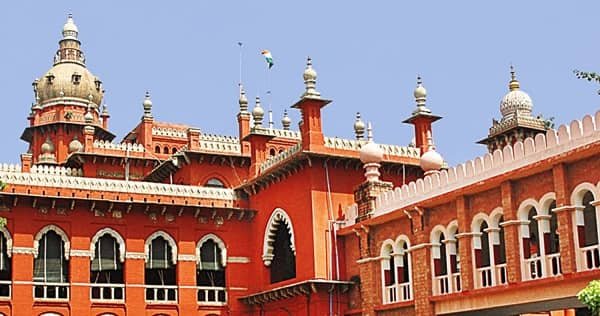
The Iconic Court Building — A World-Class Architectural Marvel
| Building Feature | Detail |
| Inaugurated | July 12, 1892 |
| Design | J.W. Brassington — expanded by Henry Irwin |
| Style | Indo-Saracenic — domes, arches, minarets |
| World War I damage | September 22, 1914 — SMS Emden German cruiser shelled Madras port |
| Interior highlights | Stained glass doors, painted ceilings — masterwork craftsmanship |
| Lighthouse | Old Chennai lighthouse — 175 ft height — on court campus |
| Complex size | One of the largest court complexes in the world by area |
| Madurai Bench | Four-storey building — 22,929 sq m + two-storey court — 15,209 sq m — 24 court halls |
| Statue outside | Chola King Ellalan (Manu Needhi Cholan) — symbolising justice for all |
The Madras High Court complex is classified among the largest court complexes in the world by area and is also notable for housing the largest number of courts in Asia on a single campus. The stained glass doors and painted ceilings of the main building are extraordinary examples of Victorian-era craftsmanship — and the building carries within its walls a rare story of wartime history: on September 22, 1914, the German light cruiser SMS Emden shelled Madras port, and the High Court building suffered damage — making it one of the very few judicial buildings in the world to have been damaged by enemy military action.
The silver mace tradition is a distinctly preserved colonial heritage — judges of the Madras High Court are still led by orderlies bearing ceremonial silver maces, a practice so old and so specifically Anglican in origin that most High Courts and even the Supreme Court of India have long since abandoned it. The Madras High Court’s preservation of this tradition makes it unique in India’s contemporary judicial landscape.
Frequently Asked Questions
Q: When was the Madras High Court established?
A: The Madras High Court was established on June 26, 1862, by Letters Patent granted by Queen Victoria under the Indian High Courts Act, 1861.
Q: What makes the Madras High Court historically unique?
A: It is one of only three Charter High Courts in India — created by British royal charter rather than Indian legislation — along with the Calcutta and Bombay High Courts, giving it the oldest and most historically distinctive constitutional pedigree among India’s High Courts.
Q: Where is the Madras High Court located?
A: The principal seat is in Chennai, in the George Town area. A permanent bench functions at Madurai since July 24, 2004.
Q: What is the sanctioned judge strength?
A: The sanctioned strength is 75 judges — comprising 56 permanent and 19 additional judges including the Chief Justice.
Q: What jurisdiction does the Madras High Court exercise?
A: It exercises appellate jurisdiction over Tamil Nadu and Puducherry, original jurisdiction over Chennai, writ jurisdiction under Articles 226 and 227, admiralty jurisdiction, and testamentary jurisdiction.
Q: When was the Madurai Bench established?
A: The permanent Madurai Bench was established on July 24, 2004, under the Madras High Court (Establishment of a Permanent Bench at Madurai) Order, 2004, covering 13 southern Tamil Nadu districts.
Q: What is the silver mace tradition?
A: Judges of the Madras High Court are still preceded by orderlies bearing ceremonial silver maces — an ancient colonial tradition that the court has uniquely preserved while most other Indian courts have abandoned it.
Q: Was the Madras High Court building damaged in a war?
A: Yes. On September 22, 1914, during World War I, the German cruiser SMS Emden shelled Madras port and the High Court building suffered damage — making it one of the few judicial buildings in the world to have been struck by enemy military action.
Q: Who was the first Indian judge of the Madras High Court?
A: Justice T. Muthuswamy Iyer was the first Indian to sit as a judge of the Madras High Court — a historic appointment in the colonial era.
Q: Can judgments of the Madras High Court be appealed?
A: Yes. Judgments can be appealed to the Supreme Court of India through statutory appeal or through a Special Leave Petition under Article 136 of the Constitution.