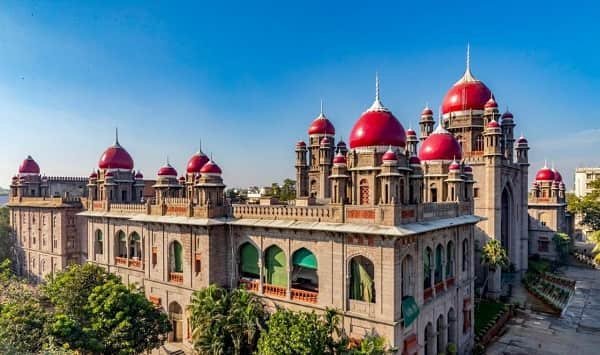
The High Court for the State of Telangana — universally known as the Hyderabad High Court for its seat in the City of Pearls on the banks of the Musi River — is one of India’s most historically remarkable judicial institutions, carrying over a century of continuous judicial tradition that has served three different states. Founded in 1919 by the 7th Nizam of Hyderabad, His Exalted Highness Mir Osman Ali Khan, as the High Court of Hyderabad for the Princely State of Hyderabad Deccan, it has journeyed through the Nizam era, accession to independent India in 1948, service to united Andhra Pradesh from 1956 to 2014, a transitional phase as a common court for both Telangana and Andhra Pradesh, and finally its current form as the High Court for the State of Telangana from January 1, 2019. The court’s building — constructed in the magnificent Indo-Saracenic style on the southern bank of the Musi River, blending Mughal, Persian, and European architectural elements — is recognised as a heritage structure by the Indian National Trust for Art and Cultural Heritage and was included in the prestigious World Monuments Fund 2025 World Monuments Watch, affirming its status as one of India’s most architecturally significant judicial buildings. The Hyderabad High Court has produced 14 judges elevated to the Supreme Court of India, including Justice N.V. Ramana who became the 48th Chief Justice of India — a legacy of judicial excellence that gives this court an honoured place in India’s constitutional history.
History and Establishment
The origins of organised judicial administration in Hyderabad precede the modern court by several decades — attributable to Sir Salar Jung, the reforming Prime Minister of Hyderabad State from 1853 to 1883, who introduced regular courts of justice, a legal department for framing laws, and the beginnings of a structured judiciary. Before his reforms, civil judicial power was vested in the Subhedar and criminal justice was administered by the Kotwal. The court’s language was Persian until 1883, when Urdu replaced it — a linguistic history that reflects the cosmopolitan and multicultural identity of the Hyderabad State.
A pivotal institutional moment arrived in 1921, when Chief Justice Mirza Yar Jung achieved the clear separation of powers between the executive and judiciary in Hyderabad State — an achievement of profound constitutional importance, since this separation of powers acquired formal constitutional status in India only after independence in 1947, meaning Hyderabad had achieved it nearly thirty years before the rest of the country.
The High Court building was commissioned under the 7th Nizam, with construction beginning on April 15, 1915, and concluding on March 31, 1919. The court was inaugurated on April 20, 1919, and shifted to its present iconic riverside location. Before this building was completed, the court functioned from five different locations across Hyderabad — at Pathergatti, then the residence of Nawab Sir Asman Jah in 1909, then Public Gardens in 1912, then the residence of Nawab Salar Jung Bahadur at Chatta Bazaar, and finally the residence of Nawab Sartaj Jung at Saifabad before the permanent building was ready. This nomadic early history makes the court’s eventual settlement in its present magnificent home all the more significant.
Hyderabad State acceded to the Indian Union on September 17, 1948, and the court transitioned to the Indian constitutional framework. After the States Reorganisation Act of 1956 created Andhra Pradesh on linguistic lines, the court was renamed the High Court of Andhra Pradesh, serving the unified state from 1956 to 2014 — with judges growing from 12 in 1956 to 61 by 2014. The bifurcation of Andhra Pradesh under the Andhra Pradesh Reorganisation Act 2014 created Telangana from June 2, 2014, with the Hyderabad court serving as the common court for both states. On January 1, 2019, following the Presidential Order of December 26, 2018, the High Court for the State of Telangana was formally constituted — the present form in which the Hyderabad High Court serves Telangana’s 35 million citizens.
Jurisdiction and Powers
The Hyderabad High Court exercises the complete constitutional jurisdiction of a superior court over all 33 districts of Telangana under Articles 226 and 227 of the Constitution. It issues all five constitutional writs for the enforcement of fundamental rights, exercises appellate jurisdiction over civil and sessions court decisions, and exercises supervisory powers over every subordinate court, tribunal, and administrative authority in the state. Its jurisdiction encompasses civil, criminal, constitutional, environmental, service, tax, and commercial matters across Telangana — including the rapidly growing technology hub of Hyderabad that has established itself as one of India’s most important centres for IT, pharmaceutical, and biotechnology industries.
The court has established a dedicated Special Bench to expedite disposal of cases involving Members of Parliament and Members of Legislative Assembly — reflecting its commitment to implementing Supreme Court directives on timely resolution of political representatives’ cases. Discussion has also advanced toward dedicated green benches for environmental disputes, reflecting the court’s responsiveness to Telangana’s emerging environmental litigation landscape.
Structure, Composition, and Key Facts
| Dimension | Detail |
| Original establishment | 1919 — as High Court of Hyderabad by 7th Nizam |
| Present form established | January 1, 2019 — High Court for State of Telangana |
| Location | High Court Road, Ghansi Bazaar, Hyderabad |
| Building setting | Southern bank of the Musi River — 9 acres |
| Building construction | April 15, 1915 to March 31, 1919 |
| Building inauguration | April 20, 1919 |
| Architectural style | Indo-Saracenic — pink and white granite |
| Heritage recognition | INTACH heritage structure; WMF 2025 World Monuments Watch |
| Sanctioned judge strength | 42 judges (32 permanent + 10 additional) |
| Current judges (2025) | 29 judges |
| Chief Justice (from July 2025) | Justice Aparesh Kumar Singh |
| Jurisdiction | All 33 districts of Telangana |
The Historic Building — A Heritage and Architectural Marvel
| Building Feature | Detail |
| Architectural style | Indo-Saracenic — Mughal, Persian, European blend |
| Material | Pink and white granite — distinctive riverside presence |
| Site area | Approximately 9 acres — southern bank of Musi River |
| Architect | British architect Vincent J. — Nizam era commission |
| Heritage recognition | INTACH — listed as heritage structure |
| World Monuments Watch | Included in WMF 2025 World Monuments Watch |
| Previous locations | Five locations before permanent building in 1919 |
| Notable architectural features | Grand domes, minarets, jali work — Osmanian style |
The Hyderabad High Court building stands as one of the finest examples of Indo-Saracenic architecture in India — a style characterised by the integration of Mughal decorative traditions, Persian geometric precision, and European structural engineering into a uniquely Indian institutional aesthetic. The building’s riverside location on the southern bank of the Musi River gives it visual prominence that few court buildings in India can match. Its inclusion in the World Monuments Fund 2025 World Monuments Watch — a globally recognised list of the world’s most important heritage sites requiring attention and preservation — affirms the international community’s recognition of its exceptional historical and architectural significance.
Distinguished Legacy — 14 Supreme Court Judges
The Hyderabad High Court’s contribution to India’s apex judiciary is one of the most remarkable in the country’s judicial history. The court has produced 14 judges elevated to the Supreme Court of India — including Justice Koka Subba Rao, Justice P. Satyanarayana Raju, Justice O. Chinnapa Reddy, Justice B.P. Jeevan Reddy, Justice Jasti Chelameswar, and most recently Justice N.V. Ramana, who became the 48th Chief Justice of India. The elevation of Justice N.V. Ramana — born in a farming family in Andhra Pradesh and who rose through the Andhra Pradesh and Hyderabad courts to the Supreme Court’s highest office — represents a journey from the Hyderabad High Court’s traditions to India’s judicial summit that brings immense pride to the institution.
Frequently Asked Questions
Q: When was the Hyderabad High Court originally established?
A: The High Court of Hyderabad was founded in 1919 by the 7th Nizam, Mir Osman Ali Khan, for the Princely State of Hyderabad Deccan. The current court — as the High Court for the State of Telangana — was formally constituted on January 1, 2019.
Q: What is the official name of the Hyderabad High Court?
A: The official name is the High Court for the State of Telangana. It is widely known as the Hyderabad High Court because of its seat in Hyderabad.
Q: Where is the court located?
A: The court is located at High Court Road, Ghansi Bazaar, Hyderabad, on the southern bank of the Musi River.
Q: What is the sanctioned judge strength?
A: The sanctioned strength is 42 judges — comprising 32 permanent and 10 additional judges including the Chief Justice. As of 2025, 29 judges are serving.
Q: Is the Hyderabad High Court building a heritage structure?
A: Yes. The building is included in the INTACH list of heritage structures and was placed on the World Monuments Fund 2025 World Monuments Watch for its outstanding historical and architectural significance.
Q: How many states has this court served?
A: The court has served three states — the princely Hyderabad State, united Andhra Pradesh from 1956 to 2014, and the State of Telangana from 2019 onwards.
Q: Has the court produced any Chief Justice of India?
A: Yes. Justice N.V. Ramana, who has roots in the Andhra Pradesh and Hyderabad High Court traditions, became the 48th Chief Justice of India. The court has produced 14 Supreme Court judges in total.
Q: What types of cases does the Hyderabad High Court hear?
A: The court hears writ petitions, civil and criminal appeals, bail applications, service matters, taxation cases, environmental litigation, constitutional matters, and public interest litigation across Telangana’s 33 districts.
Q: What was the language of the court during the Nizam era?
A: The court used Persian until 1883, after which Urdu replaced it. English was adopted after India’s independence and integration of Hyderabad in 1948.
Q: Can judgments of the Hyderabad High Court be appealed?
A: Yes. Judgments can be appealed to the Supreme Court of India through statutory appeal or through a Special Leave Petition under Article 136 of the Constitution.