The District Court Surat — the apex trial court for Surat district in the state of Gujarat — is one of India’s most historically venerable district courts, serving a city whose commercial and maritime identity stretches back centuries as one of the subcontinent’s most important port towns. As per available records, the District Court of Surat came into existence in 1817 — making it one of the older district courts in western India. The court currently functions from two modern court complexes at Athwalines, Surat — the main District Court Complex divided into A-Block and B-Block, and the Fast Track Court Building — after a remarkable institutional journey that included damage from the 2001 earthquake, displacement to alternate premises, and a comprehensive retrofitting and reinauguration in 2005 by then Gujarat Chief Justice Justice Bhawani Singh and then Chief Minister Narendra Modi. Under the supervision of the Gujarat High Court, the Surat District Court serves India’s eighth-largest city and one of its fastest-growing diamond and textile economies.
History
The District Court of Surat came into existence in 1817 as per available record and was originally located at the Old Court Building near the Collector Office, Multistoried Building, Surat. Surat’s significance in the judicial context mirrors its extraordinary commercial history — the city was for centuries one of the most important port towns in the Indian subcontinent, a hub of Persian, Arabic, and European maritime trade, and a centre of Mughal commercial wealth. By the time the British East India Company established formal judicial administration in Surat, the city had already experienced over a millennium of mercantile law, customary adjudication, and community dispute resolution shaped by the diverse merchant communities — Parsi, Bohra Muslim, Jain, Hindu, and European — who traded from its port.
The District Court Complex at Athwalines was constructed in 1994 — a purpose-built modern judicial campus that brought Surat’s courts into a single organised location after years of dispersed functioning. However, on January 26, 2001, the massive Gujarat earthquake caused significant structural damage to the building, rendering it uninhabitable. Courts functioning in the building were shifted to alternate locations including the Multistoried Building and Old Rest House. Following completion of comprehensive retrofitting work, the courts were re-shifted to the present building in 2005. The District Court Complex at Surat was formally inaugurated by Justice Bhawani Singh, the then Chief Justice of the High Court of Gujarat, in the presence of Shri Narendra Modi, the then Chief Minister of Gujarat, on February 27, 2005 — a ceremony that formally certified the complex’s post-earthquake rehabilitation and reopening.
Structure and Composition
| Dimension | Detail |
| Court established | 1817 — as per available record |
| Original location | Old Court Building, near Collector Office, Surat |
| District Court Complex constructed | 1994 |
| Earthquake damage | January 26, 2001 — Gujarat earthquake |
| Courts shifted to alternate premises | Post-2001 — Multistoried Building, Old Rest House |
| Retrofitting completed and courts re-shifted | 2005 |
| Complex reinauguration | February 27, 2005 — CJ Justice Bhawani Singh + CM Narendra Modi |
| Current location | Athwalines, Surat — 9 km from Railway Station and Bus Station |
| District Court Complex structure | Ground + 6 floors — divided into A-Block (Courts) and B-Block (Offices) |
| A-Block courts | 44 courts sitting arrangement |
| Fast Track Court Building | Constructed 2005 — Ground + 4 floors |
| High Court supervision | Gujarat High Court |
| Special facilities | Mediation Centre, Permanent Conciliation, DLSA office, Computer Centre, Central Filing Centre, Video Conference Court |
| Digital infrastructure | eCourts Mission Mode, e-filing, AI-assisted judgment translation project |
Architecture — Two-Block Complex at Athwalines
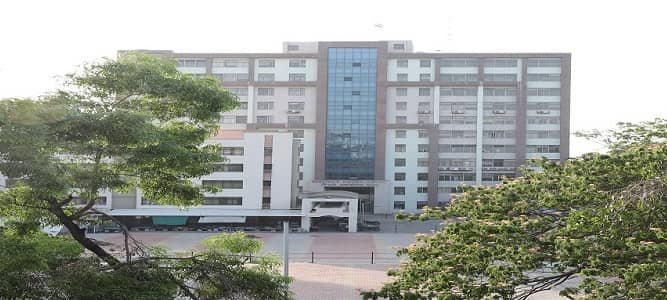
The District Court Complex at Athwalines is divided into two functional blocks — A-Block earmarked for functioning courts, and B-Block for administrative offices — a design that separates the judicial functioning area from administrative support functions while maintaining them within a unified campus. Both the District Court Complex (Ground + 6 floors) and the Fast Track Court Building (Ground + 4 floors) are large and spacious, set within a spacious tree-lined compound. Water coolers are available at each floor of both buildings, lifts including a separate lift for judicial officers ensure accessibility, and custody rooms for under-trial prisoners are provided at each floor. The Mediation Centre, Permanent Conciliation facility, and DLSA office are housed within the complex — creating a comprehensive justice services ecosystem. The District Court Computer Centre at the third floor and the Central Filing Centre at the ground floor of the newly constructed building reflect the court’s investment in digital infrastructure. The Fast Track Building additionally provides a Video Conference Court, Conference Room, Common Seminar Hall, and Bar Rooms — a modern judicial facility set built to contemporary standards from its 2005 construction.
Frequently Asked Questions
Q: When was the District Court of Surat established?
A: 1817 — as per available records, making it one of western India’s older district courts.
Q: Where is the Surat District Court currently located?
A: Athwalines, Surat — approximately 9 kilometres from both the railway station and bus station.
Q: What happened to the court building in 2001?
A: The 1994-constructed building was significantly damaged by the January 26, 2001 Gujarat earthquake, rendering it uninhabitable and requiring courts to shift to alternate premises.
Q: When was the Surat District Court Complex reinaugurated after earthquake retrofitting?
A: February 27, 2005 — by Gujarat Chief Justice Justice Bhawani Singh in the presence of then Chief Minister Narendra Modi.
Q: How is the District Court Complex structured?
A: Ground plus six floors — A-Block for courts (44 court arrangements) and B-Block for offices.
Q: Which High Court supervises the Surat District Court?
A: The Gujarat High Court.
Q: What special facilities are within the complex?
A: Mediation Centre, Permanent Conciliation facility, DLSA office, District Court Computer Centre, Central Filing Centre, Video Conference Court, and Common Seminar Hall.
Q: How many courts are in the A-Block?
A: 44 courts sitting arrangement with water coolers, lifts, and custody rooms at every floor.